BUREAU_VERITAS_URD_2025 2025
-
-
Presentation of the Group
-
1.1General overview of the Group
Mission
Bureau Veritas is a world leader in Testing, Inspection and Certification (TIC) services. The Group helps strengthen trust between companies, authorities and consumers. Its mission is to reduce its clients' risks and improve their performances. It also supports its clients with their innovations in the areas of quality, health, safety and sustainable development.
Bureau Veritas is recognized for its expertise, impartiality, integrity and independence, acquired over its 198 years of existence.
The services provided by Bureau Veritas are designed to ensure that products, assets and management systems conform to given standards and regulations in terms of quality, health, safety, environmental protection and social responsibility (QHSE).
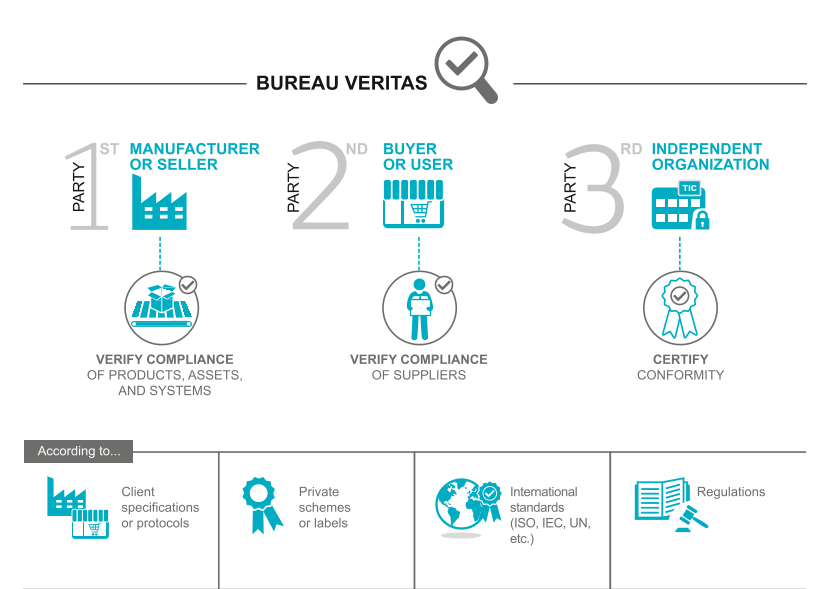
Depending on its clients' needs and on applicable regulations, standards or contractual requirements, Bureau Veritas acts:
- ●as a "third party", independently issuing reports and conformity certificates for products, assets, systems, services and organizations;
- ●as a "second party", on behalf of and upon the instructions of its clients to ensure better control of the supply chain; or
- ●as a "first party", on behalf of clients seeking support in ensuring or improving the conformity of their products, assets, systems and services.
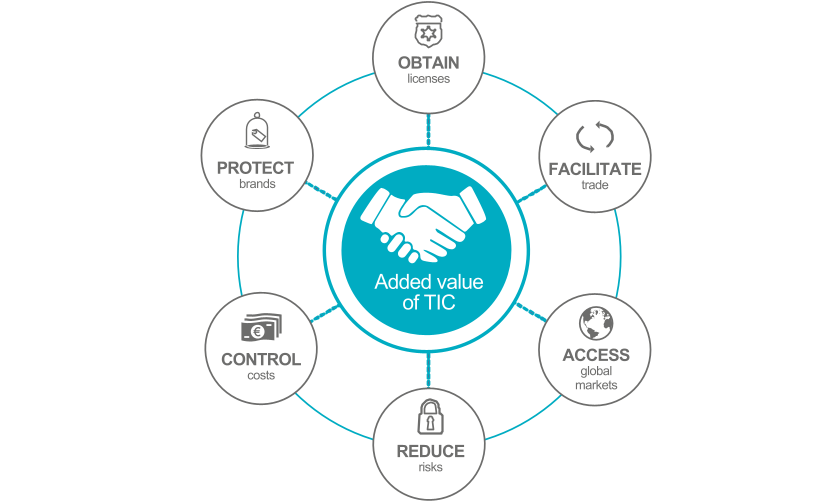
Obtaining a license to operate
Companies must prove that they are compliant with a large number of standards and regulations. Bureau Veritas helps them by providing its in-depth expertise on the standards applicable to their businesses. As an independent third party, Bureau Veritas verifies that companies comply with these standards. This allows them to conduct and develop their businesses in compliance with local and international regulatory requirements and thereby to obtain and maintain the necessary licenses to operate issued by public authorities.
Facilitating trade
International trade relies on third-party players who certify that the goods exchanged comply with the quality and quantities stipulated in commercial contracts. Bureau Veritas plays a key role in these transactions by testing materials, verifying that goods comply with contractual specifications and validating quantities. Exchanges of commodities, for example, are based on certificates issued by companies such as Bureau Veritas.
Accessing global markets
Capital goods and mass consumer products must meet national and international standards before being sold on the market in a given country. These standards act as technical trade barriers within the meaning of the WTO. Companies design and manufacture their products and equipment in accordance with the standards of different countries. They call on Bureau Veritas to carry out tests and optimize their test plan, with the aim of getting their products to market faster.
Reducing risks
Managing risks relative to quality, health, safety, environmental protection and social responsibility improves the efficiency and performance of organizations. Bureau Veritas helps its clients to identify and manage these risks, from project design to completion and decommissioning.
Controlling costs
Second- and third-party testing, inspection and auditing methods allow companies to determine the true condition of their assets. This enables them to launch new projects and products with the assurance that costs, timing and quality are under control. During the operational phase, inspections help optimize maintenance and extend the useful life of industrial equipment.
Protecting brands
The huge rise in the use of social networks has transformed how global brands are managed. Brands may quickly find themselves impacted by a malfunction in one of the links in their supply or distribution chain. Bureau Veritas helps companies better manage these risks, by conducting analyses as a highly reputed independent global player.
-
1.3The TIC industry
To the Group's knowledge, there is no comprehensive report covering or dealing with the markets in which it operates. As a result, and unless otherwise stated, the information presented in this section reflects the Group's estimates, which are provided for information purposes only and do not represent official data. The Group gives no assurance that a third party using other methods to collect, analyze or compile market data would obtain the same results. The Group's competitors may also define these markets differently.
1.3.1A market estimated to be worth close to €300 billion
Services related to quality, safety, performance, sustainability and responsibility are termed as Testing, Inspection, and Certification (TIC). TIC tasks range from on-site tests and supply chain inspections to data verifications. They can be carried out at any supply chain stage, in all sectors, and by various private or public parties.
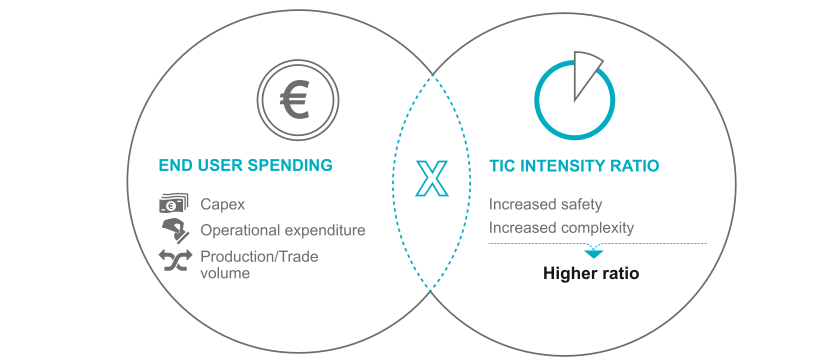
The TIC market size is tied to the value and risk of products or assets. The "TIC intensity" corresponds to the fraction of an item's value dedicated to controlling this asset or product. Typically, this fraction ranges from 0.1% to 0.8%. The TIC market's value is determined by multiplying the TIC intensity by the amount spent on goods and products by manufacturers, operators, buyers and sellers.
Market fluctuations are linked to economic factors like inflation or global economic activity and trade. Using this method, Bureau Veritas estimates the size of the global TIC market to represent almost €300 billion. This estimate takes into account external factors such as investment volume per market and the production value of goods and services.
-
1.4Group's strategy and objectives
1.4.1Key competitive advantages
The Group benefits from an efficient international network
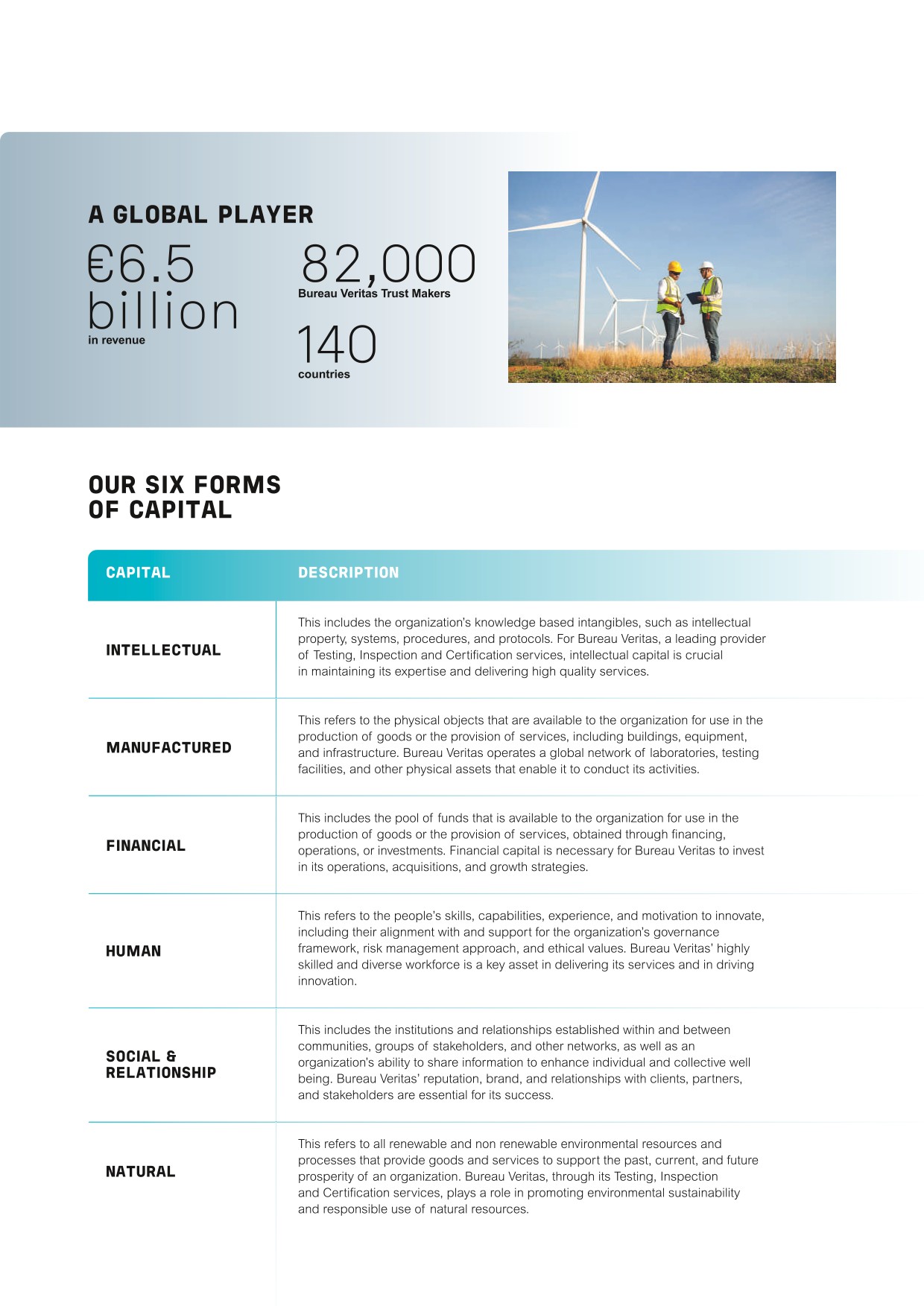
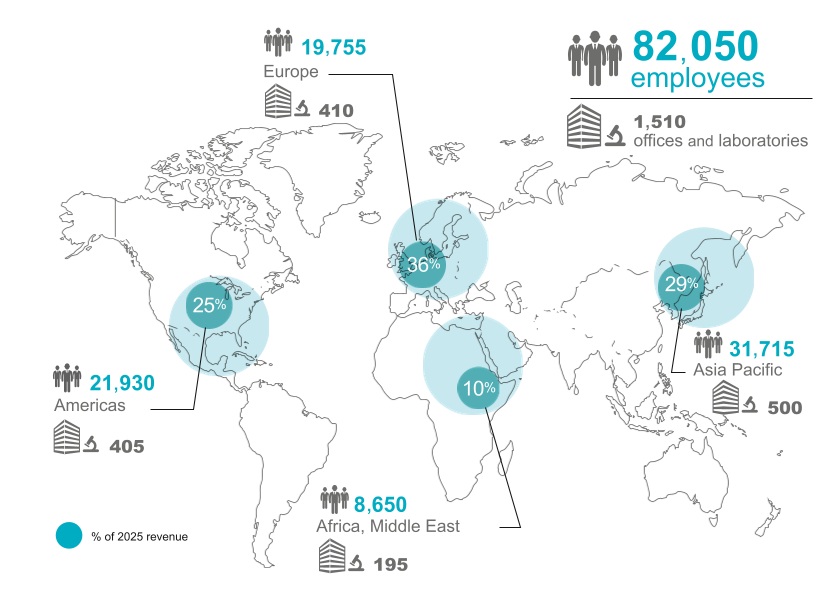
Bureau Veritas boasts a vast global network with more than 1,500 offices and labs in almost 140 countries across the world.
The Group is well-established in mature economies with strong regulatory frameworks, and is recognized for its technical prowess and advanced production capabilities.
It is also firmly established in some rapidly developing economies, securing strong footholds for sustainable growth. The Group has fostered a significant local presence over time in these regions and continues to grow by inaugurating new offices and labs.
The scale of the Group's network is a core asset, offering value and differentiation at different levels:
- ●on the sales front, it allows Bureau Veritas to cater to key accounts and secure major international contracts, which represent a growing portion of its business;
- ●operationally, the Group capitalizes on its scale to enhance profitability. Economies of scale arise from shared office spaces, support functions, IT resources, and the distribution of costs associated with innovating in new services and standardizing inspection procedures over a broader base.
A regional hub organization enables Bureau Veritas to efficiently distribute knowledge, technical aid, and sales teams, and to leverage the benefits of scale.
A strong image of technical expertise and integrity
Bureau Veritas has built a large-scale, successful global business based on its long-standing reputation for technical expertise, high quality and integrity. This reputation is one of its most valuable assets and is a competitive advantage for the Group worldwide.
Technical expertise recognized by authorities and by many accreditation bodies
Throughout its history, the Group has honed expertise across diverse technical fields and developed a comprehensive understanding of regulatory landscapes. At present, Bureau Veritas holds accreditation from numerous national and global delegating authorities and accreditation bodies, either as a second or third party. The Group persistently works to uphold, refresh, and broaden its array of accreditations and approvals. Regular inspections and audits by these bodies ensure the Group's procedures, staff qualifications, and management systems adhere to the necessary standards, rules, and regulations.
Quality and integrity embedded in the Group's culture and processes
Bureau Veritas places paramount importance on values like integrity, ethics, impartiality, and independence. These core values not only shape the brand's reputation but also enhance its value to clients.
In 2003, with the guidance of the TIC Council (an international body representing independent testing, inspection, and certification firms), these values were at the heart of the efforts in the TIC profession. This collaboration culminated in the creation of the Group's inaugural Code of Ethics, released in October 2003 and regularly updated since then.
A profitable growth model supported by strong cash generation
Bureau Veritas' financial structure is built on a robust foundation that hinges on four essential characteristics:
- 1.Two major growth drivers:
- ●organic growth, at around 8.2% since 2022(1),
- ●strategic acquisitions.
- 2.A profitable growth model, with an adjusted operating margin of 16.3% in 2025. This demonstrates the Company's ability to effectively manage its operations and maintain profitability.
- 3.Steady available cash flow generation, averaging around €715 million over the past five years. This is due to the significant efforts deployed to monitor and optimize its cash flow and liquidity, especially when it comes to working capital requirements.
- 4.Rigorous capital allocation strategy:
- ●net debt remains considerably below banking ratio thresholds,
- ●the Group must have the liquidity to fund potential acquisitions and continue its commitment to pay dividends to its shareholders.
-
1.5Presentation of business activities
1.5.1Marine & Offshore
Group revenue
Group adjusted operating profit
Supporting and certifying the Marine & Offshore sector
In the Marine sector, Bureau Veritas' main role is to verify that ships and offshore facilities comply with classification rules, mainly as regards the robustness and reliability of equipment. This mission is often carried out together with the regulatory certification mission essential for operating ships. Marine insurance companies require such certificates to provide coverage, and port authorities also check that valid certificates exist when ships come into port.
The Group is a member of the International Association of Classification Societies (IACS), which brings together the largest international companies in the sector. Together, these companies classify around 90% of the world’s ships. The rest of the world's fleet is either classified by smaller companies or not classified at all.
It is also essential for offshore operators to make sure that their facilities are in line with applicable safety and quality standards, as well as regulatory requirements. Bureau Veritas Marine & Offshore services help clients apply these regulations. They also help them to reduce risk, extend asset lifecycles and protect the marine environment.
The Group is involved at every stage of the ship lifecycle
The Group is involved from the construction phase, approving drawings, surveying the shipyard and inspecting materials and equipment. Regular inspections are then undertaken throughout the vessel’s lifetime to provide ongoing oversight.
Bureau Veritas also provides a comprehensive range of technical services, including asset integrity management. It monitors any changes in regulations, identifies applicable standards, and manages dealings with the authorities. The Group informs its clients about the compliance process and carries out project design and execution reviews.
Over time, Bureau Veritas has expanded its range of services to include post-accident expertise, risk assessment for the offshore industry, marine accident investigations, pre- and post-salvage advice and the refloating of vessels. In 2018, the creation of Bureau Veritas Solutions Marine & Offshore (BV Solutions M&O) consolidated this diversification.
In 2025, 47% of the Group’s Marine & Offshore revenue was generated by the certification of ships under construction, while the remainder was generated by the surveillance of ships in service and complementary services.
Bureau Veritas adapts to the needs of a diversified fleet
Bureau Veritas is the world leader in terms of the number of ships classified, and ranks number six worldwide in terms of tonnage, confirming its ever growing market share and influence in the sector.
The Group has recognized expertise in all segments of maritime transport (bulk carriers, tankers, container ships, gas carriers, passenger ships, warships and tugs).
It also has expertise in offshore facilities designed for the exploration and development of coastal and deep-water oil and gas fields (fixed and floating platforms, support vessels, drill ships and subsea equipment).
Bureau Veritas also holds the leading position in the market for highly technical ships such as liquefied natural gas (LNG)-fueled vessels.
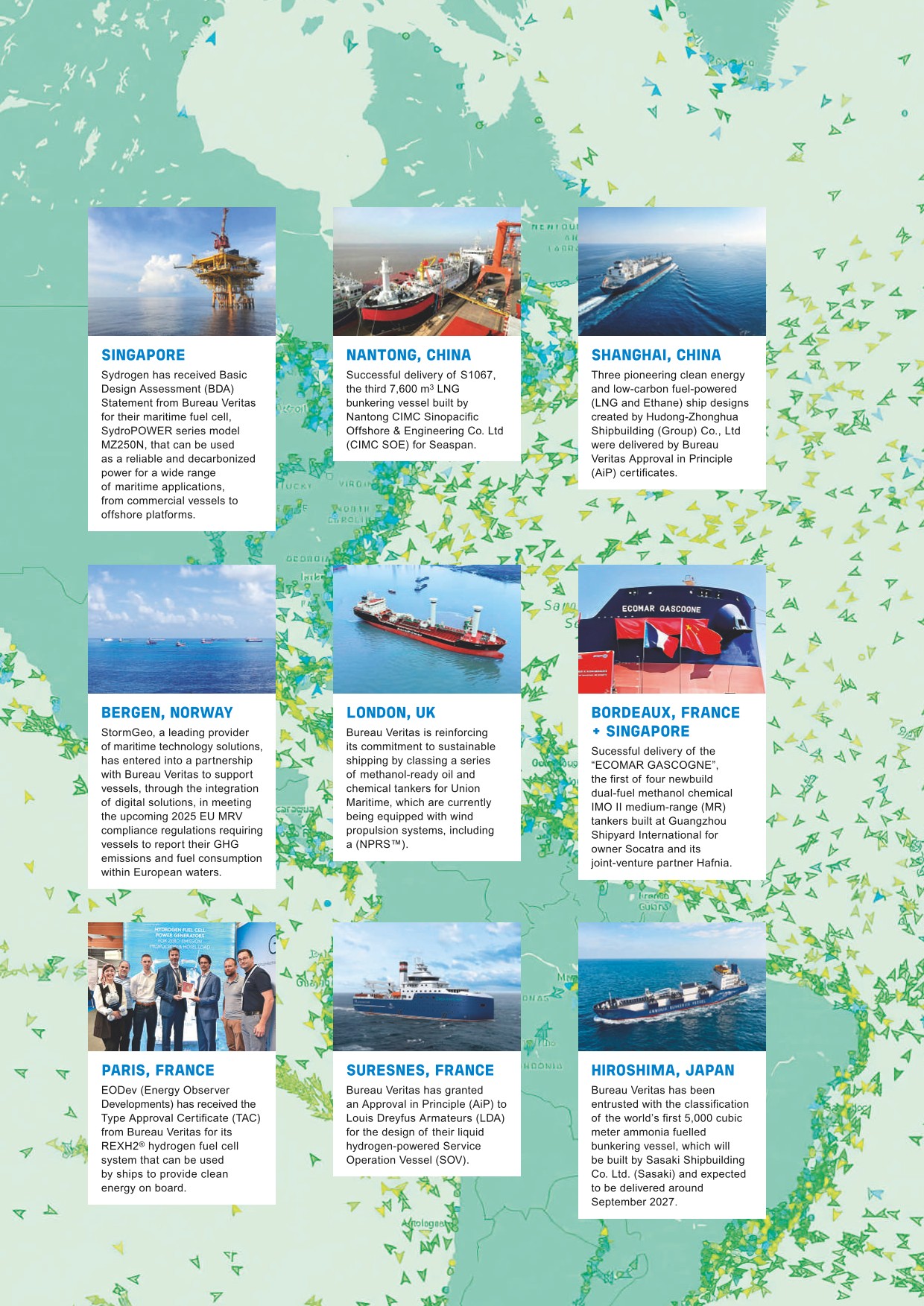
The Group supports the maritime industry in its innovations, from Arctic shipping to LNG supply chains. It supplies solutions and ratings adapted to on-board safety and technological developments, notably for alternative fuels and on-board autonomy.
A global network facilitating swift and effective action
To meet the needs of its clients in the maritime sector, Bureau Veritas leverages a global network of more than 3,000 experts in 90 countries. The Group has 19 local design approval offices located near its clients, and a network of 180 control stations staffed with qualified surveyors in the world's largest ports.
This means that inspections can be conducted on demand, without delaying the activities of ships or their owners and thereby providing clients with a local, agile, high-quality service.
Bureau Veritas operates in a fast-moving industry
The worldwide fleet continues to expand
Maritime trade has been on the rise since the early 2000s, except in 2020 due to the Covid-19 pandemic.
At the end of 2025, the global order book represented around four years' worth of orders(10). Demand is particularly strong for container ships, bulk carriers and oil tankers.
A diversified and loyal client base
- ●shipowners;
- ●shipyards and shipbuilders around the world;
- ●equipment and component manufacturers;
- ●oil companies and Engineering, Procurement, Installation and Commissioning (EPIC) contractors for offshore production units;
- ●insurance companies, P&I (Protection & Indemnity) clubs and lawyers.
Changes in the order book
Changes in the Group's in-service fleet
Bureau Veritas solutions are adapted to a changing market
A changing regulatory environment
International regulations applicable to maritime safety and environmental protection are evolving rapidly, providing classification companies with growth opportunities and momentum. These include:
- ●Reduction in greenhouse gas (GHG) emissions: with the adoption of stricter regulations under the auspices of the International Maritime Organization (IMO) and the European Union, new and existing ships must improve their energy performance. Bureau Veritas can play a crucial role in certifying compliance with the new EEXI and CII standards.
- ●The EU's "Fit for 55" package: these measures set out a roadmap for achieving the European Union's goal of reducing GHG emissions in the EU by at least 55% by 2030 as part of the European green deal. Bureau Veritas offers audit, inspection and certification services to help maritime companies comply with new requirements applicable as from 2024 and 2025.
- ●The Ballast Water Management (BWM) Convention adopted under the aegis of the IMO: this entered into force in 2017 and has since given classification societies a greater role in certifying ballast water management systems. Since September 2024, ships must be equipped with a ballast water treatment system.
- ●Ship recycling: the Hong Kong international convention – effective from June 2025 – and European regulations offer opportunities for inspection and certification services related to the Inventory of Hazardous Materials (IHM) on-board ships, with a view to their recycling.
- ●Regulations applicable to ships for inland navigation transporting hazardous materials: Bureau Veritas is one of the classification societies recognized by the European Union.
- ●Cyber resilience: the International Association of Classification Societies (IACS) unified requirement sets out classification rules for the cyber resilience of ships and of on-board systems and equipment. A revised version of the unified requirement came into force in July 2024.
- ●Monitoring, Reporting and Verification (MRV) and Data Collection System (DCS): the EU and IMO have introduced regulations on the monitoring, reporting and verification of carbon dioxide emissions and on the collection of ships' fuel consumption data. These rules are designed to drive further decarbonization efforts in the maritime sector. BV M&O offers verification services for following up plans and data supplied by shipowners.
- ●The Polar Code and ban on heavy fuel oil: the "Polar Code", or "IMO Guidelines for Ships Operating in Polar Waters" came into effect in January 2017. The IMO's ban on the use of heavy fuel oil in the Arctic region has also been in place since January 1, 2024.
- ●The International Code of Safety for Ships Carrying Industrial Personnel (IP Code): this is designed to ensure the safe carriage of people working on offshore facilities, including wind farms, and came into force on July 1, 2024. The aim is to provide minimum safety standards for vessels carrying industrial personnel, as well as for the personnel themselves, and to address the specific risks of marine operations in the offshore and energy sectors, such as personnel carriage operations.
- ●The requirements of the SOLAS convention – effective January 1, 2026 – relating to lifting appliances and removable fittings (loose gear).
As a classification and certification company, the Group is well positioned to help maritime companies navigate this complex and fast-changing regulatory landscape.
The sector is shifting towards a more sustainable model
The maritime sector is undergoing a deep-seated transformation, driven by the energy transition and international regulations aimed at reducing greenhouse gas emissions. This development is driving increased demand for low-carbon vessels, powered by alternative fuels (LNG, methanol, LPG) and innovative technologies such as wind propulsion and carbon capture and storage (CCUS). At the end of 2025, over half of orders for new ships were based on dual-fuel systems.
The offshore market has also seen a significant rise in investments from oil companies for both fixed and floating wind farms.
As part of its LEAP | 28 strategy, and as a leader in the energy transition for the shipping industry, Bureau Veritas helps its clients to decarbonize their fleets. It offers recognized expertise and promotes low-carbon ship classification and solutions by supporting the adoption of innovative technologies. Thanks to cutting-edge digital solutions such as digital twins, it optimizes inspections and maintenance, while reducing carbon footprint.
- ●setting standards for new fuels and technologies;
- ●developing solutions to improve operational efficiency;
- ●tracking carbon emissions and certifying environmental performance;
- ●providing consulting services for sustainable construction and crew health and safety;
- ●developing onshore and offshore wind lifecycle solutions.
This approach underscores Bureau Veritas' role as a key partner in supporting the maritime sector's transition to a more sustainable model.
Partnering with our clients beyond the regulatory and compliance field
The growth of the Group and its brands is driven by the ongoing development of high value-added services, particularly relevant in this era of energy transition. Faced with the challenges of sustainability, players in the shipping industry are looking for innovative solutions to design and operate in a more responsible way.
As a consultant independent from the Group, Bureau Veritas Solutions Marine & Offshore (BV Solutions M&O) offers specialized technical support. Its engineering and modeling expertise enables clients to evaluate and compare various technological solutions, strengthening informed decision-making.
The recent expansion of BV Solutions M&O on the international stage – most recently in Australia and South Korea – testifies to the growing demand for these types of services. The organization stands out for its risk and feasibility studies on the integration of new fuels such as hydrogen, ammonia or methanol, as well as vessel propulsion systems, which are at the heart of debates on decarbonizing the shipping industry. BV Solutions M&O also develops GHG strategy studies for both shipowners and financial institutions using a global fleet analysis approach and various management scenarios. This coherent, cross-cutting approach addresses the sector's major challenges, enabling stakeholders to make a lasting commitment to the energy transition.
Bureau Veritas shares its expertise with the industry
The Group regularly shares its technical expertise and approach through authoritative publications designed to inform and guide stakeholders in the industry. These include:
- ●White papers on alternative fuels (“Alternative Fuels Outlook”) and the decarbonization of the shipping industry (“Decarbonization Trajectories – Sharing Expertise: Realistic Approaches to Shipping’s Decarbonization”);
- ●Technology assessment report on the electrification of the maritime sector (“Maritime Electrification: Charting the Course"), which explores the levers and conditions for adopting these technologies;
- ●The "Toward a Sustainable Blue Economy” book by Matthieu de Tugny, Executive Vice-President of Bureau Veritas Marine & Offshore, which sets out the vision of a maritime industry capable of thinking outside the box, reconciling ambitious goals with pragmatic execution, and making decarbonization a driver of sustainable transformation.
Leveraging digitalization to meet the challenges of the maritime sector
Efficiency is at the heart of digital classification
The digital revolution in the maritime industry is gathering momentum. Bureau Veritas Marine & Offshore is at the forefront of this revolution, integrating digital technology in the classification of ships and offshore facilities. These innovations save time and money, improve safety, and optimize maintenance and operations.
- ●3D classification, which transforms the design review and monitoring process for the construction of new vessels and offshore facilities by using a shared digital model, thereby enabling design offices, shipyards and Bureau Veritas to work together more effectively. This allows real-time adjustments along with greater efficiency and optimal coordination between all project stakeholders;
- ●Remote inspections, combined with the use of drones, which provide added flexibility for carrying out checks without having to move inspectors on board. This process improves personnel safety, reduces transport costs and facilitates inspections in difficult-to-access areas. It also ensures better preparation and flexibility of operations for clients;
- ●Thanks to artificial intelligence and the latest generation of drones equipped with a LiDAR sensor, Bureau Veritas creates high-precision 3D models of inspected areas. These point clouds can be used to identify and locate defects, such as corrosion, in a collaborative tool (Augmented Surveyor 3D) that helps clients efficiently plan equipment maintenance and repair;
- ●The Connect My Systems application, which simplifies the automatic exchange of large quantities of data, such as that relating to travel and fuel consumption or equipment maintenance. This data exchange enables shipowners to optimize fleet management, adapt their operations and get closer to their emission reduction targets. Eventually, the data gathered will enable Bureau Veritas to move towards optimized, predictive inspection programs based on specific risk analyses, thus saving time and money.
Intelligent navigation is a driver of decarbonization in the shipping industry
Classification societies play an important role in facilitating the transition to smart shipping. They help industry players to implement new automation and connectivity tools and smart functions, and to manage processes based on reliable data. The introduction of smart functions on board ships plays a key role in ensuring safer and more efficient operations, key drivers in the transition to a low-carbon industry.
-
1.6Accreditations, approvals and authorizations
To conduct its business, the Group has numerous Licenses To Operate – LTO (hereafter "Authorizations"), which vary depending on the country or business concerned: accreditations, approvals, delegations of authority, official recognition, certifications or listings. These Authorizations may be issued by national governments, public or private authorities, and national or international organizations, as appropriate.
Marine & Offshore (M&O) division
The Group is a certified founding member of the International Association of Classification Societies (IACS), which brings together the 12 largest international classification societies. At European level, Bureau Veritas is a "recognized organization" under Regulation (EC) 391/2009 of the European Parliament and of the Council of April 23, 2009, setting common rules and standards for ship inspection and survey organizations. Bureau Veritas is also an accredited body under Directive 2014/90/EU of the European Parliament and of the Council of July 23, 2014 on marine equipment. Bureau Veritas currently holds more than 150 delegations of authority on behalf of national maritime authorities.
-
1.7Research and development, innovation, patents and licenses
Bureau Veritas is actively engaged in research and innovation to bolster its market positioning and explore new opportunities. The Group's major initiatives include:
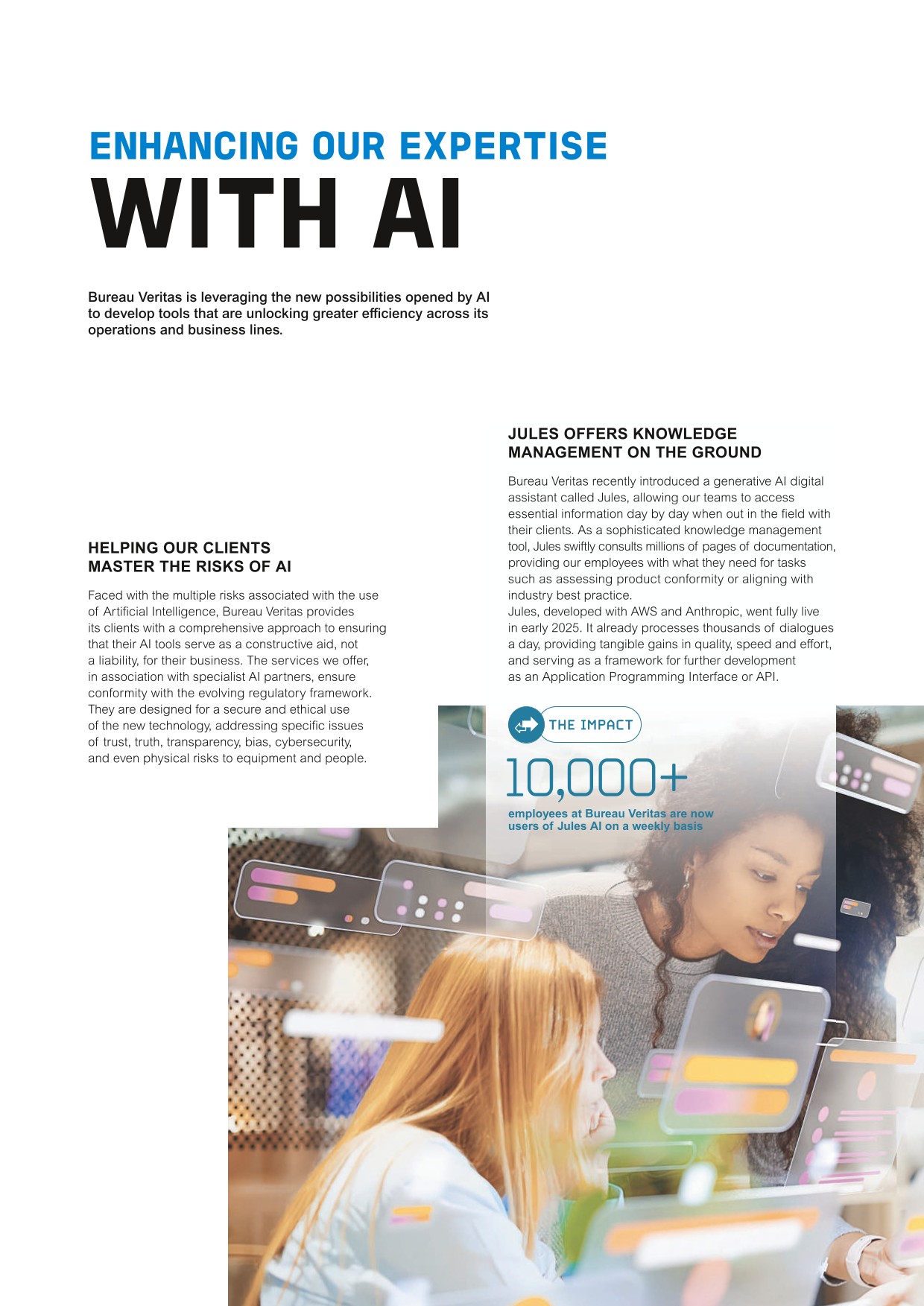
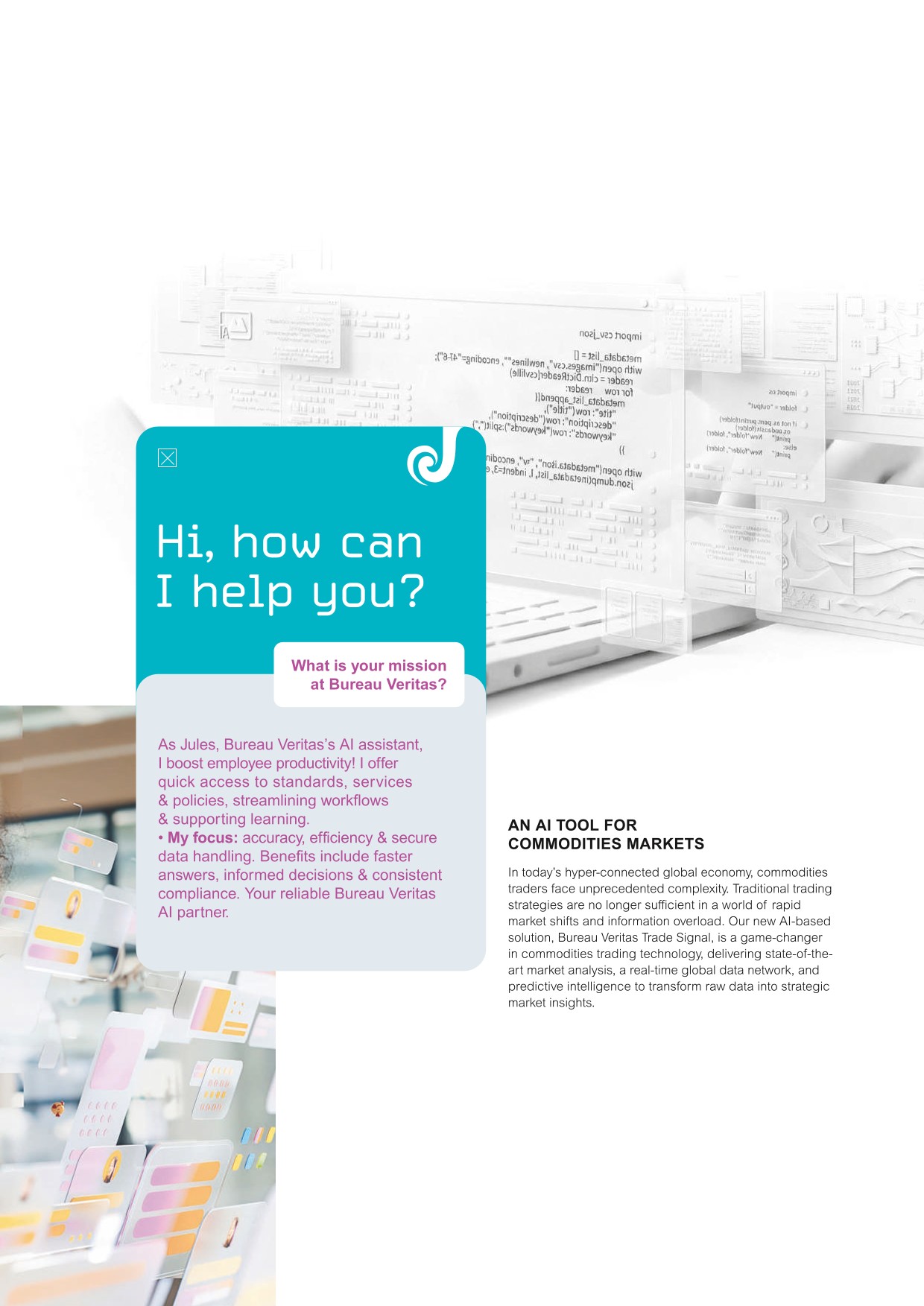
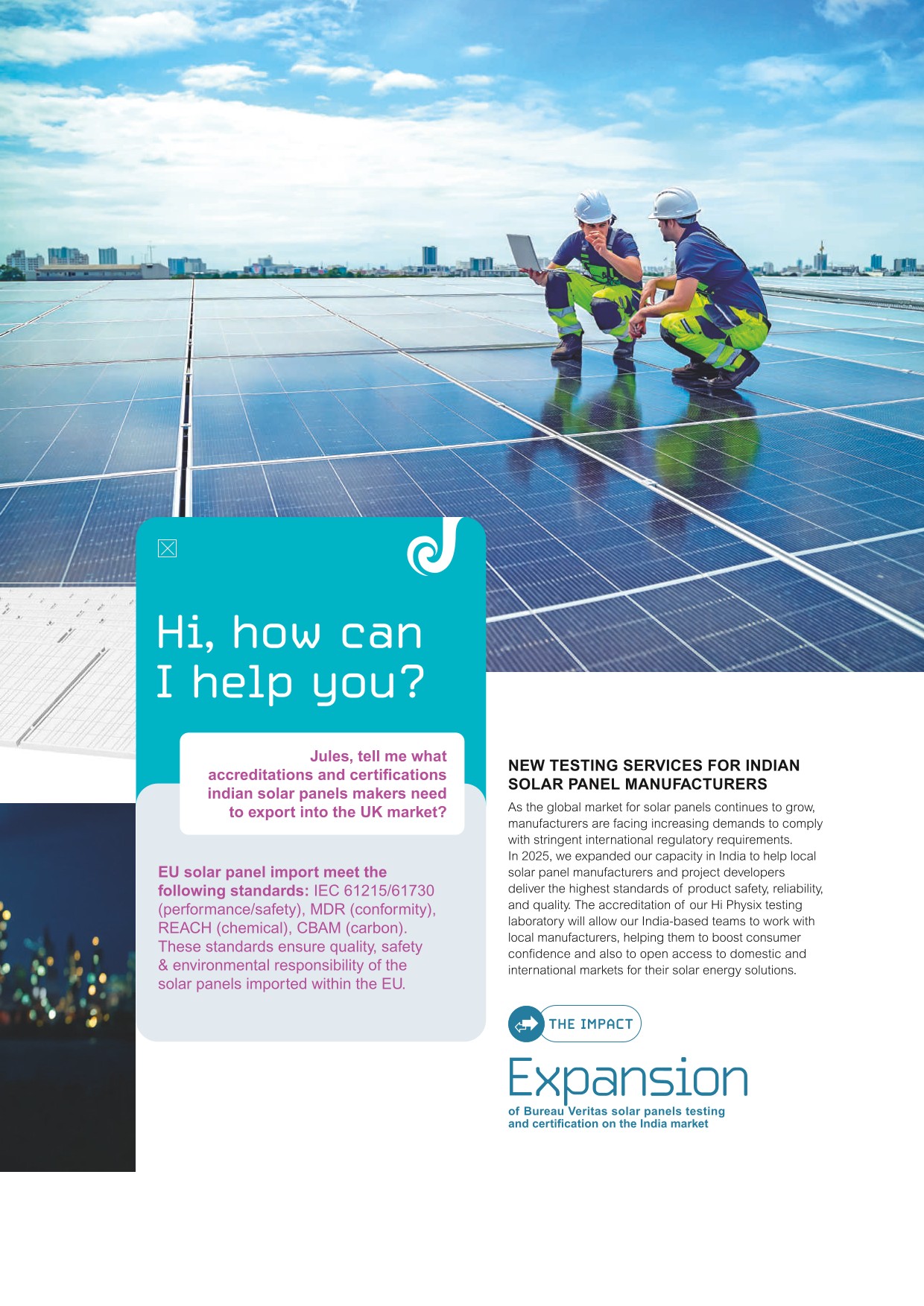
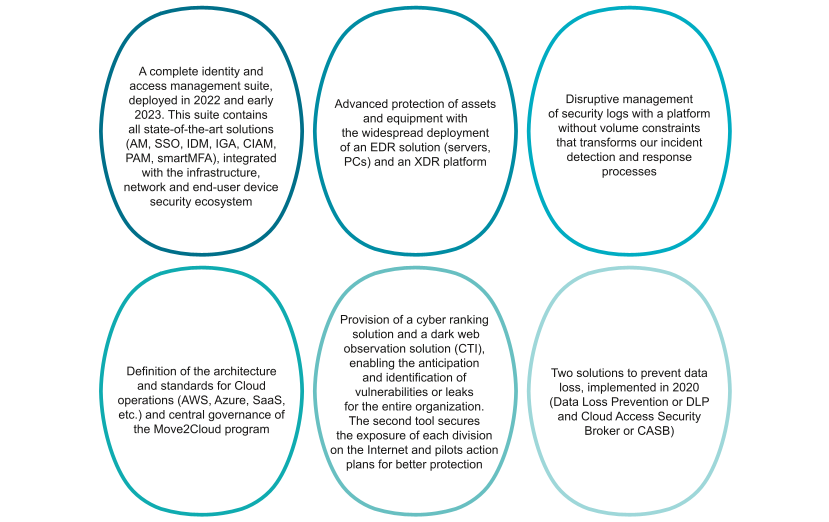
- ●Technological partnerships: in the wake of its Move to Cloud project, during which it optimized its portfolio of applications, Bureau Veritas is now exploiting the possibilities offered by AWS to develop AI-powered tools and improve its data management capabilities. Following the deployment in early 2025 of its in-house conversational agent (Jules) – based on LLMs provided by AWS partners enabling retrieval-augmented generation (RAG) – Bureau Veritas launched its interface with business applications via on-demand API integrations. By targeting the most relevant use cases, Bureau Veritas ensures a reasoned and responsible integration of AI into its processes;
- ●Strategic alliances: agreements are signed with various companies focused on specific technologies and segments. In November 2025, Bureau Veritas stepped up its commitment to the maritime sector's energy transition by signing a declaration of cooperation with the New Energy Coalition to accelerate nuclear for maritime applications. This partnership aims to advance innovative, safe and low-carbon propulsion solutions, contributing to the emergence of next-generation energy systems for maritime transport. Through this move, Bureau Veritas confirms its key role in the decarbonization of the sector and its ability to support the development of high-tech energy ecosystems;
- ●Cybersecurity: involvement in the work of the European Cyber Security Organisation underlines the importance of this issue, in line with the European Commission's objectives;
- ●Collaborative projects: involvement in projects funded by institutions such as the Single Inter-Ministerial Fund and in European calls for projects underscores the Group's commitment to large-scale initiatives. Bureau Veritas has joined CleanHyPro, for example. This project:
- ●is a consortium of 28 partners from original equipment manufacturers (OEMs) and research and technology organizations,
- ●is co-funded by the European Union, and its primary mission is to spearhead innovation in electrolysis technologies and materials. Bureau Veritas' remit is to develop a quality label for electrolyzer stacks, offering transparency on technology and guaranteed product quality, reliability and performance. Product quality covers reliability, the effects of aging, efficiency and durability criteria;
- ●Hydrogen and renewable energies: by joining the Hydrogen Council and actively participating in ISO and CEN standardization committees, the Group is demonstrating its intention to support and shape the future of clean energies;
- ●Digitalization: Bureau Veritas is aware of the need to transition to more digital offerings and is therefore stepping up efforts to develop new concepts such as future inspection/audit services;
- ●Continuous innovation: in light of fast-paced changes in the TIC market, the Group is constantly investing to adapt and meet emerging client needs. Bureau Veritas is resolutely forward-looking, harnessing a proactive approach to research and innovation to stay at the forefront of its industry. Initiatives include:
- ●development of artificial intelligence (AI) for new inspection techniques (shape recognition AI and 3D technologies) and for the use of technical rules and data (natural language-processing AI),
- ●revamp of production tools to form a collaborative digital platform open to clients, leveraging product lifecycle management solutions (partnership with Aras Innovator),
- ●ongoing development of classification services to support the digitalization of maritime shipments through intelligent ratings, developed together with clients and digital solution suppliers,
- ●Bureau Veritas is strengthening its digital modeling skills with the integration of Building Information Modeling (BIM) and digital twin technologies, supported by the acquisition of the IDP group. These solutions improve coordination, data management, 3D visualization and the lifecycle of construction and infrastructure projects. They also accelerate the decarbonization and operational optimization of these assets to ensure safer, more sustainable and resilient infrastructure.
-
1.8Information systems
- ●Defining the Group's technological architecture. The department sets the standards for applications and infrastructure across all businesses and geographical areas;
- ●Selecting and managing integrated solutions for all Group units. These solutions include messaging, collaboration tools and various systems such as ERP finance, client management, Human Resources and production;
- ●Guaranteeing the availability and security of all of the Group's infrastructures and solutions;
- ●Managing the Group's overall relationship with its main suppliers of equipment, software, telecommunications and services.
The department is supported by six regional centers: North America and Latin America, Europe, France, Africa, Asia-Pacific, and the Middle East. These centers provide various services to the countries in their respective regions.
A global shared services center has also been set up in India to pool certain support processes. In 2025, operating expenses and running costs for the Group's information systems represented 4% of the Group's revenue.
(1)Weighted average Group organic growth over the period 2022 to end-2025(2)Box sizes for illustration purposes only(3)As of December 31, 2025.(4)Scope 1 and 2 greenhouse gas emissions are calculated over a 12-month period from January to December 2025. Emissions for the fourth quarter of 2025 are estimated based on figures for the fourth quarter of 2024, taking into account any major events likely to impact emissions during this period.(5)TAR: Number of accidents with and without lost time x 200,000/Number of hours worked.(6)Proportion of women on the Executive Committee in Band III (internal grade corresponding to a management position) in the Group (number of full-time equivalent women occupying a management position/total number of full-time equivalents occupying a management position).(7)Average annual growth rate.(8)At constant exchange rates.(9)(Net cash generated from operating activities – repayment of lease liabilities + income tax)/adjusted operating profit.(10)Sources: Clarkson -
2.1General disclosures (ESRS 2)
Since 1828, Bureau Veritas has acted as trust maker between companies, governments and society. It is an independent, impartial guarantor of its clients’ word.
Identity
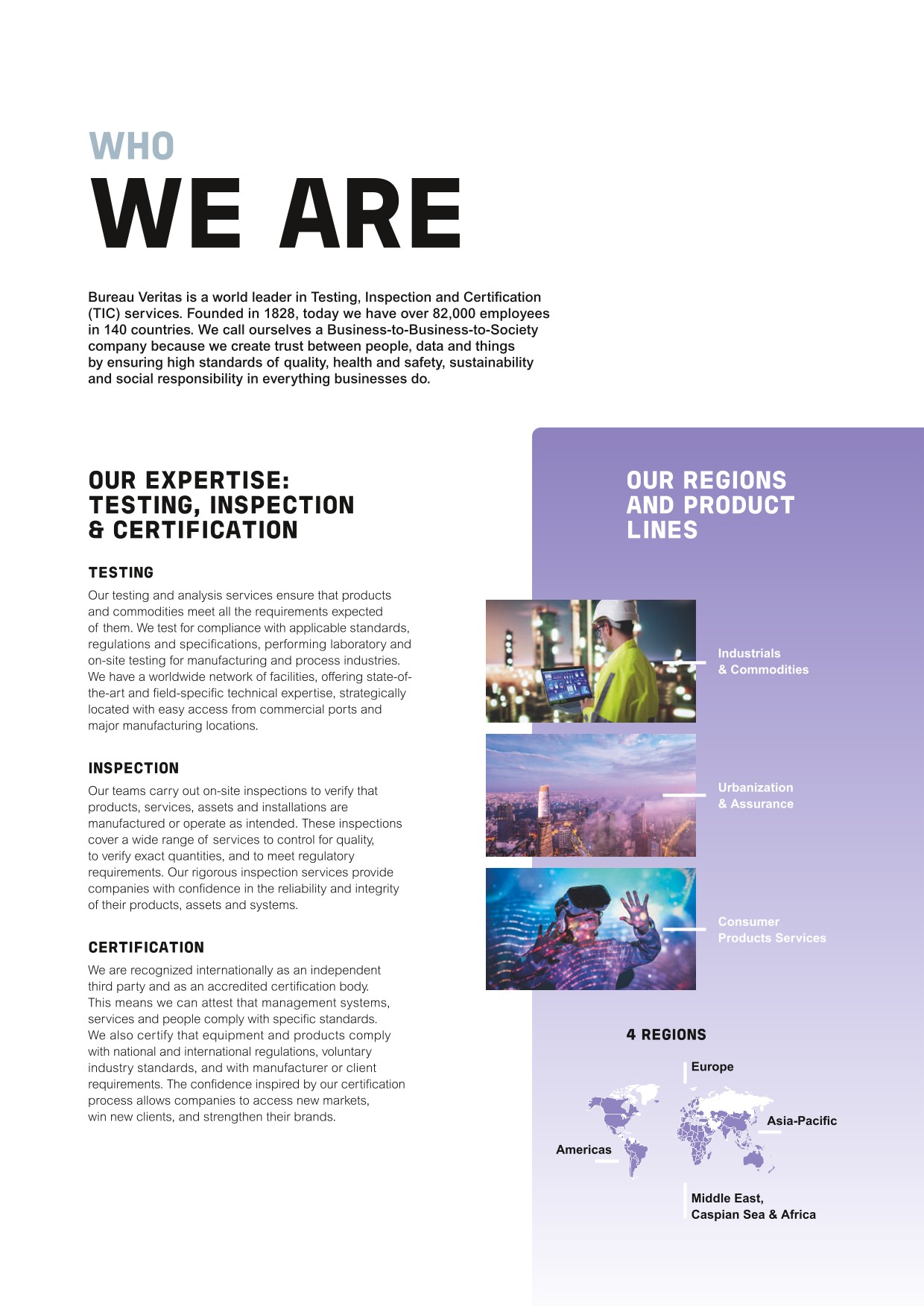
Bureau Veritas is a world leader in laboratory testing, inspection and certification services. Created in 1828, the Group has approximately 82,000 employees located in more than 1,500 offices and laboratories across the globe. Bureau Veritas helps its clients improve their performance by offering services and innovative solutions in order to ensure that their assets, products, infrastructure and processes meet standards and regulations in terms of quality, health and safety, environmental protection and social responsibility.
-
2.2Environmental information
2.2.1Taxonomy
This European Taxonomy reporting complies with Regulation (EU) No. 2020/852 of the European Parliament and of the Council of June 18, 2020 on the establishment of a framework to facilitate sustainable investment, and with Delegated Regulation (EU) No. 2021/2178 of the Commission of July 6, 2021, amended by Delegated Regulation (EU) 2023/2486 of June 27, 2023, and by Delegated Regulation 202/73 of July 4, 2025, specifying the content and presentation of information to be disclosed.
2.2.1.1Background
The Taxonomy regulation aims to direct funding to activities that significantly contribute to one or more of the Taxonomy’s six following environmental objectives:
- ●climate change mitigation;
- ●climate change adaptation;
- ●sustainable use and protection of water and marine resources;
- ●transition to a circular economy;
- ●prevention and reduction of pollution;
- ●protection and restoration of biodiversity and ecosystems.
Delegated acts set the technical screening criteria for determining the conditions under which an economic activity may claim to make a substantial contribution to one or more of the objectives of the Regulation, and for determining whether it does any significant harm to any of the other environmental objectives.
- ●they make a substantial contribution to at least one of the six environmental objectives;
- ●they do no significant harm to any of the other environmental objectives;
- ●they comply with minimum social safeguards; and
- ●they comply with the technical screening criteria set by the European Commission.
2.2.1.2Reporting methodology
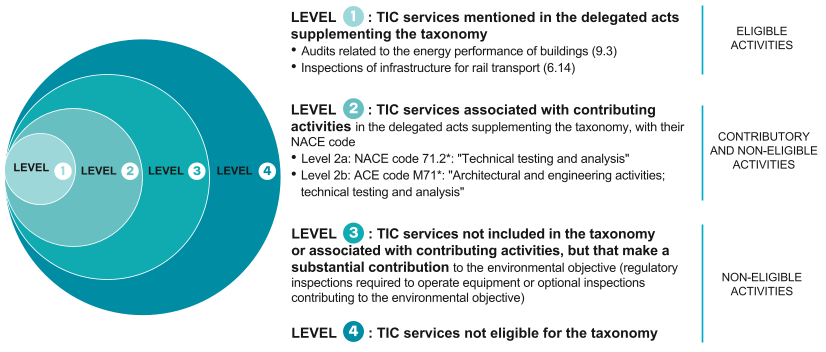
TIC Council, the professional association of compliance verification bodies, has published a guide on Taxonomy reporting for the TIC (testing, inspection, certification) sector. This guide specifies which services are Taxonomy-eligible.
- ●services eligible for the Taxonomy:
- ●Level 1: TIC services explicitly mentioned in the delegated acts of the Taxonomy;
- ●services not eligible for the Taxonomy:
- ●Level 2: TIC services implicitly included in Taxonomy-eligible activities,
- ●Level 3: other TIC services contributing substantially to one or more environmental objectives,
- ●Level 4: TIC services that do not contribute to environmental objectives.
Eligible and/or contributory services
Ref. Economic activity
Economic activity
Eligible and/or contributory TIC services
CCA 6.13
Infrastructure for personal mobility, cycle logistics
- ●Technical inspection of personal mobility infrastructure (roads, bridges and tunnels);
- ●Safety inspection of electrical charging systems for bicycles;
- ●Inspections of electric chargers.
CCA 6.14
Infrastructure for rail transport
Services delivered to electric rail infrastructure:
- ●Regulatory technical control and safety inspections;
- ●Project management and asset management;
- ●Rail component and structure tests.
CCA 6.15
Infrastructure enabling road transport and public transport
Services related to road and public transport:
- ●Regulatory technical control and safety inspections;
- ●Project management and asset management;
- ●Material, component and structure tests.
CCA 6.16
Infrastructure for water transport
Services related to water transport:
- ●Regulatory technical control and safety inspections;
- ●Project management and asset management;
- ●Material, component and structure tests.
CCA 9.1
Engineering activities and related technical consultancy dedicated to climate change adaptation
- ●Technical climate change adaptation assistance;
- ●Urban planning services.
CCA 9.3
Consultancy of physical climate risk management and adaptation
- ●Climate change impact assessment;
- ●Consulting services for climate change adaptation;
- ●Consulting services for physical risk management.
CCM 6.13
Infrastructure for personal mobility, cycle logistics
- ●Technical inspection of personal mobility infrastructure (roads, bridges and tunnels);
- ●Safety inspection of electrical charging systems for bicycles;
- ●Inspections of electric chargers.
CCM 6.14
Infrastructure for rail transport
Services delivered to electric rail infrastructure:
- ●Regulatory technical control and safety inspections;
- ●Project management and asset management;
- ●Rail component and structure tests.
CCM 6.15
Infrastructure enabling low-carbon road transport and public transport
- ●Electrical vehicle charging station (EVCS) inspections; Electrical urban transport infrastructure control and PMA; Hydrogen fueling station inspections.
CCM 6.16
Infrastructure enabling low-carbon water transport
- ●Technical inspection of infrastructure enabling low-carbon water transport;
- ●Regulatory safety inspections of low-carbon infrastructure enabling low-carbon water transport.
CCM 7.3
Installation, maintenance, and repair of energy efficiency equipment
- ●HVAC installation/equipment periodical inspections;
- ●Technical control of energy efficiency works;
- ●Refrigerant fluid expert certification.
CCM 7.4
Installation, maintenance and repair of charging stations for electric vehicles in buildings (and parking spaces attached to buildings)
- ●According to substantial contribution (SC) criteria.
CCM 7.5
Installation, maintenance and repair of instruments and devices for measuring, regulation and controlling energy performance of buildings
- ●According to substantial contribution (SC) criteria.
CCM 7.6
Installation, maintenance, and repair of renewable energy technologies
- ●Control and inspection of wind, hot water and photovoltaic solar projects.
CCM 9.3
Professional services related to energy performance of buildings
- ●Assessment of building energy performance.
CE 3.2
Renovation of existing buildings
- ●Structural diagnosis – Asbestos inspections;
- ●Waste categorization – Safety plans.
CE 3.4
Maintenance of roads and motorways
- ●Infrastructure inspections;
- ●Maintenance surveys.
CE 3.5
Use of concrete in civil engineering
- ●Concrete testing.
PPC 2.4
Remediation of contaminated sites and area
- ●Environmental tests.
WTR 1.1
Manufacture, installation and associated services for leakage control technologies enabling leakage reduction and prevention in water supply
- ●Configuration and installation of leakage control technologies.
WTR 4.1
Providing IT/OT data-driven solutions for leakage reduction
- ●Configuration and installation of leakage control technologies.
CCA: climate change adaptation.
CCM: climate change mitigation.
CE: circular economy.
PPC: pollution prevention and control.
WTR: water and marine resources.
2.2.1.3Bureau Veritas 2025 reporting
The Taxonomy reporting is prepared by a Committee spanning the Finance, Operations, Systems and CSR functions. The Committee reviews and validates the reporting method used and verifies the data collected.
Bureau Veritas’ reporting complies with the recommendations of the Taxonomy Reporting Guide issued by TIC Council, the professional association of compliance auditors, as revised in 2026.
- ●this Statement covers the proportion of revenue (turnover), capital expenditure (Capex) and operating expenditure (Opex) associated with eligible/not-eligible and aligned/non-aligned activities;
- ●activities that would be eligible under both climate change mitigation and climate change adaptation are reported only under climate change mitigation, to avoid any risk of being counted twice;
- ●eligibility: only level 1 activities are reported as eligible;
- ●alignment:
- ●Substantial contribution (SC):
- ●SC criteria are met for the activities with which TIC services are associated,
- ●because of the difficulties involved in collecting SC data owing to the large number of clients concerned, only activities without SC criteria are considered aligned in this report;
- ●DNSH (Do No Significant Harm):
- ●none of the reported activities do any significant harm to the other environmental objectives (Article 17 of the Taxonomy Regulation),
- ●the DNSH requirements for the activities with which TIC services are associated apply only when relevant, as recommended in the European Commission FAQ of December 19, 2022,
- ●the DNSH requirements listed in Annex A ("Generic criteria for DNSH to climate change mitigation") of the Delegated Act for Climate Change Mitigation apply;
- ●minimum safeguards:
- ●the minimum safeguards fall into four categories;
- ●human rights
- Bureau Veritas’ Human Rights Policy and the Duty of Care Report ensure that Bureau Veritas respects human rights in its operations, subsidiaries and value chain (see sections 2.3.1.2 – B – Human rights, including forced labor and child labor and 2.4.4 – Duty of Care Plan, of this Universal Registration Document),
- ●corruption
- Bureau Veritas’ Code of Ethics, which undergoes regular internal and external audits, ensures that Bureau Veritas complies with anti-corruption expectations (see section 2.4.1 – Business conduct, of this Universal Registration Document),
- ●tax
- Bureau Veritas ensures that its businesses comply with laws and regulations on tax evasion, and strives to conduct its business in strict compliance with applicable tax regulations (see section 2.1.2.5 – Tax evasion, of this Universal Registration Document),
- ●fair competition
- Compliance with fair competition practices is covered by Bureau Veritas’ Code of Ethics, which undergoes regular internal and external audits (see section 2.4.1 – Business conduct and corporate culture, of this Universal Registration Document),
- ●human rights
- ●Bureau Veritas conducts its business in accordance with the OECD Guidelines for Multinational Enterprises and the UN Guiding Principles on Business and Human Rights, including the principles and rights set out in the eight core conventions cited in the International Labor Organization’s Declaration on Fundamental Principles and Rights at Work and the International Bill of Human Rights (Article 18 of the Taxonomy Regulation). See sections 2.1.3.1 – Strategy, business model and value chain, 2.4.1 – Business conduct and 2.3.1.2-B – Human rights, including forced labor and child labor, of this Universal Registration Document;
- ●in 2025, there were no major convictions for employment law violations that called into question Bureau Veritas’ compliance with the minimum safeguards.
- ●the minimum safeguards fall into four categories;
- ●Substantial contribution (SC):
This report is presented according to the requirements of Annex 8 of the EU Taxonomy Regulation and Delegated Regulation (EU) No. 2020/852 of the Commission.
Turnover
- ●turnover is taken from the Group’s management tool (FLEX), for traceability of the amounts declared. The eligibility of each case is examined through criteria defined for three attributes:
- 1.nature of the service,
- 2.the client’s market, and
- 3.the object in respect of which the service is provided.
The total turnover taken into account to calculate Taxonomy indicators follows the accounting principles of IFRS 15 and corresponds to “Turnover and service costs rebilled to clients”.
- ●the eligibility and alignment criteria used are those defined in the TIC Council 2026 Taxonomy Guidelines.
Taxonomy-eligible and aligned turnover by environmental objective
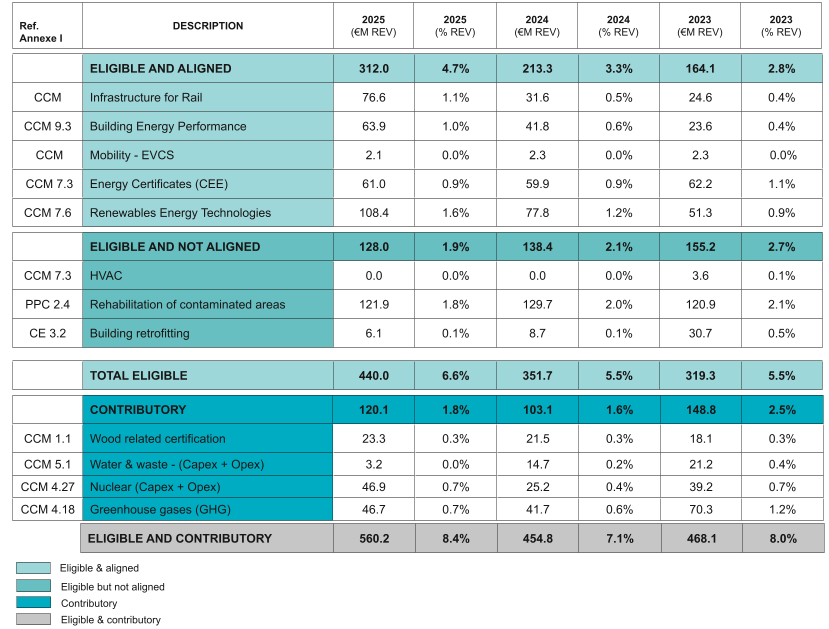
Share of total, eligible and aligned turnover
Proportion of total turnover - Fiscal 2025
Capex
In 2025, capital expenditure related to assets or processes associated with economic activities that could be considered environmentally sustainable under Annexes I and II of the Taxonomy regulation include:
- ●office, laboratory and vehicle leases (IFRS 16):
- ●amount of office and laboratory leases signed in 2025,
- ●company vehicle leases signed in 2025.
CapEx breakdown
Capex
2025 amount
(in €m)%
2024 amount
(in €m)%
Office or laboratory leases
98.1
30%
108.8
21%
Equipment and company vehicle leases
74.9
23%
64.4
12%
Total eligible Capex (numerator)
173.0
53%
173.2
33%
Property, plant and equipment (land, buildings or equipment)
114.0
35%
152.5
29%
Intangible assets (software, patents, etc.)
37.4
12%
198.1
38%
Total Capex (denominator)
324.3
100%
523.8
100%
Capex is made available to Bureau Veritas businesses indiscriminately. As we do not have the means to quantify the proportion of aligned Capex, Bureau Veritas considers that all of this Capex is non-aligned.
Bureau Veritas was unable to carry out a complete analysis of the alignment of its Capex with the EU Taxonomy for the following reasons:
- 1.Unverifiable alignment criteria: technical screening criteria (DNSH): The lack of granular data at Capex project level makes it impossible to verify compliance with the "Do No Significant Harm" criteria, particularly with regard to secondary environmental impacts;
- 2.Supplier traceability: since Capex is allocated indiscriminately to the Group's various activities, it is not possible to trace the associated supply chains and verify their compliance with sustainability criteria;
- 3.Documentation and certification: the absence of standardized documentation at project level limits the ability to demonstrate alignment with the specific technical criteria of each eligible economic activity.
This approach is in line with FAQ 13 on the Delegated Regulation - Article 8 (December 2022, published in the Official Journal in October 2023), which recognizes that when the information needed to assess alignment is not available or verifiable, Capex should be classified as non-aligned.
Opex
Opex encompasses operating expenditure related to assets or processes associated with economic activities that could be considered environmentally sustainable, including the following:
- ●research and development for €5.0 million;
- ●short-term leases for €45.6 million;
- ●maintenance and repair of assets for €116.5 million.
OpEx breakdown
This operational expenditure accounts for less than 5% of operational costs (salaries, sub-contractors and purchasing). It is not material for Bureau Veritas’ business model. Consequently, it will not be reported according to the exemption rule set out in article 1.3.1.2 of Commission delegated regulation (EU) 2021/2178 of July 6, 2021.
(in €m)
Salaries (a)
Sub-
contractors (b)Purchasing (c)
Op. costs
(a)+(b)+(c)Eligible Opex/
Op.costs (%)2025 operational costs (Op. Costs)
2,793
687
1,323
4,803
1.1%
Turnover
Year N
2025
Substantial contribution criteria
DNSH criteria (“Do No Significant Harm”) (h)
Economic activities (1)
Code(s) (2)Turnover (3)
Proportion of turnover,
year N (4)
Climate change
mitigation (5)
Climate change
adaptation (6)
Water (7)
Pollution (8)
Circular economy (9)
Biodiversity (10)
Climate change
mitigation (11)
Climate change
adaptation (12)
Water (13)
Pollution (14)
Circular economy (15)
Biodiversity (16)
Minimum
safeguards (17)
Proportion of Taxonomy-
aligned (A.1) or
Taxonomy-eligible (A.2)
turnover, year N-1 (18)
Category (enabling
activity) year N-1 (19)
Category (transitional
activity) (20)€m
%
YES/NO;
N/ELYES/NO;
N/ELYES/NO;
N/ELYES/NO;
N/ELYES/NO;
N/ELYES/NO;
N/ELYES/NO
YES/NO
YES/NO
YES/NO
YES/NO
YES/NO
YES/NO
%
E
T
A - Taxonomy-eligible activities
A.1. Environmentally sustainable activities (Taxonomy-aligned)
Infrastructure for rail transport (Annex I-6.14)
Technical control and inspection of rail transport infrastructure
CCM 6.14
76.6
1.1%
YES
NO
NO
NO
NO
NO
YES
YES
YES
YES
YES
YES
YES
0.5%
E
Professional services related to energy performance of buildings (Annex I-9.3)
Audits of building energy performance
CCM 9.3
63.9
1.0%
YES
NO
NO
NO
NO
NO
YES
YES
YES
YES
YES
YES
YES
0.6%
E
Infrastructure enabling low-carbon road transport and public transport (Annex I-6.15)
Inspection of electric vehicle charging stations
CCM 6.15
2.1
0.0%
YES
NO
NO
NO
NO
NO
YES
YES
YES
YES
YES
YES
YES
0.0%
E
Installation, maintenance and repair of energy efficiency equipment (Annex I-7.3)
Issuance of energy saving certificates
CCM 7.3
61.0
0.9%
YES
NO
NO
NO
NO
NO
YES
YES
YES
YES
YES
YES
YES
0.9%
E
Installation, maintenance and repair of renewable energy technologies (Annex I – 7.6)
Inspection of renewable energy production facilities
CCM 7.6
108.4
1.6%
YES
NO
NO
NO
NO
NO
YES
YES
YES
YES
YES
YES
YES
1.2%
E
Turnover of environmentally sustainable activities (Taxonomy-aligned) (A.1)
312.0
4.7%
4.7%
0%
0%
0%
0%
0%
YES
YES
YES
YES
YES
YES
YES
3.3%
o/w enabling
312.0
4.7%
4.7%
0%
0%
0%
0%
0%
YES
YES
YES
YES
YES
YES
YES
3.3%
E
o/w transitional
0
0%
YES
YES
YES
YES
YES
YES
YES
0%
T
A.2. Taxonomy-eligible but not environmentally sustainable activities (not Taxonomy-aligned) (g)
EL; N/EL
(f)EL; N/EL
(f)EL; N/EL
(f)EL; N/EL
(f)EL; N/EL
(f)EL; N/EL
(f)Installation, maintenance and repair of energy efficiency equipment (Annex I-7.3)
Inspection of heating, ventilation
and air conditioning equipmentCCM 7.3
EL
N/EL
N/EL
N/EL
N/EL
N/EL
0%
Remediation of contaminated sites and areas (Annex III-2.4)
Environmental tests
PPC 2.4
121.9
1.8%
N/EL
N/EL
N/EL
EL
N/EL
N/EL
2.0%
Renovation of existing buildings
(Annex II - 3.2)
Renovation of buildings
CE 3.2
6.1
0.1%
N/EL
N/EL
N/EL
N/EL
EL
N/EL
0.1%
Turnover of Taxonomy-eligible but not environmentally sustainable activities (not Taxonomy-aligned) (A.1)
128.0
1.9%
0.0%
0%
0%
1.8%
0.1%
0%
2.1%
Taxonomy-eligible turnover (A.1 + A.2)
440.0
6.6%
4.7%
0.0%
0.0%
1.8%
0.1%
0.0%
5.5%
B - Taxonomy-non-eligible activities
Taxonomy non-eligible turnover
6,241.3
93.4%
Total (A + B)
6,681.3
100%
CapEx
Year N
2025
Substantial contribution criteria
DNSH criteria (“Do No Significant Harm”) (h)
Economic activities (1)
Code(s) (2)Capex (3)
Proportion of Capex,
year N (4)
Climate change
mitigation (5)
Climate change
adaptation (6)
Water (7)
Pollution (8)
Circular economy (9)
Biodiversity (10)
Climate change
mitigation (11)
Climate change
adaptation (12)
Water (13)
Pollution (14)
Circular economy (15)
Biodiversity (16)
Minimum
safeguards (17)
Proportion of Taxonomy-
aligned (A.1) or
Taxonomy-eligible (A.2)
Capex, year N-1 (18)
Category (enabling
activity) year N-1 (19)
Category (transitional
activity) (20)€m
%
YES/NO
YES/NO
YES/NO
YES/NO
YES/NO
YES/NO
YES/NO
YES/NO
YES/NO
YES/NO
YES/NO
YES/NO
YES/NO
%
E
T
A - Taxonomy-eligible activities
A.1. Environmentally sustainable activities (Taxonomy-aligned)
Infrastructure for rail transport (Annex I-6.14)
Technical control and inspection of rail transport infrastructure
CCM 6.14
0
0%
YES
NO
NO
NO
NO
NO
YES
YES
YES
YES
YES
YES
YES
0%
E
Professional services related to energy performance of buildings (Annex I-9.3)
Audits of building energy performance
CCM 9.3
0
0%
YES
NO
NO
NO
NO
NO
YES
YES
YES
YES
YES
YES
YES
0%
E
Infrastructure enabling low-carbon road transport and public transport (Annex I-6.15)
Inspection of electric vehicle charging stations
CCM 6.15
0
0%
YES
NO
NO
NO
NO
NO
YES
YES
YES
YES
YES
YES
YES
0%
E
Installation, maintenance and repair of energy efficiency equipment (Annex I-7.3)
Issuance of energy saving certificates
CCM 7.3
0
0%
YES
NO
NO
NO
NO
NO
YES
YES
YES
YES
YES
YES
YES
0%
E
Installation, maintenance and repair of renewable energy technologies (Annex I – 7.6)
Inspection of renewable energy production facilities
CCM 7.6
0
0%
YES
NO
NO
NO
NO
NO
YES
YES
YES
YES
YES
YES
YES
0%
E
Capex of environmentally sustainable activities (Taxonomy-aligned) (A.1)
0
0%
0.0%
0%
0%
0%
0%
0%
YES
YES
YES
YES
YES
YES
YES
0%
o/w enabling
0
0%
0.0%
0%
0%
0%
0%
0%
YES
YES
YES
YES
YES
YES
YES
0%
E
o/w transitional
0
0%
YES
YES
YES
YES
YES
YES
YES
0%
T
A.2. Taxonomy-eligible but not environmentally sustainable activities (not Taxonomy-aligned) (g)
EL; N/EL
(f)EL; N/EL
(f)EL; N/EL
(f)EL; N/EL
(f)EL; N/EL
(f)EL; N/EL
(f)Installation, maintenance and repair of energy efficiency equipment (Annex I-7.3)
Inspection of heating, ventilation and air conditioning equipment
CCM 7.3
0
0.0%
EL
N/EL
N/EL
N/EL
N/EL
N/EL
0%
Acquisition and ownership of buildings
CCM 6.5
98.1
30.2%
EL
N/EL
N/EL
N/EL
N/EL
N/EL
20.8%
Road transport - Acquisition and ownership of vehicles
CCM 7.7
74.9
23.1%
EL
N/EL
N/EL
N/EL
N/EL
N/EL
12.3%
Capex of Taxonomy-eligible but not environmentally sustainable activities (not Taxonomy-aligned) (A.1) (1)
173.0
53.3%
53.3%
0%
0%
0%
0%
0%
33.1%
Taxonomy-eligible CapEx (A.1 + A.2)
173.0
53.3%
53.3%
0%
0%
0%
0%
0%
33.1%
B - Taxonomy-non-eligible activities
Taxonomy non-eligible Capex
151.4
46.7%
Total (A + B)
324.3
100%
- (1)An error in the allocation of Capex eligible for the EU Taxonomy has been identified for previous years. This error was corrected in 2025 with the reclassification of commercial leases and electric vehicle leasing to the appropriate activities (7.7, 6.5 - CCM).
OpEx
Year N
2025
Substantial contribution criteria
DNSH criteria (“Do No Significant Harm”) (h)
Economic activities (1)
Code(s) (2)
Opex (3)
Proportion of Opex,
year N (4)
Climate change
mitigation (5)
Climate change
adaptation (6)
Water (7)
Pollution (8)
Circular economy (9)
Biodiversity (10)
Climate change
mitigation (11)
Climate change
adaptation (12)
Water (13)
Pollution (14)
Circular economy (15)
Biodiversity (16)
Minimum
safeguards (17)Proportion of Taxonomy-
aligned (A.1) or
Taxonomy-eligible (A.2)
Opex, year N-1 (18)
Category (enabling
activity) year N-1 (19)
Category (transitional
activity) (20)€m
%
YES/NO
N/ELYES/NO
N/ELYES/NO
N/ELYES/NO
N/ELYES/NO
N/ELYES/NO
N/ELYES/NO
YES/NO
YES/NO
YES/NO
YES/NO
YES/NO
YES/NO
%
E
T
A - Taxonomy-eligible activities
A.1. Environmentally sustainable activities (Taxonomy-aligned)
Infrastructure for rail transport (Annex I-6.14)
Technical control and inspection of rail transport infrastructure
CCM 6.14
0
0%
YES
NO
NO
NO
NO
NO
YES
YES
YES
YES
YES
YES
YES
0%
E
Professional services related to energy performance of buildings (Annex I-9.3)
Audits of building energy performance
CCM 9.3
0
0%
YES
NO
NO
NO
NO
NO
YES
YES
YES
YES
YES
YES
YES
0%
E
Infrastructure enabling low-carbon road transport and public transport (Annex I-6.15)
Inspection of electric vehicle charging stations
CCM 6.15
0
0%
YES
NO
NO
NO
NO
NO
YES
YES
YES
YES
YES
YES
YES
0%
E
Installation, maintenance and repair of energy efficiency equipment (Annex I-7.3)
Issuance of energy saving certificates
CCM 7.3
0
0%
YES
NO
NO
NO
NO
NO
YES
YES
YES
YES
YES
YES
YES
0%
E
Installation, maintenance and repair of renewable energy technologies (Annex I – 7.6)
Inspection of renewable energy production facilities
CCM 7.6
0
0%
YES
NO
NO
NO
NO
NO
YES
YES
YES
YES
YES
YES
YES
0%
E
Opex of environmentally sustainable activities (Taxonomy-aligned) (A.1)
0
0%
0%
0%
0%
0%
0%
0%
YES
YES
YES
YES
YES
YES
YES
0%
o/w enabling
0
0%
0%
0%
0%
0%
0%
0%
YES
YES
YES
YES
YES
YES
YES
0%
E
o/w transitional
0
0%
YES
YES
YES
YES
YES
YES
YES
0%
T
A.2. Taxonomy-eligible but not environmentally sustainable activities (not Taxonomy-aligned) (g)
EL; N/EL
(f)EL; N/EL
(f)EL; N/EL
(f)EL; N/EL
(f)EL; N/EL
(f)EL; N/EL
(f)Installation, maintenance and repair of energy efficiency equipment (Annex I-7.3)
Inspection of heating, ventilation and air conditioning equipment
CCM 7.3
0
0%
EL
N/EL
N/EL
0%
Remediation of contaminated sites and areas (Annex III-2.4)
Environmental tests
PPC 2.4
0
0%
N/EL
N/EL
N/EL
0%
Renovation of existing buildings
(Annex II - 3.2)
Renovation of buildings
CE 3.2
0
0%
N/EL
N/EL
N/EL
0%
Opex of Taxonomy-eligible but not environmentally sustainable activities (not Taxonomy-aligned) (A.1)
0
0%
0%
0%
0%
0%
0%
Taxonomy-eligible OpEx (A.1 + A.2)
0
0%
0%
0%
0%
0%
0%
B - Taxonomy-non-eligible activities
Taxonomy non-eligible Opex
167.1
100%
100%
Total (A + B)
167.1
100%
100%
-
2.3Labor-related information
2.3.1Own workforce (S1)
2.3.1.1Strategy
Stakeholder interests and opinions (S1 SBM-2)
The interests, views and rights of the Group’s stakeholders inform the strategy and business model of Bureau Veritas through a number of priorities. These priorities help achieve a workforce for the Group that can meet the growth objectives through the creation of innovative solutions, the provision of expert advice and knowledge and the uncompromising application of ethical standards in the delivery of services to the Group’s customers. These priorities are also reflected in the Group’s human resources strategy and inform the three key policies of this strategy: attract, engage, and grow.
Actions ensuing from the human resources strategy feature in the Bureau Veritas' LEAP | 28 strategic plan, which sets 2028 as its main deadline. Bureau Veritas precisely maps the time horizons of each action by identifying:
- ●intermediate milestones for structuring implementation;
- ●clear traceability of progress throughout the period.
The three components of the Group’s human resources strategy enable the execution of the strategy through policies, processes, systems and initiatives, which reflect the interests, views and rights of the Group’s workforce. These include:
- ●the provision of secure and sustainable employment;
- ●a diverse workforce and inclusive culture;
- ●on-going learning and career development;
- ●highly engaged members of the workforce;
- ●a safe workplace;
- ●the respect of human rights, including labor rights.
For each of these components there is a specific time-scaled roadmap, with objectives and milestones set for the short term (1 year), medium term (2-5 years) and long term (2028 and beyond), to ensure clear accountability and measurable traceability of progress.
Material impacts, risks and opportunities and their interaction with strategy and business model (S1 SBM-3)
Actual and potential material impacts, risks and opportunities related to the Group’s workforce
Topic
Sub-topic
IMPACTS
RISKS
OPPORTUNITIES
Working conditions
Secure employment
Positive/actual
An insufficiently secure job has a negative impact on employees’ stable, long-term income, leading to stress and a lower standard of living. A secure job, on the other hand, gives employees a better quality of life and better mental and physical health.Working conditions
Working time
Positive/actual
The demands of the Company’s activities that require long working hours may negatively impact work-life balance.Actual
Decreased productivity and ability to attract, retain and engage talent.Working conditions
Adequate wages
Potential
Inadequate wages could result in reputational damage, legal claims, higher labor costs, employee attrition and disengagement.Working conditions
Social dialogue/
existence of work councils/
information, consultation and participation rights of workersFreedom of association/
collective bargaining including the rate of workers covered by collective agreementsPositive/actual
Too little social dialogue and collective bargaining impacts employee and local community engagement and in some cases quality of life.Actual
Failing to foster an environment that supports workers’ rights and social dialogue at Bureau Veritas poses risks of lower productivity, higher turnover, compliance issues, operational disruptions, reputational damage, and recruitment challenges.Working conditions
Work-life balance
Negative/potential
Demands of Bureau Veritas’ business, such as irregular schedules and client site assignments, can disrupt the work-life balance of its employees, impacting their families and local communities.Working conditions
Health & Safety
Positive/actual
Bureau Veritas’ testing and inspection activities expose its employees to health and safety risks, which the Group addresses through robust safety measures.Equal treatment and opportunities for all
Gender equality and equal pay for work of equal value
Negative/potential
The Group’s current pay practices may perpetuate gender disparities which can impact social cohesion and women’s livelihoods due to wage gaps.
Actual
Failing to address compensation disparities can lead to reputational, financial, and operational risks, such as potential non-compliance, social issues and productivity declines.Equal treatment and opportunities for all
Training and skills development
Positive/actual
Ensuring equitable training opportunities is necessary to ensure equal opportunities for personal, professional and career growth.Equal treatment and opportunities for all
Employment and inclusion of persons with disabilities
Negative/potential
Unsuitability of Bureau Veritas’ positions or work environment for persons with disabilities, as well as under-representation in its workforce, can have negative societal impacts.Equal treatment and opportunities for all
Measures against violence and harassment in the workplace
Negative/potential
Insufficient internal measures taken by Bureau Veritas to address violence and harassment in the workplace could have a detrimental physical and psychological impact on its employees. This, in turn, could lead to reputational consequences for the Company’s clients, partners and current/future talent.Equal treatment and opportunities for all
Diversity
Negative/actual
Insufficient focus on diversity and inclusion could undermine the trust and satisfaction of employees, communities, and shareholders, as the Group could fail to reflect the diversity of its stakeholders or capitalize on the benefits of a diverse workforce and inclusive culture. It also impacts the ability of more underrepresented groups to secure sustainable employment. Equal treatment and opportunities for all means a more diverse workforce and ensures that minorities have access to enriching career paths.Actual
Neglecting diversity and inclusion can lead to reputational, performance and financial risks, such as potential non-compliance, insufficient innovation, reduced capacity to attract and retain talent, and client deselection.Other work-related rights
Child labor and forced labor
Actual
Failing to prevent child labor and forced labor carries reputational, legal, and compliance risks that could severely undermine Bureau Veritas’ ethical standards and public trust.Other work-related rights
Data privacy
Actual
Privacy protection is a key issue for Bureau Veritas, given the Group's significant exposure to risk. GDPR compliance failures, data security breaches and inadequate information management practices are major risk vectors: data breaches affecting employees and customers, substantial regulatory fines, legal disputes, reputational damage and loss of contracts. Strong privacy protection is critically important in reducing such risk exposures and enabling the Group to operate effectively in a secure and compliant digital environment.The frequency of significant negative work-related incidents, particularly those relating to secure employment, depends on a variety of factors, such as economic conditions, and is therefore impossible to report.
- ●the need for the Group to have a highly skilled workforce to meet the changing regulations and expectations of its customers;
- ●the competitive advantage in productivity the Group receives from having a workforce that is engaged;
- ●innovation and creativity from the Group’s workforce that it leverages to develop solutions for its customers and its own operations through a diverse workforce;
- ●a strong organizational and employer brand that the Group utilizes to attract and retain members of its workforce and its customers to meet its growth plans through an inclusive, consultative, and safe culture.
These impacts, risks, and opportunities mainly concern employee and non-employee members of the Group’s workforce.
Employees: employees have mainly permanent contracts. Due to the specificity of certain activities, Bureau Veritas also uses fixed term, and non-guaranteed hours employment contracts.
Non-employees (ESRS S1 − Own workforce): Non-employees represent an insignificant proportion of its workforce. Non-employees mainly comprise freelancers and people working directly for Bureau Veritas under its direct responsibility.
- ●work under the responsibility of Bureau Veritas management;
- ●apply Bureau Veritas policies and processes;
- ●have technical and organizational autonomy;
- ●are directly involved in the Group's operations.
The Group does not currently consolidate central records of these non-employees. For this reason, the information provided in section 2.3.1 − Own workforce, of this Universal Registration Document relates to employees only, unless otherwise stated.
2.3.1.2Impacts, risks and opportunities management
I- Policies & Actions (S1-1)
The Group has designed and implemented a human resources strategy based on the guiding principle of “Safety & Well-being”. This strategy is designed to manage actual and potential material impacts, risks and opportunities related to the Group’s own workforce, and is structured around three key policies: "Strategic skills", "Employee experience" and "Career growth". Its design is partly based on employee testimonials and feedback gathered through initiatives such as the annual engagement survey.
The impact of this strategy is measured by employee feedback from engagement surveys and from meetings with managers, and discussions with employee representatives. Employees are informed about this strategy by Group managers and through centralized communications. The Chief People Officer is responsible for implementing the relevant policies at Group level, with the aim of completing the key actions by the end of 2028.
3 key policies
Common thread
Strategic skills
Employee experience
Career growth
Safety & Well-being
- ●Strategic talent attraction
- ●Competitive and fair compensation, with pay equity
- ●Employee Feedback
- ●Inclusive culture
- ●Workforce mix:
- ●gender balance
- ●diverse ethnic representation
- ●people with disabilities
- ●people identifying as LGBTI+
- ●cross-generational employees
- ●military veterans
- ●First Nations employees
- ●people with family responsibilities
- ●Harassment-free working environment
- ●Respect for human rights, including issues relating to forced labor and child labor
- ●Learning Strategy, Professional and Leadership Development
- ●Technical learning, vocational skills and externally recognized qualifications
- ●Onboarding
- ●Career development and internal mobility
- ●Training, communication and employee engagement
- ●Safety & Well-being
Bureau Veritas identifies necessary and appropriate actions in response to actual or potential negative impacts on its workforce, based on risk monitoring metrics for these impacts and on consultations with its employees and/or their representatives. These monitoring and consultation efforts enable Bureau Veritas to assess whether the Company’s practices are having a material negative impact on its employees.
Actual and potential material impacts, risks and opportunities concerning the Group’s workforce
Secure employment
Policy
Dialogue process and remediation plans implemented
Action plans (1)
2028 goals
Metrics
Career growth
- ●Dialogue: annual engagement survey, annual reviews of employee performance and development with employee managers, consultation with employees and/or their representatives on planned changes and on employees’ past experiences;
- ●Remediation plans: upgrading skills and retraining employees.
- ●Career development and internal mobility
- ●Technical learning, vocational skills and externally recognized qualifications
40
Number of training hours per employee
95%
% of employees participating in a performance review
- (1)Details on the action plans, policy by policy, appear following the tables for each topic.
Working time
Policy
Dialogue process and remediation plans implemented
Action plans (1)
2028 goals
Metrics
Employee experience
Safety & Well-being
- ●Dialogue: annual engagement survey, annual reviews of employee performance and development with employee managers, consultation with employees and/or their representatives on planned changes and on employees’ past experiences;
- ●Remediation plans: changes to working hours and planned assignments for Group clients.
- ●Employee Feedback
- ●Training, communication and employee engagement (safety and well-being)
76
Employee engagement rate measured by annual engagement survey (2)
0.23
Total Accident Rate (TAR): number of accidents with and without lost time x 200,000/number of hours worked
- (1)Details on the action plans, policy by policy, appear following the tables for each topic.
- (2)Bureau Veritas uses the engagement rate as a cross-functional metric to gauge the overall effectiveness of its HR policies. The engagement survey comprises 24 questions, listed below, covering several areas. Impact, risk and opportunity action plans are measured by one or more questions in the survey. For example, the action plan for training, communication and employee engagement (safety and well-being) is measured by survey questions covering aspects such as safety climate, ethics, role modeling, management communication, feedback, inclusion, collaboration, connection and post-survey follow-up. This metric captures the cumulative impact of policies at Group and local levels, and is supplemented by specific metrics (voluntary departure rate, recruitment, etc.) for a granular assessment of each policy.
Field of commitment
Employee perspective
Authenticity
I feel I can be myself at work.
Autonomy
I feel empowered to make decisions about my work.
Goal
I get something out of working for Bureau Veritas.
Career
Bureau Veritas opens interesting career prospects for me.
Clarity of purpose
I clearly understand what's expected of me in my job.
Safety climate
Safety is a top priority here.
Team - Collaboration
Bureau Veritas teams work together effectively to achieve results.
Management communication
Managers do a good job of communicating with employees.
Development
At Bureau Veritas, I have interesting opportunities to learn and develop my potential.
Ethics
Bureau Veritas employees behave in an ethical manner.
Team - Inclusion
Teamwork accommodates different points of view.
Intention to stay
I plan to continue working for Bureau Veritas in the coming year.
Mobility
Management offers full support to employees seeking positions in other teams or departments.
Model
At Bureau Veritas, senior managers lead by example.
Obstacles to implementation
At Bureau Veritas, we know how to lift obstacles that impede our work.
Customer focus
Bureau Veritas offers a quality customer experience greatly appreciated by its clients.
Outlook
I'm enthusiastic about the way Bureau Veritas is heading.
Measures
I’m sure this survey will trigger significant measures.
Anything else?
Do you have any other ideas?
Connection
I feel a sense of comradeship with my colleagues.
Recommendation
I would recommend Bureau Veritas as a great place to work.
Recognition
I am satisfied with the recognition or praise I get for my work.
Feedback
My manager gives me feedback to help me improve my performance.
Values
Bureau Veritas employees embody the company's values.
Adequate wages
Policy
Dialogue process and remediation plans implemented
Action plans (1)
2028 goals
Metrics
Strategic skills
- ●Dialogue: annual engagement survey, annual reviews of employee performance and development with employee managers, consultation with employees and/or their representatives;
- ●Remediation plans: salary reviews.
- ●Competitive and fair compensation, with pay equity
76
Employee engagement rate (2)
- (1)Details on the action plans, policy by policy, appear following the tables for each topic.
- (2)Bureau Veritas uses the engagement rate as a cross-functional metric to gauge the overall effectiveness of its HR policies. The engagement questionnaire comprises 25 questions covering five key areas: (i) technical and engineering, (ii) quality and safety, (iii) environment, (iv) digital transformation, and (v) human resources. This synthetic metric captures the cumulative impact of policies at Group and local levels, and is supplemented by specific metrics (voluntary departure rate, recruitment, etc.) for a granular assessment of each policy.
Social dialogue/existence of works councils/information, consultation and participation rights of workers and Freedom of association/Collective bargaining, including the rate of workers covered by collective bargaining agreements
Policy
Dialogue process and remediation plans implemented
Action plans (1)
2028 goals
Metrics
Employee experience
- ●Dialogue: annual engagement survey, annual reviews of employee performance and development with employee managers, consultation with employees and/or their representatives;
- ●Remediation plans: introduction of new consultation processes.
- ●Employee Feedback
- ●Respect for human rights, including issues relating to forced labor and child labor
76
Employee engagement rate
- (1)Details on the action plans, policy by policy, appear following the tables for each topic.
Work-life balance
Policy
Dialogue process and remediation plans implemented
Action plans (1)
2028 goals
Metrics
Employee experience
- ●Dialogue: annual engagement survey, annual reviews of employee performance and development with employee managers, consultation with employees and/or their representatives, discussions with groups of employee representatives specializing in safety;
- ●Remediation plans: modification of working hours and working methods.
- ●Employee Feedback
- ●Well-being framework
76
Employee engagement rate (2)
- (1)Details on the action plans, policy by policy, appear following the tables for each topic.
- (2)Bureau Veritas uses the engagement rate as a cross-functional metric to gauge the overall effectiveness of its HR policies. The engagement questionnaire comprises 25 questions covering five key areas: (i) technical and engineering, (ii) quality and safety, (iii) environment, (iv) digital transformation, and (v) human resources. This synthetic metric captures the cumulative impact of policies at Group and local levels, and is supplemented by specific metrics (voluntary departure rate, recruitment, etc.) for a granular assessment of each policy.
Health & Safety
Policy
Dialogue process and remediation plans implemented
Action plans (1)
2028 goals
Metrics
Employee experience
Safety & Well-being
- ●Dialogue: annual engagement survey, annual reviews of employee performance and development with employee managers, consultation with employees and/or their representatives, discussions with groups of employee representatives specializing in safety;
- ●Remediation plans: modification of working hours, working methods, working rules and work-based processes.
- ●Employee Feedback
- ●Training, communication and employee engagement (safety and well-being):
- ●Cardinal Safety Rules & Safety Fundamentals
- ●HSSE Requirements Handbook for Subcontractors and Non-Exclusive Workers
76
N/A
Employee engagement rate (2)
Total Accident Rate (TAR): number of accidents with and without lost time x 200,000/number of hours worked (3)
- (1)Details on the action plans, policy by policy, appear following the tables for each topic.
- (2)Bureau Veritas uses the engagement rate as a cross-functional metric to gauge the overall effectiveness of its HR policies. The engagement questionnaire comprises 25 questions covering five key areas: (i) technical and engineering, (ii) quality and safety, (iii) environment, (iv) digital transformation, and (v) human resources. This synthetic metric captures the cumulative impact of policies at Group and local levels, and is supplemented by specific metrics (voluntary departure rate, recruitment, etc.) for a granular assessment of each policy.
- (3)Bureau Veritas uses TAR (total number of work-related accidents with or without lost time, divided by hours worked) to gauge the effectiveness of its health and safety actions. This metric tracks accident trends independently of variations in activity, providing a reliable measure of the effectiveness of preventive actions.
Gender equality and equal pay for work of equal value
Policy
Dialogue process and remediation plans implemented
Action plans (1)
2028 goals
Metrics
Employee experience
Strategic skills
- ●Dialogue: annual engagement survey, annual employee performance and development reviews with employee managers, consultation with employees and/or their representatives, discussions with under-represented employee groups (e.g., women at certain grades) on specific topics;
- ●Remediation plans: training for managers and employees, targeted professional development for under-represented groups, salary reviews.
- ●Workforce mix, including gender balance
- ●Competitive and fair compensation, and pay equity
36%
% women managers (Band EC-II)
36%
% women managers (Band EC-IV)
35%
% women in total workforce
1.0
Gender pay ratio
- (1)Details on the action plans, policy by policy, appear following the tables for each topic.
Training and skills development
Policy
Dialogue process and remediation plans implemented
Action plans (1)
2028 goals
Metrics
Career growth
- ●Dialogue: annual engagement survey, annual reviews of employee performance and development with employee managers, consultation with employees and/or their representatives;
- ●Remediation plans: new training plans, identification of new career paths and career development opportunities.
- ●Learning Strategy, Professional and Leadership Development
- ●Technical learning, vocational skills and externally recognized qualifications
- ●Career development and internal mobility
- ●Onboarding
35%
Internal mobility index
(from band EC to band IV)- (1)Details on the action plans, policy by policy, appear following the tables for each topic.
Employment and inclusion of persons with disabilities
Policy
Dialogue process and remediation plans implemented
Action plans (1)
2028 goals
Metrics
Strategic skills
Career growth
- ●Dialogue: annual engagement survey, discussions with disabled employees and their representatives;
- ●Remediation plans: training managers and employees, modifying workplaces and workspaces, working with external associations.
- ●Strategic attraction of talent (including persons with disabilities)
- ●Learning Strategy, Professional and Leadership Development
N/A
Percentage of employees recorded as having a disability (France)
- (1)Details on the action plans, policy by policy, appear following the tables for each topic.
Measures against violence and harassment in the workplace
Policy
Dialogue process and remediation plans implemented
Action plans (1)
2028 goals
Metrics
Employee experience
- ●Dialogue: annual engagement survey, discussions with under-represented employees and their representatives;
- ●Remediation plans: training for managers and employees, communicating processes for raising concerns.
- ●Harassment-free working environment
N/A
Total number of incidents of discrimination, including harassment, reported in the reporting period
- (1)Details on the action plans, policy by policy, appear following the tables for each topic.
Diversity
Policy
Dialogue process and remediation plans implemented
Action plans (1)
2028 goals
Metrics
Employee experience
- ●Dialogue: annual engagement survey, discussions with under-represented employees and their representatives;
- ●Remediation plans: training for managers and employees, inclusive recruitment campaigns, targeted development programs.
- ●Workforce mix
36%
% women managers (Band EC-II)
36%
% women managers (Band EC-IV)
35%
% women in total workforce
- (1)Details on the action plans, policy by policy, appear following the tables for each topic.
Child labor and forced labor
Policy
Dialogue process and remediation plans implemented
Action plans (1)
2028 goals
Metrics
Employee experience
- ●Dialogue: consultation with employees and their representatives;
- ●Remediation plans: training managers and employees, communicating codes and rules.
- ●Respect for human rights, including child labor and forced labor
0
Number of severe human rights incidents connected to Bureau Veritas’ workforce personnel
0
Number (including zero) of severe human rights incidents connected to employees in the reporting period, including an indication of how many of these are cases of non-respect of the UN Guiding Principles on Business and Human Rights, ILO Declaration on Fundamental Principles and Rights at Work or OECD Guidelines for Multinational Enterprises
- (1)Details on the action plans, policy by policy, appear following the tables for each topic.
Note on employee personal data protection
The protection of Bureau Veritas employees' personal data follows the same principles and standards as those applied to the protection of external data. This topic is therefore covered in the section on sustainability issues specific to the sector (section 2.5.2 − Data protection), which covers all issues regarding data management and security in the broadest sense, regardless of their nature (internal or external personal data).
A. Strategic skills
a. Strategic talent attraction
In order to support continued secure employment for its workforce, the Group strives to continuously attract qualified and skilled individuals able to meet the Group’s operational and growth imperatives. This approach is designed to ensure the long-term viability of the Company’s activities and to foster the development of talent within the organization. The Group’s strategic workforce planning uses talent analytics with data sourced from the Group’s talent assessment, development, and succession planning processes. This data helps show the key skills and profiles needed to achieve the growth ambitions in Bureau Veritas’ strategy. These skills and profiles include:
- ●sales specialists and leaders of sales teams to drive organic growth;
- ●sustainability experts and managers to design and market new services;
- ●digital skills to support the transformation of Group service offerings;
- ●cybersecurity specialists to offer enhanced cybersecurity assessment and consulting services;
- ●transformation specialists to contribute to enterprise transformation programs;
- ●diverse talent with a focus on balance (gender, age, nationality, disability) in managerial functions.
The above talent analytics insights have influenced the approaches used by talent acquisition teams to recruit new hires, including:
- ●selecting and leveraging talent sourcing platforms;
- ●strengthening partnerships with external talent search providers;
- ●training recruitment teams and managers, particularly in inclusive recruitment;
- ●enhancing the Group’s employer branding strategy, as a distinctive employer brand, called LEAVE YOUR MARK, that focuses on the opportunities available to people in the workforce of the Group to make concrete and valuable contributions to Bureau Veritas that impact the sustainable growth of the communities where the Group operates;
- ●digitalization of talent attraction processes, including leveraging artificial intelligence;
- ●deploy and/or expand programs for those at the start of their careers, including graduate recruitment, internships and apprenticeships.
The Group’s employer branding and talent attraction, assessment and selection processes also aim to recruit individuals people who will consistently carry forward the Group’s Values and Absolutes (set out below) and Leadership Framework habits.
b. Competitive and fair compensation, with pay equity
The Group regularly carries out compensation surveys to ensure that its competitive positioning is maintained, enabling it to attract the right applicants, retain its people and compensate employees fairly based on the roles that they occupy.
Bureau Veritas also has profit-sharing agreements and savings plans, such as in France, where all employees participate in profit-sharing based on local labor law. In addition, employees in France who have worked for the Group for more than three months are entitled to contractual profit-sharing proportional to their seniority.
The Group is committed to achieving gender pay equity by 2028, by assessing the pay gap for equal work within its organization at least once a year, taking into account legitimate factors such as the location of employees and their roles and responsibilities. The purpose of this analysis is to identify material pay gaps of more than 5% that cannot be explained by legitimate factors. Once identified, the Group undertakes to implement remediation actions and timelines to close these gaps.
B. Employee experience
Employee Feedback
The Group runs an annual survey to obtain feedback from its employees, then takes appropriate measures based on the survey results. These surveys include:
- ●an annual employee engagement survey;
- ●Onboarding surveys for new arrivals: an initial survey 30 days after their start date, followed by a second assessment 90 days after. These measures identify areas for improvement and guarantee quality integration within the organization;
- ●exit surveys sent to employees who are about to leave Bureau Veritas;
- ●specific thematic surveys focusing, for example, on the effectiveness of communications on change management and the new strategy.
Inclusive culture
The Group’s commitment to building a sustainably diverse and inclusive workforce through equity is illustrated by its implementation of various action plans and initiatives, including:
- ●one of the four BV Values, “Open & Inclusive” (below), reflects the Group’s belief that employees can only reach their full potential if they are able to express themselves freely and openly and if Bureau Veritas’ employees encourage such expression. Employees are evaluated each year as part of their performance assessment on their effective demonstration of all Bureau Veritas values;
- ●managers are expected to demonstrably stand for and promote the Group’s inclusive culture by applying the Leadership Framework principles in their managerial practices. The "Build engaged Teams" focus commits managers to establishing a climate of psychological safety within their teams. In the resulting trust-conducive environment, employees are able to contribute fully, express divergent points of view and collaborate without fear of reprisal, thus fostering commitment, innovation and collective progress;
- ●training(11) for managers co-facilitated by experienced leaders, addressing the following fundamentals of inclusive leadership:
- ●inclusive behaviors to remove unconscious bias,
- ●mentoring and sponsoring of employees identified on objective grounds,
- ●attracting, assessing, and selecting talent by objective means;
- ●running women's health awareness sessions for all UK employees;
- ●Bureau Veritas is a signatory of the "Charte de la Diversité" in France.
Workforce mix
Achieving greater diversity within its workforce is a strategic priority for Bureau Veritas. To this end, the Group has put in place and will continue to implement strategies aimed at achieving its objectives in this area. The following elements, together with the corresponding strategies, help establish a diverse workforce:
Gender balance
- ●accelerated leadership development programs for high potential women in all regions of the world, including:
- ●Elevate HER – a global leadership development program for high potential women in the Group from all parts of the world and all businesses of the Group. The aim is to offer participants accelerated growth opportunities through individual coaching, mentoring and group learning activities to enhance their readiness for management roles within different Group entities or divisions, and
- ●Women@BV in France. This program is designed to accelerate the development of high potential women and includes mentoring from senior leaders, guest speakers on priority topics, and tools to develop one’s leadership style. It also aims to increase access to the Group’s sector for women, as through partnership with the "Elles bougent” organization, with operations such as inviting teenage girls to the Group’s offices to learn about career options;
- ●all employees in the Group are provided maternity protection from workplace risks as an application of its Cardinal Safety Rules, and maternity protection from dismissal based on local laws and regulations;
- ●longer paid parental leave than provided for under local legislation (note that eligibility conditions for such leave vary from one country to the next; for example, in the United States, you must have been employed by the Company for at least 12 months, have worked at least 1,250 hours in the 12 consecutive months immediately preceding the start date of the leave, and be a regular full-time employee):
- ●in the United Kingdom, the maternity and paternity leave offered is as follows: for maternity leave, the first six weeks are paid at 100% (vs. 90% required by law) and weeks seven to 16 are also paid at 100% (vs. GBP 152 per week required by law); for paternity leave, two weeks are paid at 100% (vs. GBP 152 per week required by law),
- ●in Australia, paid parental leave is provided to an employee who is the primary caregiver of a newborn or recently adopted child, once he or she has 12 months’ seniority. Paid leave is six weeks at the employee’s basic rate of pay, with a further two weeks’ pay if the employee returns to the business for at least one month. In addition, employees who are not the primary caregiver can use five days of accrued "personal leave" (sick and career leave) when the child comes home,
- ●in the United States, Bureau Veritas offers paid parental (maternity) leave for a period of up to 14 weeks,
- ●in India, parental leave benefits are extended to fathers in the form of five days paid leave,
- ●in Spain, employees benefit from a number of family support measures to help them balance professional and personal lives. They receive a cash allowance when a new child joins the family, by birth or adoption. Families receive financial assistance for children in the 6 to 16 age bracket, additional allowances for children with disabilities, and special cash contributions for large families (usually three or more children). Mothers are entitled to a minimum of 12 weeks' paid maternity leave, plus five additional paid days beyond this legal minimum, with the option of transferring part of this leave to the father. Specific assistance is available for victims of gender-related violence, in the form of paid leave of up to 10 days to deal with ensuing administrative, legal or medical procedures;
- ●the Group’s offices in France and Spain provide dedicated breast-feeding rooms for women;
- ●in Spain, the Group holds Gender Equality European and International Standard (GEEIS) certification, granted on examination of criteria including the existence of specific action plans and practices in human resources;
- ●Bureau Veritas is a signatory of the United Nations Women’s Empowerment Principles in order to reinforce its commitment, and support its strategies, to advance gender equality and women’s empowerment in the workplace and more broadly within society;
- ●Hinda Gharbi, the Group’s Chief Executive Officer, is a mentor in the "Ateliers Entreprise et Mixité" mentoring program, and in the Equaleaders organization in France, whose aim is to promote a better balance in company leadership;
- ●Bureau Veritas’ Executive Vice-President, Marine & Offshore, Matthieu Gondallier de Tugny, is a founding member of the Global Maritime Forum’s Diversity Study Council whose mission is to develop a Global Charter for Diversity & Inclusion for the maritime industry with the objective of enabling women’s access to, and advancement within, the maritime industry;
- ●the Vice-President Sales, Marketing and Communication – Bureau Veritas France, Nathalie Brunel, is a member of the board of the association “Elles bougent” which aims to attract more women to pursue careers in engineering.
Diversity in nationality and ethnicity
- ●the Group is also committed to enhancing the nationality and ethnicity diversity of its workforce, and to ensuring a rewarding workplace culture for all, regardless of nationality or ethnicity. Bureau Veritas operates in 140 countries with 164 nationalities represented among its employees. The Bureau Veritas values and Leadership Framework ensure that this commitment on diversity in ethnicity and nationality is carried through right up to the most senior management levels. For example, the Group Executive Committee includes a range of nationalities (German, American/Argentinian, Australian/Tunisian, Brazilian, Chinese, Spanish, French, Pakistani and Thai), with 36% of members having non-European nationalities;
- ●the Group continues to broaden the capabilities of individual managers to enhance diversity in their teams, and to develop a workplace culture in which everyone enjoys equal opportunities to succeed and advance in their careers. Initiatives taken to support this include:
- ●training programs on inclusive leadership, including awareness of unconscious bias, inclusive recruitment and mentoring/sponsoring of employees to objective criteria,
- ●local events, such as cultural celebrations, to celebrate and recognize differences,
- ●tracking nationality data for the total workforce and for the management workforce in order to close gaps between these two workforces.
The Group is constantly seeking ways to create a workplace that increases access to employment for people with disabilities. Several targeted initiatives were run in 2025:
- ●in France, Bureau Veritas has implemented initiatives to increase access to employment which include:
- ●internal communication campaigns with expert consultants to raise awareness of all employees,
- ●participation in awareness-raising events: Activ'Challenge, SEEPH and DuoDay,
- ●strategy for recruiting persons with disabilities, including a link from the Group’s recruitment site to that of AGEFIPH, the French organization for collecting funds to promote the occupational integration of disabled persons, along with access to its applicant database,
- ●the provision of a call line for Group employees to obtain support or advice in having their disability recognized,
- ●an Operational Employment Preparation program, run with AFPA to facilitate Bureau Veritas hiring for currently unemployed disabled persons;
- ●in South Africa, Bureau Veritas partners with training providers to fund learning for people with disabilities to increase their access to employment;
- ●in Spain, Bureau Veritas holds the “Bequal Plus” certification, which assesses companies’ recruitment and human resources policies, office accessibility, and the retention and rehabilitation of workers with disabilities.
People who identify as LGBT+
The Group aims to attract and engage talent who identify as LGBT+ by creating a workplace where they can feel free to fully and openly contribute in their roles and progress in their careers. Examples of other initiatives include:
- ●local events in countries including the UK and Canada to celebrate Pride Month. These promote Bureau Veritas’ inclusive culture for all employees, including those who identify as LGBT+, encourage more people to support those who identify as LGBT+, and educate employees on how they can create a more LGBT+ inclusive workplace;
- ●network groups of LGBT+ employees and their allies, such as the LGBT+ Diversity Group in the UK, are encouraged, and guides are available on setting up and running such groups;
- ●providing employees with the option to record their gender as “non-binary”;
- ●Bureau Veritas' inclusion policy applies zero tolerance to any discrimination on the identity markers of gender, gender expression or sexual orientation;
- ●having started with the United Kingdom, the Group records and reports employees who volunteer to identify as LGBT+. This data provides valuable feedback and insights on how to improve the take-up of inclusion in Group culture.
Cross-generational employees
The development of talent across all generations is critical given the significant number of employees at Bureau Veritas within different age groups. This was achieved through multiple initiatives, including:
- ●The Group places particular emphasis on targeting external candidates of all ages. Its LEAVE YOUR MARK employer brand illustrates its employment value proposition to multiple generations, drawing a link between employee expertise and concrete benefits to society. The Group keeps a close eye on employee engagement, voluntary attrition rate and hours spent on training and development by age band and level within the organization. The aim is to identify any discrepancies between the different groups, so that appropriate strategies can be put in place to reduce them;
- ●In France, recruitment teams have run initiatives on the recruitment of people in professional reintegration and young people (interns, work-study students, first-time job-seekers, etc.) with visibility campaigns on social networks (including Meta, Tik-Tok and Pinterest);
- ●In Japan, in order to retain older talent, the Group offers a continued employment program for those who have reached the local retirement age (63), which includes offering part-time work options.
Military veterans
Bureau Veritas values the recruitment of veterans through the technical, professional, and leadership skills they bring. The Group also believes it has a responsibility to enable more employment pathways to individuals who have served in the armed forces.
- ●In the United States, Bureau Veritas has signed a partnership with “RecruitMilitary.com”, a leader in connecting employers with the military community program that helps veterans access employment. Then as an approved supplier of the Department of Defense SkillBridge, Bureau Veritas demonstrates its commitment to supporting military personnel in their career transitions. The Group’s regional recruitment teams in the United States have a targeted strategy on forming and maintaining relationships with “Transition Officers” in the military, to enhance the Bureau Veritas’ brand as an employer of choice for veterans.
- ●Bureau Veritas has an agreement with “RecruitMilitary.com”, the exclusive agency for the “Soldier for Life” program of the United States Army that helps veterans’ transition to employment. In addition, the Group’s recruitment teams in the United States have a targeted strategy of creating and maintaining relationships with "Transition Officers" in the military in order to enhance Bureau Veritas’ brand as an employer of choice for veterans.
- ●In the United Kingdom, in 2025 Bureau Veritas was confirmed as holder of the Gold award under the Ministry of Defense Employer Recognition Scheme, in recognition of its induction program targeting British army veterans and the opportunities this gives them to build a second career. This award has now been held by the Group for eight years and in part reflects the numerous options available to veterans to organize their work by giving them a role as mentors or consultants, or by offering them part-time work solutions.
First Nations employees
- ●In Australia, Bureau Veritas partners various First Nations groups and local communities to attract more candidates from First Nations communities. And its "innovative action plan for reconciliation" has been approved by Reconciliation Australia.
Persons with family responsibilities
- ●Globally, Bureau Veritas’ flexibility policy sets a framework providing employees with flexibility on working hours, location and form of work when circumstances in their private lives demand such adaptation, as with family carers. In addition, paid leave is provided in some countries specifically for employees who have caring responsibilities. For example: In Spain, employees are provided up to 30 working days of paid leave to assist first-degree relatives (children, parents, parents/son/daughter-in-law) when hospitalized.
Harassment-free working environment
- ●The Group has specific codes that are aligned with relevant internationally recognized instruments, including the UN Guiding Principles on Business and Human Rights. These codes for their own workforce, including employees and non-employees, explicitly address trafficking in human beings, forced labor/compulsory labor and child labor. These include the Human Rights Policy, the Anti-harassment Policy, the Inclusion Policy, Cardinal Rules and Safety Fundamentals and the Code of Ethics. The following grounds for discrimination are specifically prohibited by the Group's Inclusion Policy: ethnicity, race, color, age, visible differences, heritage or ancestry, place of origin, socio-economic status, gender, gender identity, gender expression, sexual orientation, marital status, family status (including having or not having children), medical condition (including pregnancy and breastfeeding), disability status, political opinion, religion (belief), any other status protected by law.
- ●These above-mentioned codes are implemented through specific procedures to ensure discrimination is prevented, mitigated and acted upon once detected. They also promote diversity and inclusion in general. The Group treats all claims of discrimination and harassment with the utmost seriousness and commits to investigating all claims swiftly and to taking appropriate action as a result of the findings of the investigations. The Group’s policy confirms that anyone who files a complaint will be protected against retaliation. Bureau Veritas is also committed to ensuring, through on-going training and communications, that employees are aware of what constitutes discrimination and harassment and how to lodge claims where they believe it has taken place – this includes providing an independent whistleblowing channel that is operated by a third party.
- ●The Group has made specific commitments to increase the representation of women. The commitments include targets to achieve greater representation of women in the workforce, among leadership/experts and in senior leadership through targeted recruitment, development and engagement strategies.
- ●Training on the Group’s Code of Ethics, which includes its zero tolerance regarding harassment and its commitment to building a diverse workforce and inclusive culture, is mandatory for all employees. In addition, "Open & Inclusive" seminars were held for managers in 2025, led by experienced executives based in the same countries or regions as the managers. The seminar leaders had received prior instruction from an inclusion expert with backing from local human resources managers, to ensure quality and consistency of the seminars. The Group-wide seminars were designed to reinforce the manager's role in fostering a working environment free from all forms of discrimination and harassment, and to promote a culture of inclusion. In addition to these Group initiatives, local measures have included mandatory training for employees in France on the prevention of psychosocial risks.
Respect for human rights, including issues relating to forced labor and child labor
The Group’s codes and initiatives in relation to its own workforce explicitly prohibit trafficking in human beings, forced labor or compulsory labor and child labor. The Group also has a comprehensive workplace accident prevention policy and management system.
The codes and initiatives of Bureau Veritas and their deployment are aligned with relevant internationally recognized instruments, including the UN Guiding Principles on Business and Human Rights and the Organisation for Economic Co-operation and Development Guidelines for Multinational Enterprises on Responsible Business Conduct.
- ●freedom of association and the right to collective bargaining: Bureau Veritas respects the right of all employees to form or join trade unions and to bargain collectively, in accordance with local laws. A non-discriminatory policy is applied in respect to union membership and activity in areas such as employment, promotion transfer or dismissal. Bureau Veritas encourages open and honest communication in its workplaces where employees can speak with their managers about their ideas, concerns or issues and work together to deal with work condition issues;
- ●elimination of discrimination and remuneration inequalities: Bureau Veritas combats all types of discrimination, harassment and any other disrespectful or inappropriate behavior, including unfair treatment or retaliation of any kind in the workplace or in any work-related circumstance. Recruitment, appointment, training, remuneration and career advancement decisions are based solely on qualifications, performance, skills and expertise, disregarding any consideration of ethnicity, race, color, age, visible differences, heritage or ancestry, place of origin, socio-economic status, gender, gender identity, gender expression, sexual orientation, marital status, family status (including having or not having children), medical condition (including pregnancy and breast-feeding), disability, political opinion, religion (belief), any other status protected by law. Bureau Veritas is also committed to identifying remuneration inequities based on gender and taking action to remove them. Processes to identify such inequities and take action include regular analysis and reporting, followed by the development and execution of local action plans to address identified gaps;
- ●support for diversity and inclusion: Bureau Veritas supports and promotes diversity and inclusion in all its workplaces;
- ●provision of a safe and secure workplace: Bureau Veritas is committed to providing a safe and healthy workplace, free from violence, harassment, intimidation and other unsafe or disruptive conditions, to minimize the risk of accidents and injury and to reduce exposure to safety, health and security risks, for all its employees. Bureau Veritas Health and Safety program complies with applicable laws and regulations. It includes provision of appropriate personal protective equipment to workers, establishing safety procedures and training programs on workplace hazards and ensuring codes and procedures are in place to deal with any emergency situations;
- ●protection of privacy: Bureau Veritas is committed to the right of privacy and freedom of expression and takes all reasonable measures to endeavor to protect employees against unauthorized access, use, destruction, modifications or disclosure of their personal information and data. Bureau Veritas processes employee personal data in accordance with our global privacy policy and applicable laws and regulations. Security safeguards for employee data are provided as needed and are maintained with respect for employee privacy and dignity.
The Group has processes and mechanisms for monitoring compliance with the United Nations Guiding Principles on Business and Human Rights, the International Labor Organization Declaration on Fundamental Principles and Rights at Work and the Organization for Economic Co-operation and Development Guidelines for Multinational Enterprises on Responsible Business Conduct. These processes and mechanisms include:
- ●a partnering policy: Bureau Veritas endeavors to ensure that its partners, such as agents, intermediaries, joint venture and consortia members apply its Business Partner Code of Conduct and its Human Rights Policy. Bureau Veritas may decide to stop its activities with clients, governments or local communities who do not respect human rights;
- ●a whistleblowing process: Bureau Veritas operates a policy of encouraging employees to speak out if they witness any behaviors or practices they suspect in breach of our Code of Ethics. This is supported by an external Alert Line enabling people to report issues online, via e-mail or by telephone, giving their name or not as they choose.
- ●Reporting for employees: if any employee has any questions about this human rights policy or wishes to report any alleged violation of this policy, he or she can follow the procedures set forth in the Bureau Veritas Code of Ethics. Bureau Veritas is committed to investigating and addressing issues raised by employees as appropriate and to maintaining confidentiality to the extent reasonably practicable and as required under applicable law throughout any such process. No sanctions or other forms of retaliation will be inflicted upon a Bureau Veritas employee for reporting a violation of this policy.
- ●Reporting by external persons: all reports raised by external persons like customers, communities, suppliers or subcontractors are investigated and addressed according to the existing processes, including the external Alert Line set forth in the Bureau Veritas Code of Ethics, maintaining confidentiality to the extent reasonably practicable and as required under applicable law throughout any such process;
- ●prevention of forced labor and child labor: Bureau Veritas prohibits the use of all forms of forced labor including involuntary prison labor, indentured labor, bonded labor, military labor, slave labor or any form of human trafficking, in all of its operations. Bureau Veritas operates in full compliance with all applicable laws relating to working hours, wages including those related to minimum wages, overtime and benefits. Workers are free to withdraw from any employment relationship, subject to reasonable prior notice. Regarding the prevention of child labor, Bureau Veritas prohibits the employment of anyone under the age of 16 in all of its operations and is committed to combating any exploitation of children. Workers under the age of 18 are not asked to work on dangerous jobs that may affect their health and safety. The Group has not identified any geographic areas or operations where there is a risk of material incidents of forced or child labor.
C. Career growth
Learning Strategy, Professional and Leadership Development
The Group's Learning Strategy aims to build its people's skills to contribute to the growth objectives of Bureau Veritas and in preparing the workforce of the future. The Learning Strategy’s foundations include:
- ●learning needs analysis;
- ●meeting learning needs through the design and development of solutions based on on-the-job experiences, connections with others, and formal learning;
- ●solutions deployment and inclusion in individual development plans (IDPs) for employees (see paragraph on MyDevelopment below);
- ●solution evaluation to maximize their business impact, including using the “Kirkpatrick” model and using the Group’s learning management system.
- ●Developing competencies in alternative fuels
- The Group’s Marine & Offshore division has set up a Future Shipping Team (FST) which aligns and connects more than a hundred Group experts on more than a dozen major shipping sustainability topics, including the energy transition, decarbonization and carbon neutrality. The members of the team systematically share their knowledge with each other, work on key strategic projects as part of a global roadmap, and deliver internal training on hot topics to broader audiences.
- ●"Sustainability Academy”
- This program aims to develop specific talents and combines a number of learning experiences, including 360⁰ assessments, feedback/coaching, mentoring, and seminars. The center also develops team innovation projects with on-going support from the Group’s management, a number of which have resulted in enhanced and new services offered to Bureau Veritas’ clients.
- ●Development Center – Europe & Africa
- The Bureau Veritas Sustainability Academy is a global capacity-building program, designed to bridge the gap in sustainability expertise and accelerate the progress of early-career professionals. It offers structured technical training in key sustainability-related areas such as carbon and climate, product circularity, supply chain, nature and ESG, plus consulting, project implementation and digital skills. Through expert-led modules, on-the-job learning, mentoring and assessment, the Academy enables graduates to make rapid progress towards self-sufficiency and deliver high-quality sustainability services to our customers in all our geographical areas.
- ●Latin America Academy: Strengthening operations capabilities
- This academy builds technical and professional skills for employees beginning their careers in the sustainable development profession. Expert-led modules target specific topics addressing the needs of the cutting-edge sustainability consulting services offered by these professionals. In addition, with mentoring modules and face-to-face sessions with leaders and trainers on professional and interpersonal skills, this academy encompasses an approach that accelerates the advancement of these professionals in a high-growth business.
- ●Digital learning for all employees
- The Group’s learning platform, MyLearning, continues to be enhanced in order to provide more targeted learning to all connected employees that is accessible anywhere, anytime. In 2025, all employees were able to undertake training courses from the full program offered by the external provider, Coursera. This program includes numerous courses accredited by universities, training organizations and other recognized external bodies;
- ●Learning Week
- Bureau Veritas organizes a “Learning at Work Week”, during which all BV employees are expected to attend a webinar on a new priority topic and commit to applying three key learnings. Led by external partners and in-house experts, these training courses cover topics determined from an analysis of the company's priority training needs, namely: using artificial intelligence for productivity optimization; fine-tuning language learning; developing agility; planning professional and career advancement; and cultivating strengths and confidence.
In addition, to build a strong and diverse pipeline of talent for its managerial roles, the Group uses a talent strategy to identify, assess, and develop talent. This includes identifying talented individuals who are allocated to talent pools. The pool to which employees may be assigned is based on an assessment of their potential for future roles. These individuals are then provided targeted development programs to ensure there is a strong pipeline of talent in place.
Technical learning, vocational skills and externally recognized qualifications
Bureau Veritas operates across a large number of fields and so its technical training is essential to ensure that employees can work with full knowledge of current and emerging standards and regulations, inspection methods (sampling, analysis, non-destructive tests, measurements, etc.), technical characteristics of items inspected (products, processes, equipment, etc.) and safety standards. The Technical departments of each division monitor employee qualifications and skills, which are also audited by relevant accreditation bodies (COFRAC, IACS, UKAS, etc.). A significant portion of the formal training hours recorded reflects technical skills development, highlighting Bureau Veritas’ commitment to technical excellence.
Bureau Veritas also collaborates with a number of external schools, higher education institutions, and training organizations to enable employees to learn key vocational skills and acquire externally recognized qualifications and certifications. Examples include:
- ●Australia, where the Group takes on study costs and provides employees time away from work for traineeships that lead to certificates and diplomas in laboratory techniques issued by Labtech Training Victoria (LTT);
- ●China, where a number of new project managers attended a program in conjunction with Tianjin University to certify them in project management and leadership skills;
- ●India, employees have completed certification training courses covering all the following critical technologies: PySpark, advanced data frameworks, Python, AWS certification (cloud infrastructure and data engineering), Power Apps & Power Platform, project management, ITIL V4, cybersecurity, Netskope Proxy, generative artificial intelligence, Angular, JavaScript, Docker, identity and access governance, and Power BI;
- ●United Kingdom, where Bureau Veritas collaborates with Robert Gordon University to provide scholarships/work experience in mechanical and electrical engineering;
- ●France, where employees are given the opportunity to study for certificates in Agile and Scrum methodologies, contract management, as well as domains related to artificial intelligence (AI), such as machine learning, natural language processing, computer vision, and robotic process automation – skills that are valuable across industries and crucial for Bureau Veritas’ long-term competitiveness.
Onboarding
The Group’s new recruits are provided with a structured new employee experience that aims to maximize their productivity and sense of belonging that includes:
- ●“Moments that Matter” that are clearly defined experiences for new recruits;
- ●process digitization;
- ●guidelines and training for managers/HR teams to communicate with new recruits;
- ●the identification, training, and assignment of “BV Buddies”;
- ●learning for new recruits during their first year that is job-specific plus “Welcome to Bureau Veritas” training on the organization, culture and employer branding modules on:
- ●the Cardinal Safety Rules,
- ●the Bureau Veritas Compliance Program covering its Code of Ethics, travel security, data protection, IS/IT user charter, and driving safely,
- ●BV Absolutes and BV Values modules, focusing on what is expected of all employees,
- ●the LEAVE YOUR MARK employer brand and the role that all employees and managers play in shaping and enhancing it,
- ●the Group’s Human Resources policies.
Career development and internal mobility
Bureau Veritas is committed to providing a culture and supporting processes that optimize the performance and development of all its employees. These include MyPerformance@BV and MyDevelopment (see below), with quarterly operations for employees and their managers, including an annual evaluation of BV Values. MyPerformance@BV includes the following components:
- ●management by objectives: setting objectives that align with business strategy and with personal career ambitions;
- ●re-setting objectives as needed in response to market conditions;
- ●multidimensional performance appraisals: evaluating performance based on feedback from multiple people;
- ●effectively giving and receiving constructive feedback.
- ●agile conversations: regular career development conversations to meet changing personal and business needs and aspirations (at least once a year);
- ●a digital record of agreed and reviewed development objectives;
- ●solutions proposed to help the employee meet development objectives, such as special projects, stretch assignments, mentoring, and formal training;
- ●a role and development framework to help employees in their career planning.
Bureau Veritas Career Development Framework
Key steps
Resources
Examples
Identify
- ●Identify the future roles, responsibilities, projects, etc. of interest to employees to advance their career.
- ●Validate the need for these roles, responsibilities, projects at BV.
- ●Internal circulation of job opportunities, talent reviews, advice from mentors and managers, talent pools to guide careers towards management or expert tracks.
- ●MyDevelopment career progression conversations.
- ●Mentoring conversations for members of special groups such as Women@BV in France.
Assess
- ●Assess the skills needed for the roles, responsibilities, projects etc., of interest to employees against their existing skills.
- ●Multi-source (including 360⁰) feedback.
- ●Technical skills and qualification. assessments by experts.
- ●Leadership Framework habits.
- ●Annual global talent reviews.
- ●Performance feedback through MyPerformance.
Development
- ●Develop plans to close identified skill gaps.
- ●Specific functional/technical courses of study and expert supervision for qualifications.
- ●Leadership development programs.
- ●Surveyor certifications and qualifications.
- ●Sustainability Academy development program.
The Group believes internal mobility is critical for people development. Feedback from Bureau Veritas employees obtained from surveys confirms that this type of approach is valued by employees. Employees are therefore encouraged to apply for new roles, express interest in new projects and to take on different responsibilities. At Bureau Veritas, internal mobility is supported by an geographical and functional mobility approach, which includes:
- ●structured questions in MyDevelopment conversations between employees and managers and online fields in SuccessFactors on geographic/functional mobility preferences;
- ●training of managers on how to hold engaging career planning and development meetings;
- ●sharing employee profiles as part of talent reviews and succession planning;
- ●recruitment: virtually all job offers are first of all advertised internally using the Group’s internal job vacancies portal;
- ●notice periods: notice periods for internal moves are the same or less than in case of resignation;
- ●eligibility: all employees, whether on permanent or fixed-term contracts, can apply for internal job vacancies. The only conditions are six months’ seniority for permanent contracts. No minimum seniority is required for fixed-term contracts;
- ●notification: employees are not required to inform their manager or local HR team when they apply for roles, although this is encouraged;
- ●promotional campaigns: throughout the year, various initiatives encourage employees to be open about their career preferences, for example by talking to their managers or entering details in the human resources information system;
- ●internal communications: appointments to senior positions and promotions are announced on the Group’s intranet and in messages from the Chief Executive Officer.
D. Safety & Well-being
Managing occupational health and safety risks is paramount for Bureau Veritas, as a significant part of its activities are conducted at the premises of clients or their suppliers.
In addition, the Group faces a wide variety of hazards in its own work-spaces and operates in a very large scope of geographies with various levels of maturity and enforcement by local regulators. Ensuring every worker arrives home safe and sound is non-negotiable for the Group and essential to its business. That is why Safety in Bureau Veritas is an absolute. It does not change with time, priorities, pressure or economic climate. Working safely is the only way Bureau Veritas operates.
In October 2023, the Group reviewed its HSW (Health, Safety & Well-being) statement, setting the highest expectations on these topics. The statement was signed by the new CEO and was distributed to all entities and translated into various languages.
Bureau Veritas has an integrated (ISO 9001, 14001 and 45001) and certified management system that is audited regularly by a third-party organization. At Group level, with the support of the operational network, the QHSE (Quality, Health & Safety and Environment) manual is updated and global standards are issued on a regular basis, influenced by management investigations, incident reviews, audit findings and an overall assessment of the program.
The Group has set a goal on increasing its ISO 45001 coverage, making this a key performance indicator. The change in this indicator in 2025 primarily reflects changes in scope. In practical terms, increased coverage means having more employees working in entities with certified management systems ensuring that a long-term continuous improvement process is in place, and ultimately leading to the improvement of work conditions and the reduction of work-related accidents.
Accidents involving vehicles
The most significant risk is related to accidents involving vehicles. Bureau Veritas employees use company cars or two-wheelers within the framework of their duties. To ensure that these duties are carried out in complete safety, the Group has launched a worldwide policy, covering:
- ●programs to reduce the use of two-wheelers and limit horse power;
- ●journey management and fatigue control;
- ●management of excessive speed;
- ●enhanced training for drivers who spend a lot of time on the road.
Employee training, communication and engagement
Ensuring that the Bureau Veritas workforce remains committed to the Group’s absolutes and takes the right decisions at the right time is crucial. In 2025, the Group ran a communication campaign focused on two areas:
All of the Group's communications include a reminder on the Cardinal Rules and Fundamental Safety Principles.
During the year, the Group launched several consecutive safety alerts to share corrective and preventive measures identified during accident investigations.
Toolbox talks were deployed to raise awareness and promote good communication between management and employees in the field on safety issues; Bureau Veritas employees around the world must take part in a minimum of six toolbox talks. Depending on the business segment, local regulatory requirements and local organization, these talks can run for 15 to 30 minutes and cover health, safety and security subjects such as fall protection, use of two-wheelers, and working in confined spaces, for example.
HSSE training
In 2025, the Company released several training modules. These included a new Driving module which addresses all employees and is mandatory for all new recruits given the importance of this risk to the Group.
QHSE audit program
The implementation of effective audit programs is crucial to ensuring that field/lab operations are being carried out in line with the Group´s expectations. In a post-pandemic world, the Company has re-started in-person audits to ensure a healthy management system after so many years of remote audits. In 2025, the Group performed 248 QHSE internal audits performed by its QHSE internal auditors and received 38 external QHSE certification audits carried out by its certification body, covering ISO 9001, ISO 45001, and ISO 14001.
Machine protection
Following a serious incident in Mozambique, the Group launched a global campaign to phase out all unsafe machines in its locations. The Group developed a machine safety training course in multiple languages, a machine safety checklist and a platform to collect and manage all the machine protection data. In 2025, a program was launched requiring all Group entities to bring all non-compliant machines into compliance, with a year-end deadline for full completion of this initiative.
Digitalization
As the Company evolved to a more sophisticated management system, the need for granular data increased allowing leaders to be better informed about risk, allowing highly deliberate actions at an entity/country level. In 2024, Bureau Veritas finalized the deployment of its digital platform called NEXUS. This solution is a one-stop shop with all information modules integrated. NEXUS was developed from the ground up by our internal IT specialists in conjunction with QHSE (Quality, Health & Safety and Environment) experts and the network at large. This new enhancement allows the organization to consistently track the following programs:
- ●external audits (ISO, 9001, 14001, 45001), corrective action management, scheduling, trend analysis;
- ●internal audits, corrective action management, trend analysis;
- ●QHSE acquisition management module guaranteeing full QHSE consolidation of newly acquired companies;
- ●accident investigation module with the declaration of near misses, unsafe conditions and injury reporting, allowing a high level of detail on corrective action completion and trends;
- ●safety walks and local inspections & audits. This tool allows local management to define local checklists and plans. It has an enhanced module to configure planning and track execution;
- ●"2 minutes for My Safety" checks:
- ●office, field and laboratory,
- ●driving,
- ●riding,
- ●travel overseas – high-risk countries,
- ●safe boarding,
- ●access to restricted spaces,
- ●transportation of IR equipment.
The platform exists in 17 languages and has the goal of creating a global set of dashboards allowing transparency on the execution of the various critical safety programs.
Bureau Veritas has also developed a mobile solution, known as Maia, for users to report accidents, near misses and unsafe conditions. Maia also enables users to follow the “2 minutes for My Safety” module and conduct safety inspections. With the combination of this software solution and a mobile application our employees have all the necessary information on the tip of their fingers to manage the safety program efficiently.
86,273 safety visits logged by managers
in NEXUS in 2025705,000 “2 minutes for My Safety” checks performed by workers
Managing high-risk conditions
In 2024 and early 2025, Bureau Veritas identified a number of areas for improvement necessary to protect against serious incidents. To improve control over these risks, it launched the “10 Essential Programs for Life” initiative. This covers areas requiring action which, if not properly implemented locally, would be liable to entail possibly tragic outcome for employees. Bureau Veritas began by retraining its HSE managers on the ten essential expectations for life, then asked them to carry out a self-assessment. The 2025 self-assessment will provide essential input for the 2026 action plans with the various entities, focusing on what really matters - protecting employees.
Management of non-employees (external workers)
For Bureau Veritas the management of its non-employee workers is paramount for the success of our missions. In terms of safety expectations, non-employee workers are managed with the same level of attention as employees. They participate in talks, communication campaigns and training events. To monitor their performance, the Group performs safety walks on subcontractors, ensuring compliance with standard operating procedures, work methods and PPE use (personal protective equipment). In 2025, Bureau Veritas reported no fatalities with external workers. The Group has also reinforced the control of external workers that perform high-risk activities in BV Facilities with the deployment of a pre-start permit and 5-point verification process. Managers in charge of contracting with externals have also been formally trained.
Well-being
In order to foster well-being in its workforce, Bureau Veritas has developed a Health, Safety, Security, and Well-being Statement setting out the Group’s ambitions and commitments. It has put in place a “Well-being Framework” with four pillars: physical, emotional, financial, and purpose & community engagement.
Pillars
Examples
Physical well-being:
Looking after ourselves, our sleep, nutrition and physical exercise routines contribute positively to our ability to perform.
- ●technology upgrades to enable more effective remote working;
- ●redesigning physical workplaces to ensure employee well-being is optimized;
- ●options for job-sharing and flexibility, including reduced hours at employees’ request;
- ●reimbursement of home office equipment; and
- ●discounted bicycle purchases and free bicycle parking.
Emotional well-being:
Our emotional and mental state of mind has a direct impact on how we feel, how we adapt to changing environments and how we perform.
- ●manager advice and guidelines on leading teams during crises, such as Covid-19, that included building resilience, leading remotely, and the importance of regular employee check-ins and reporting on the health and well-being of employees;
- ●awareness raising and education initiatives on health at work (for example, in the United Kingdom around issues impacting women in the workplace, such as menopause);
- ●systematic pandemic updates, professional medical advice, and support to employees that are tailored to local contexts;
- ●mental and physical health awareness campaigns (such as “R U OK” in Australia) and programs, such as meditation and improved sleep classes and subsidized health checks and gym memberships;
- ●customized solutions to individual employees to minimize work absences;
- ●local solutions under the Group’s Flexibility Policy;
- ●the provision of free women’s sanitary products (in Australia);
- ●employee assistance programs; and
- ●sabbaticals or flexible leave periods.
Financial well-being:
Financial concerns can induce stress and take over our lives; understanding our financial position and options helps reduce this stress.
- ●health and life insurance coverage for all employees, while allowing for local conditions;
- ●extending benefits and services to employees for increased support (an example of which are hotlines for employees to obtain specialist advice such as counseling services); and
- ●including well-being and awareness programs (including financial advice) as part of the benefits of insurance policies.
Purpose & Community Engagement:
Finding meaning in our work and being able to give back, as well as working for a company that gives back to society provides a sense of purpose and positively impacts our personal well-being.
- ●employee volunteering in local communities during work hours;
- ●offering pro bono Bureau Veritas services to relevant local charities;
- ●campaigns to encourage employees to support local communities, as with blood donation programs.
II – Processes for engaging with own workforce and workers’ representatives about impacts (S1-2)
Bureau Veritas is committed to providing processes for engaging with people in its own workforce and workers’ representatives about actual and potential impacts on its own workforce. Responsibility for these processes lies with the Chief People Officer, who leads the Group’s HR teams. These processes aim to take into account perspectives of its own workforces in the decision-making processes that influence such impacts, and include:
- ●surveys: engagement surveys, carried out once a year, and for the onboarding of new recruits and the departure of employees leaving the Company;
- ●discussions with groups of employees at town hall-type meetings, held at least once a year;
- ●consultations and discussions with employee representatives, the frequency of which depends on local regulations and cultures;
- ●individual or group interviews with employees' managers.
Employees’ views on the Company’s target-setting are also taken into account at least once a year during individual performance and development reviews, during which employees and their managers:
- ●set personal objectives, which influence the objectives set for the Group as a whole;
- ●measure past performance against objectives;
- ●identify lessons from past experiences for improvements to increase future performance.
To gain insight into the perspectives of workers, for those who may be particularly vulnerable to impacts and/or marginalized, the Group examines their feedback and develops action plans where necessary. Where appropriate, Bureau Veritas also organizes additional joint brainstorming sessions with relevant employees to identify ideas from the initial feedback already given.
The effectiveness of engagement with the Group’s own workforce is assessed using metrics such as the improvement in recorded employee engagement following actions taken on the basis of feedback received in the engagement survey.
Bureau Veritas communicates and negotiates actively with employees and their representatives as a means of continually enhancing the workplace, including by developing collective agreements in many countries. The human resources leaders in the countries and/or regions where the Group operates ensure this communication and negotiation. The results of and comments set out in employee surveys (conducted at least once a year) enable the Group to measure the effectiveness of its dialogue with its workforce.
Bureau Veritas respects freedom of association, the right to collective bargaining, and the right of all employees to form or join trade unions in accordance with local laws.
The Group endeavors to comply with and promote the International Labor Organization’s (ILO) Declaration on Fundamental Principles and Rights at Work, and its fundamental conventions. The ILO’s fundamental conventions cover various topics, including the Freedom of Association and Protection of the Right to Organize Convention (ILO C87), and the Right to Organize and Collective Bargaining Convention (ILO C98).
The Group applies a non-discriminatory policy in respect of union membership and activity in areas such as employment, promotion, transfer, and dismissal. This also applies to employee representatives through the Group’s compliance with the ILO Convention on Workers’ Representatives.
The Group also has the following procedures in place that reflect its active communication with its employees and their representatives:
- ●the Group aims to inform employees and/or their representatives as early as possible of any reorganizations;
- ●in some countries, ongoing skills development agreements are signed with employee representatives. In France in particular, a forward-looking employment and skills management system (GPEC) has been set up to align jobs, headcount and skills with the Group's strategic developments and changes in the economic, social and legal environment;
- ●employee representative bodies exist in most of the countries where the Group has significant numbers of employees, including: Argentina, Australia, Belgium, Brazil, Canada, Chile, Côte d’Ivoire, Greater China, Denmark, Finland, France, Germany, India, Indonesia, Italy, Japan, Kazakhstan, Malaysia, Morocco, the Netherlands, Nigeria, Peru, the Philippines, Romania, Thailand, Senegal, Singapore, South Africa, South Korea, Spain, Sweden, Ukraine, the United Kingdom and the United States;
- ●collective agreements covering key HR topics (such as the organization of working hours, compensation policy, working conditions, etc.) have been agreed with employee representative bodies in many of Bureau Veritas' main markets, including: Argentina, Australia, Belgium, Brazil, Canada, Chile, France, India, Italy, the Netherlands, Nigeria, Peru, Romania, Singapore, South Africa, Spain, Sweden, Ukraine, and Vietnam;
- ●the Group has set up a European Works Council (EWC) to represent its employees. Internal operation rules for this have been set by Bureau Veritas and the EWC. The European Works Council for the Group has 28 representatives from European countries. It is kept informed of the Group’s economic and financial situation and the likely trends in its businesses and divestments. It is also consulted on the employment situation and trends, investments, significant changes in the organization, mergers or discontinued operations, and large-scale redundancies.
III – Processes to remediate negative impacts and channels for own workforce to raise concerns (S1-3)
The Group provides formal means by which its workforce can make their concerns and needs known directly to the Group through established grievance procedures, which includes whistleblowing. Procedures in place that support this and which provide the opportunity for employees both to raise concerns and receive responses from the Group to remediate possible negative impacts or irregularities and receive responses from the Group to remediate possible negative impacts or irregularities include:
- ●an externally managed whistleblowing hotline and website with on-going reviews of its communication and usage;
- ●internal ethics contact points;
- ●HR managers assigned to each employee;
- ●access to senior management (both operational staff and Human Resources managers) through the Company’s “open door policy”;
- ●local country/division channels that reflect local customs, cultures, etc.;
- ●employee representative bodies, such as works councils (for example, the Comité Social et Économique in France), the European Works Council (EWC) and Health & Safety Committees.
Individual employee issues are monitored and managed by Human Resources managers and internal ethics officers, with the aim of finding satisfactory solutions. These managers also assess the effectiveness of the various channels set up for employees to voice their concerns, by analyzing feedback from employees – particularly in the annual employee engagement survey – as regards their awareness of and confidence in these channels. Managers also take into account the direct feedback they receive from employees outside these surveys.
Bureau Veritas codes, such as the Code of Ethics and the Anti-harassment Policy, explicitly protect employees against reprisals when they use these different channels to express their concerns or needs.
IV – Taking action on material impacts on own workforce, approaches to managing material risks and pursuing material opportunities related to own workforce, and effectiveness of those actions (S1-4)
The Group identifies the actions to be taken when faced with a particular actual or potential negative impact on its own workforce by its managers and human resources teams, by assessing:
- ●possible actions that can be taken;
- ●how such actions mitigate material risks for the Group’s workforce;
- ●how such actions support the pursuit of material opportunities for the employee. For example, the Group has invested in a global provider of training content, including certification, to help ensure that its employees’ skills meet future market needs. This aims to mitigate the negative impacts on workers of the transition to a greener, more climate-neutral economy. These could represent experiences where demand from carbon-intensive industries for the Group’s services declines over time.
The effectiveness of actions and initiatives designed to produce results for the Group’s workforce is assessed mainly through the Group’s employee engagement survey, training courses followed by Group employees, and career growth.
Maximizing employment security is a key feature of the Group’s commitment to being a responsible employer. The Group has put in place a number of processes and dedicated resources to offer and maximize employment security to employees that include:
- ●limiting offering non-permanent employment to roles dedicated to:
- ●specific projects that are unlikely to be repeated,
- ●short-term projects for a few months,
- ●covering peak periods of activity and/or providing highly specialized expertise not available in the regular recruitment market;
- ●mitigating the impact of non-permanent employment by providing:
- ●setting compensation and benefits based on checks on compensation and provision of benefits for employees on fixed-term contracts relative to permanent employees,
- ●giving priority to recruitment on permanent contracts, in line with our career management approach. No minimum length of service is required for employees on fixed-term contracts applying for an internal vacancy, while employees on permanent contracts are required to have at least six months’ seniority;
- ●only considering employee lay-offs after an extensive review of alternatives, including a three-level approach:
- ●maximizing redeployment opportunities for employees:
- ●consultation with employees/their representatives on operational changes as soon as practical,
- ●continuous skills evaluation and subsequent development of employees as part of a commitment to on-going training,
- ●internal job search, identification and matching to employees’ skills,
- ●individual employee follow-up, including support to apply for roles;
- ●encouraging flexible work practices:
- ●encouraging employees to take paid and unpaid leave, including the use of local furlough schemes,
- ●reductions in working hours, including overtime;
- ●proposing voluntary redundancy schemes:
- ●investigating early retirement options,
- ●out-placement services including career coaching, skills assessments and development, external job-search support, and counseling and psychological services.
- ●maximizing redeployment opportunities for employees:
Note that due to the differences in employment conditions that are applicable in the countries where Bureau Veritas operates, the resources that are available to take action on material impacts on its workforce vary depending on the country where impacted employees are based.
The Group identifies the actions to be taken when faced with a particular actual or potential negative impact on its own workforce by its managers and human resources teams, by assessing:
- ●possible actions that can be taken;
- ●how such actions mitigate material risks for the Group’s workforce;
- ●how such actions support the pursuit of material opportunities for the employee. For example, the Group has invested in a global provider of training content, including certification, to help ensure that its employees’ skills meet future market needs. This aims to mitigate the negative impacts on workers of the transition to a greener, more climate-neutral economy. These could represent experiences where demand from carbon-intensive industries for the Group’s services declines over time.
The effectiveness of actions and initiatives designed to produce results for the Group’s workforce is assessed mainly through the Group’s employee engagement survey, training courses followed by Group employees, and career growth.
2.3.1.3Metrics and targets (S1-5)
A. Characteristics of the undertaking’s employees (S1-6)
Human resources data are captured by local Bureau Veritas offices in a common human resources information system. Data analytics is performed by the Bureau Veritas Group Human Resources department using dedicated resources.
Where targets have been set, they cover the period from the year of this Universal Registration Document through to 2028, unless otherwise indicated. The effectiveness of policies and measures aimed at achieving targets is monitored at least quarterly, based on material impacts, risks and opportunities related to sustainability matters. To this end, Bureau Veritas regularly reports on metrics that measure its progress against targets.
Headcount at December 31, 2025
Breakdown by type of contract
Bureau Veritas distinguishes two categories of employment contracts(12), in accordance with ESRS S1-6:
- ●Permanent contracts: Open-ended employment contracts offering long-term job stability. These contracts account for the majority of Bureau Veritas' workforce.
- ●Temporary contracts: Employment contracts concluded for a set period, including contracts with non-guaranteed hours. These contracts are used to meet specific, temporary needs.
Global headcount at December 31, 2025
Female
Male
Non-binary
Not
reportedTotal
Number of employees
24,536
56,621
7
13
81,117
Number of employees on permanent contracts
20,377
42,505
6
11
62,899
Number of employees on fixed-term contracts
4,159
14,116
1
2
18,278
Number of employees on non-guaranteed hours contracts
410
1,316
1
0
1,727
Number of full-time employees
22,979
54,984
6
13
77,982
Number of part-time employees
1,557
1,637
1
0
3,195
Global headcount at December 31, 2024
Female
Male
Non-binary
Not
reportedTotal
Number of employees
25,981
58,245
9
10
84,245
Number of employees on permanent contracts
21,265
43,025
6
9
64,305
Number of employees on fixed-term contracts
4,716
15,220
3
1
19,940
Number of employees on non-guaranteed hours contracts
542
1,412
3
0
1,957
Number of full-time employees
24,171
56,097
6
9
80,283
Number of part-time employees
1,810
2,148
3
1
3,962
Regional headcount at December 31, 2025 – Europe
Female
Male
Non-binary
Not
reportedTotal
Number of employees
6,677
12,197
4
6
18,884
Number of employees on permanent contracts
6,282
11,762
4
5
18,053
Number of employees on fixed-term contracts
395
435
-
1
831
Number of employees on non-guaranteed hours contracts
18
102
-
-
120
Number of full-time employees
5,712
11,691
4
6
17,413
Number of part-time employees
965
506
-
-
1,471
Regional headcount at December 31, 2025 – Africa, Middle East
Female
Male
Non-binary
Not
reportedTotal
Number of employees
1,750
6,900
-
1
8,651
Number of employees on permanent contracts
1,601
6,402
-
1
8,004
Number of employees on fixed-term contracts
149
498
-
-
647
Number of employees on non-guaranteed hours contracts
26
61
-
-
87
Number of full-time employees
1,744
6,895
-
1
8,641
Number of part-time employees
6
4
-
-
10
Regional headcount at December 31, 2025 – Americas
Female
Male
Non-binary
Not
reportedTotal
Number of employees
6,912
15,013
2
3
21,930
Number of employees on permanent contracts
3,889
5,616
2
3
9,510
Number of employees on fixed-term contracts
3,023
9,397
-
-
12,420
Number of employees on non-guaranteed hours contracts
95
422
-
-
517
Number of full-time employees
6,606
14,397
2
3
21,008
Number of part-time employees
306
616
-
-
922
Regional headcount at December 31, 2025 – Asia Pacific
Female
Male
Non-binary
Not
reportedTotal
Number of employees
9,197
22,511
1
3
31,712
Number of employees on permanent contracts
8,605
18,725
-
2
27,332
Number of employees on fixed-term contracts
592
3,786
1
1
4,380
Number of employees on non-guaranteed hours contracts
271
731
1
-
1,003
Number of full-time employees
8,917
22,000
-
3
30,920
Number of part-time employees
280
511
1
-
792
Metrics in line with CSRD methodology
2025
2024
Number of permanent hires
12,487
12,605
Number of fixed-term hires
15,426
16,900
Number of employees who left the Group
31,240
28,635
Employee turnover rate(1)
27.8%
25.3%
Number of voluntary departures
11,353
11,928
Voluntary attrition rate(2)
10.1%
10.6%
Number of dismissals
4,701
3,435
Number of departures for other reasons
2,567
1,723
Calculation methodologies used:
(1) Employee turnover rate:
Numerator (total departures):
- ●Voluntary departures (permanent + fixed-term contracts) during the year
- ●Involuntary departures - Redundancies (permanent + fixed-term contracts) during the year
- ●Termination of temporary contracts during the year
- ●Other departures (permanent + fixed-term contracts) during the year
Denominator (reference headcount):
- ●Headcount at January 1 (permanent + fixed-term)
- ●Recruitment during the year (permanent + fixed-term contracts)
- ●Employees joining during the year (permanent + fixed-term contracts)
(2) Voluntary departure rate:
Numerator (voluntary departures):
- ●Voluntary departures (permanent + fixed-term contracts) during the year
Denominator (reference headcount):
- ●Headcount at January 1 (permanent + fixed-term)
- ●Recruitment during the year (permanent + fixed-term contracts)
- ●Employees joining during the year (permanent + fixed-term contracts)
- ●on-site mission coverage: Some inspection and certification activities require temporary resources for projects of limited duration;
- ●local specificities: Some regional markets require greater flexibility to adapt staffing levels to variations in activity;
- ●specific technical expertise: Some technical missions require occasional call on specific skills.
Temporary contract terminations are included in the employee turnover rate. They account for a significant proportion of the overall attrition rate and reflect the temporary nature of these contracts.
- ●limiting the call upon fixed-term contracts to real and temporary needs;
- ●ensuring equivalent working conditions for both temporary and permanent employees;
- ●improving the monitoring and transparency of data on temporary contracts.
Bureau Veritas metrics
2025
2024
Number of employees who left the Group – Excluding fixed-term contracts
14,515
13,018
Employee turnover rate – Excluding fixed-term contracts
15.5%
14.7%
Number of voluntary departures – Excluding fixed-term contracts
7,247
7,860
Voluntary departure rate – Excluding fixed-term contracts
9.4%
10.3%
Breakdown of workforce by gender in the main countries representing more than 10% of Bureau Veritas’ employees at December 31, 2025
B. Characteristics of non-employee workers (S1-7)
The Group is currently unable to provide the number of non-employee workers (13) at December 31, 2025. The records of these workers are decentralized without any existing process to report this information globally. Bureau Veritas is working to put in place solutions to report this information in the future.
C. Coverage of collective bargaining and social dialogue (S1-8)
Scope
Type of coverage
At December 31, 2025
At December 31, 2024
Global
Percentage of employees who are covered by collective bargaining agreements and social dialogue agreements
33%
34%
EEA
87%
88%
Europe – outside EEA
7%
8%
Africa, Middle East
12%
12%
Americas
31%
35%
Asia Pacific
13%
14%
Global
Percentage of employees who are covered by formally-elected employee representatives
30%
31%
Coverage Rate
Collective Bargaining Coverage
Social dialogue
Employees – EEA countries representing >10% of total employees
Employees – non-EEA countries based on estimate for countries with >10% of total employees
Workplace representation – EEA countries representing>10% of total employees
0-19%
China
20-39%
40-59%
60-79%
80-100%
France
France
D. Diversity metrics (S1-9)
E. Adequate Wages (S1-10)
As a fundamental aspect of its compensation strategy, the Group acknowledges the importance of remaining aligned with legal requirements and has prioritized compliance with national minimum wage standards.
In 2025, Bureau Veritas undertook an in-depth analysis of the levels of fixed compensation paid to its employees, covering around two-thirds of its workforce in the 20 main countries in which Bureau Veritas operates. This analysis found that 100% of its employees receive wages consistent with the national minimum wage set by legislation or collective bargaining.
With a view to continuous improvement, salary analysis will continue to be examined in depth in 2026, notably with a view to covering the entire Bureau Veritas workforce and streamlining reporting practices in this area. Bureau Veritas’ commitment to fair compensation remains unwavering, and the Group continually strives to improve the well-being and financial security of its global workforce.
F. Social protection (S1-11)
In alignment with its commitment to adhere to legal requirements in each country of operation and its existing group policy on life insurance, Bureau Veritas strives to ensure that employees receive adequate social protection. The primary element of its social protection framework is the provision of a group life insurance policy, guaranteeing a minimum coverage of 12 months’ salary in the unfortunate event of an employee’s death.
It is important to note that Bureau Veritas’ approach to social protection is decentralized, relying on compliance with legal requirements specific to each country. Consequently, the coverage may vary based on the prevailing regulations and practices in the respective jurisdictions. While our group policy on life insurance serves as a foundational element, Bureau Veritas acknowledges that in some countries and for certain employee types, complete coverage for all major life events may not be achieved.
Specifically, in some of the 140 countries where Bureau Veritas operates, there may be variations in the coverage for major life events such as sickness, unemployment, employment injury and acquired disability, parental leave, and retirement between employee categories.
As part of its ongoing commitment to employee welfare, the Group is actively reviewing and enhancing its social protection initiatives where necessary, striving to align with international standards while respecting local regulations. The focus remains on providing comprehensive support to our diverse workforce, addressing the unique circumstances of each country and employee type to ensure equitable and robust social protection coverage (sickness, unemployment, employment injury and acquired disability, parental leave, retirement).
G. Persons with disabilities (S1-12)
Male
Female
Total
Percentage of employees recorded as having a disability
at December 31, 20252.72%
4.65%
3.4%
Note that this information is provided for employees working in France only and is based on employees informing Bureau Veritas that they are recognized as workers with a disability by the French Commission for the Rights and Independence of People with a Handicap (la commission des droits et de l’autonomie des personnes handicapées – CDAPH) at December 31, 2025.
Each country has its local definitions and reporting practices for people with disabilities, based on local customs, laws and regulations, which can be significantly different from each other. Therefore, reporting for the global workforce is not shown.
H. Training and skills development metrics (S1-13)
I. Health and safety metrics (S1-14)
The percentage of the workforce covered by a Group health and safety management system corresponds to the percentage of the workforce covered by ISO 45001 certification.
Health and safety metrics
2025
2024
Percentage of employees covered by a health and safety management system based on legal requirements and/or recognized standards or guidelines (Percentage of own workforce working in ISO 45001-certified entities)
88%
93%
Number of fatal accidents
0
2
Number of accidents at subcontractors
9
10
Number of accidents at subcontractors working on a Bureau Veritas site
0
1
Number of fatal accidents at subcontractors
0
0
Number of work-related accidents
181
197
Number of work-related accidents without lost time
47
75
Number of work-related accidents with lost time
134
120
TAR – Total Accident Rate (based on 1,000,000 hours worked) – CSRD methodology
1.13
1.17
TAR – Total Accident Rate (based on 200,000 hours worked) – Bureau Veritas internal methodology
0.23
0.24
LTR – Lost-time accident frequency rate (based on 1,000,000 hours worked) – CSRD methodology
0.83
0.71
LTR – Lost time accident frequency rate (based on 200,000 hours worked) – Bureau Veritas internal methodology
0.17
0.15
Accident Severity Rate (ASR)
0.025
0.013
Number of days lost
3,960
2,250
Number of days lost to work-related injuries and fatalities from work-related accidents, work-related ill health and fatalities from ill health – employees
3,960
2,250
Number of days lost to work-related injuries and fatalities from work-related accidents, work-related ill health and fatalities from ill health – non-employees
35
86
As part of its 2028 strategy, Bureau Veritas has defined key performance metrics for occupational health and safety, calculated on the basis of 200,000 hours worked. These metrics, the Total Accident Rate with lost time (TAR) and the Lost-time Rate (LTR) measuring severity, track the Group’s performance in this area.
In order to meet the requirements of the CSRD, which specifies that these metrics are to be calculated on the basis of 1,000,000 hours worked, Bureau Veritas presents these two methodologies separately for the sake of transparency and clarity.
J. Work-life balance metrics (S1-15)
Family-related leave type
% of employees entitled to this leave type
% of employees who took this leave in 2025 – male
% of entitled employees who took this leave in 2025 – female
Maternity/adoption leave: for employed women directly around the time
of childbirth or for women and men for adoption100%
0%
3.6%
Paternity leave/second parent leave: for fathers or second parents,
on the occasion of the birth or adoption of a child100%
4.2%
0%
Parental leave: leave from work for parents on the grounds of the birth
or adoption of a child to take care of that child100%
0.6%
2.3%
Carers’ leave: leave to provide support to a relative, or a person who lives in the same household, in need of significant care or support for a serious medical reason
100%
0%
0.3%
Family-related leave type
Number of employees who took this leave in 2025 – male
Number of entitled employees who took this leave in 2025 – female
Maternity/adoption leave: for employed women directly around the time of childbirth
or for women and men for adoption0%
881
Paternity leave/second parent leave: for fathers or second parents, on the occasion
of the birth or adoption of a child1,191
-
Parental leave: leave from work for parents on the grounds of the birth or adoption
of a child to take care of that child349
565
Carers’ leave: leave to provide support to a relative, or a person who lives in the same household, in need of significant care or support for a serious medical reason
-
81
K. Compensation metrics (pay gaps) (S1-16)
Overall ratio in accordance with ESRS S1-16
- ●(Average gross hourly pay for male employees - Average gross hourly pay for female employees)/Average gross hourly pay for male employees.
This gap was calculated taking into account all employees, while applying the exclusions strictly necessary to guarantee the consistency and accuracy of the data, namely:
- ●employees for which data anomalies exist (salaries at nil, undefined status, no gender identification);
- ●employees receiving annual compensation that is inconsistent with their level of responsibility: reporting or system input anomalies, and/or conversion unit anomalies.
The scope of employees considered in the presented results table covers more than 98% of the Group’s overall employee population.
As well as an overall ratio, Bureau Veritas applies a more fine-tuned approach which it uses to take decisions on equal pay. This method is based on:
- ●weighted calculation: the pay gap is adjusted according to the distribution of the workforce in order to better reflect the actual pay structure;
- ●statistical exclusion of small groups: groups comprising fewer than three men or three women are excluded from the weighted calculation to guarantee statistical reliability and preserve data confidentiality;
- ●analysis by employee category;
- ●differentiation between managerial and non-managerial staff on permanent contracts.
The scope of employees considered in the presented results table covers 72% of the Group’s total workforce (i.e., 95% of the Group’s permanent employees).
L. Total compensation ratio (S1-16)
Scope
The annual total compensation ratio covers all Bureau Veritas employees worldwide, ensuring a comprehensive and representative assessment of its international compensation practices. This approach reflects the diversity of the Group’s activities and salary structures.
To ensure data reliability and consistency, certain strictly necessary exclusions have been applied:
- ●employees for whom data anomalies exist (zero salaries);
- ●employees receiving annual compensation that is inconsistent with their level of responsibility: reporting or system input anomalies, and/or conversion unit anomalies.
These exclusions represent 2% of the overall population. No other exclusions have been applied to ensure that the ratio is calculated on the basis of all the compensation categories required by ESRS S1-16.
Methodology
The methodology applied complies with the principles defined by ESRS S1-16, including all the compensation components mentioned in AR 101 (b).
The ratio is calculated by comparing the Chief Executive Officer’s total compensation (numerator) with the median compensation of all employees (denominator), covering all compensation categories, i.e.:
- ●fixed compensation;
- ●short-term variable compensation (annual bonuses);
- ●long-term variable compensation (performance shares and stock options);
- ●benefits in kind and other compensation.
As with the overall compensation ratio, this ratio was calculated across all Group employees, with the exception of a few categories excluded to ensure data reliability. The scope covers more than 98% of the total workforce.
Results
The results of the total annual compensation ratio are presented in the context of a multinational organization operating in 140 countries. It is important to note that the comparison is made between the compensation position of a CEO of a listed multinational company based in France with employees throughout the world. This contextual information is essential for interpreting the compensation ratios across diverse global landscapes, recognizing the intricacies associated with international compensation standards, currency fluctuations, and regional variations in compensation practices.
M. Serious human rights complaints and incidents (S1-17)
Total number of incidents of discrimination, including harassment, reported in the reporting period, compiled based on information from the Group’s whistleblowing platform(1)
54
Number of complaints filed through channels for employees to raise concerns (including grievance mechanisms) – compiled based on information from the Group’s whistleblowing platform
202
Number of complaints filed with the National Contact Points for OECD Multinational Enterprises
0
Amount of fines, penalties and compensation for damages as a result of incidents of discrimination, including harassment and complaints filed – euros
not published(14)
Number of severe human rights issues connected to own workforce
0
Number (including zero) of severe human rights incidents connected to employees in the reporting period, including an indication of how many of these are cases of non-respect of the UN Guiding Principles on Business and Human Rights, ILO Declaration on Fundamental Principles and Rights at Work or OECD Guidelines for Multinational Enterprises.
0
Amount of fines, penalties and compensation for serious human rights incidents connected to the Group’s workforce – euros
0
The information presented above comes from Bureau Veritas’ system for raising concerns (presented in section 2.4.1.2), based on data compiled on the Group’s whistleblowing platform. The Group is not aware of any complaints concerning it filed with the OECD’s National Contact Points for Multinational Enterprises.
-
2.4Governance information
2.4.1Business conduct (G1)
2.4.1.1Governance (G1.GOV-1)
The Board of Directors of Bureau Veritas SA, the Group Executive Committee and the Group Ethics Committee define and monitor rules on business conduct:
- ●the Group’s Board of Directors, through its Audit & Risk Committee, is directly involved in the governance of Bureau Veritas’ compliance actions, and specifically in efforts to counter corruption and influence peddling. In this capacity, the Audit & Risk Committee oversees the definition and implementation of corresponding policies. It approves and monitors the implementation of an annual action plan on continuous improvement in the Group’s Compliance Program. It also monitors data from metrics reported to it in order to gauge the program’s performance in various areas (alert hotline, training, etc.). The Group Compliance Officer submits a half-yearly activity report to the Committee. The Audit & Risk Committee reports regularly on its work to the Board of Directors;
- ●the Group Executive Committee is regularly informed of actions taken under the Compliance Program;
- ●the Group Ethics Committee, comprising the Chief Executive Officer, the Chief Financial Officer, the Human Resources Director and the Group Compliance Officer, oversees the implementation of the Compliance Program and deals with all ethical questions referred to it by the Group Compliance Officer. The Group Compliance Officer provides the Committee with a full yearly report on the implementation and monitoring of the Compliance Program. They meet whenever the circumstances so require.
The areas of expertise and significant professional experience of the members of the Group’s Board of Directors are set out in the skills matrix in section 3.2.5 – Rules regarding the composition of the Board of Directors. Further details are provided in the biographies of Board members set out in section 3.2.2 – Biographies, of the Universal Registration Document.
The legal representative of each legal entity (subsidiary or branch) is responsible for the application of the Code of Ethics and the Compliance Program by the employees falling within his or her authority. To this end, he or she is required to provide a copy of the Code of Ethics to all of his or her employees, ensure that they receive all necessary training, inform them of their duties in simple, practical and concrete terms, and make them aware that any violation of the Code of Ethics constitutes a serious breach of their professional obligations that could result in disciplinary measures.
2.4.1.2Management of impacts, risks and opportunities
Description of procedures for assessing significant impacts, risks and opportunities (G1 IRO-1)
Bureau Veritas’ procedures for identifying material impacts, risks and opportunities are set out in section 2.1.4.1 − Description of procedures for identifying material impacts, risks and opportunities, of this Universal Registration Document.
Following this analysis, applied to business conduct questions, several issues were identified as having material impacts, risks and opportunities:
Topic
Sub-topics
IMPACTS
RISKS
OPPORTUNITIES
Corporate culture
-
Positive/actual
Bureau Veritas’ strong ethical culture and clear policies of business conduct foster trust among its clients, employees, suppliers and shareholders, contributing to a responsible business environment. Maintaining a strong integrity-driven corporate culture is essential to preserving trust and ensuring close collaboration with our partners and communities.
Protection of whistleblowers
-
Potential
Inadequate whistleblower protection can lead to investigation costs, legal problems, the suspension of certifications, reputational damage, loss of clients, disruptions to operations and trust issues with stakeholders.
Political engagement
-
Positive/actual
By sharing its technical expertise, Bureau Veritas actively contributes to the development of informed policies, particularly in the areas of ESG and conformity assessment, to support the sustainability and compliance objectives of the communities it serves.
Management of relationships with suppliers and payment practices
-
Negative/potential
Poor management of supplier relationships, such as late payments, could adversely affect the services and value that Bureau Veritas brings to its customers, as well as the business and sustainability of its supplier partners. Supply chain disruptions and quality issues caused by strained relations with suppliers can compromise the continuity, reliability and quality of solutions delivered by the Group, while threatening the financial stability and operations of its supplier network.
Corruption
and briberyPrevention and detection including training
Incidents
Potential
Failure to prevent or deal with corruption and bribery could expose Bureau Veritas to legal and financial sanctions such as fines or criminal proceedings against the Company. It could also lead to reputational damage, loss of clients, restricted market access, disruptions to operations and loss of stakeholder trust.
Corporate culture and business conduct policies, whistleblower protection, incident investigation, training (G1-1)
Corporate culture
The Bureau Veritas Group’s culture is defined by its "Absolutes," its values and its leadership expectations.
Bureau Veritas’ business inherently requires independence, impartiality and integrity. For this reason, ethics is one of the three “Absolutes.” This commitment promotes talent retention and attraction, and helps to improve brand image as well as better value chain management. This requirement means that failure to comply with the Group’s ethical rules could have a significant impact on relationships with clients and employees.
The Group’s Code of Ethics
The Group’s Code of Ethics is based on four key principles. One of them is the Group’s anti-corruption policy.
Prefaced by the Chairman of the Board of Directors, the Chief Executive Officer and the Group Compliance Officer, the Code of Ethics sets forth the principles and rules on which the Group bases its development and long-term growth and builds relationships of trust with its clients, employees and business partners. The Code of Ethics applies to all Group employees and complies with the requirements of the TIC Council.
Disciplinary measures that may lead to dismissal may be taken against any Bureau Veritas employee who fails to comply with the principles set out in the Code of Ethics.
The Code of Ethics(15) is available on the Bureau Veritas website. It is updated regularly, most recently in 2020. The latest update involved a change in writing style and the inclusion of many practical examples, intended to make the Code of Ethics more accessible and easier to read. In 2023, the Code of Ethics was updated to take account of organizational changes. The Bureau Veritas Code of Ethics is available in 24 languages.
The Group has a zero-tolerance policy for corruption and related conduct. Because of its broad geographical coverage and its business of second- or third-party testing, inspection and certification, Bureau Veritas is potentially exposed to passive corruption risks in the countries most prone to this phenomenon. More generally, all corruption and influence-peddling risks are identified in a specific map, which was updated in 2024.
Whistleblowing system
The Group has established a whistleblowing system with multiple reporting channels (hierarchical channels, compliance officers and a whistleblowing line). The whistleblowing line can be accessed by e-mail, or directly via the Internet, and guarantees anonymous and secure exchanges.
The various reporting channels are detailed in the Code of Ethics. In addition, an information leaflet is available at all Group sites to make employees aware of the existence of the whistleblowing system, how to use it and the guarantees regarding the treatment of reports received, in particular the prevention of the risk of reprisals and the protection of the identity of the whistleblower.
Information on the whistleblowing system is regularly reiterated during training sessions held throughout the year. This ongoing communication may be a factor behind the increase in the number of breaches of the Code of Ethics reported in fiscal 2025, reflecting greater awareness and increased effectiveness of the system.
Reports are handled independently by the Compliance Officers of the Operating Groups concerned, under the supervision of the Group Compliance Officer.
Each year, the Group Compliance Officer presents to the Group Ethics Committee, the Group Executive Committee and the Audit & Risk Committee a summary of the reports received by geographic area and a typology of the reports for which the Group was able to objectively establish the importance of the facts constituting a failure to comply with the Code of Ethics and/or the relevant laws and regulations.
Management of relationships with suppliers (G1-2)
Strengthening responsible purchasing at Bureau Veritas: solid foundations for a sustainable supply chain
Since 2021, Bureau Veritas has consolidated its responsible purchasing approach, in line with the Group’s Corporate Social Responsibility (CSR) strategy and Duty of Care Plan (set out in section 2.4.4 – Duty of Care Plan, of this Universal Registration Document). The publication of its responsible purchasing policy demonstrates its ongoing commitment to building a highly efficient, sustainable supply chain aligned with the Group’s strategic objectives. This policy provides a framework for buyers and all purchase request issuers, guiding them in their procurement activities in the service of Bureau Veritas’ ambition.
Thanks to several instrumental initiatives, this policy aims to strengthen relationships with suppliers by integrating CSR issues and encouraging sustainable innovation. It includes application of the Business Partner Code of Conduct and tracking of sustainability ratings.
This policy aims to strengthen relationships with suppliers by integrating CSR issues and encouraging sustainable innovation through several instrumental initiatives, including:
- ●adoption of a Business Partner Code of Conduct (BPCC);
- ●responsible purchasing requirements (acting with ethics and integrity in business dealings, conducting a fair supplier selection process, respecting human rights, health and safety, and reducing environmental impact);
- ●continuous improvement focused on responsible reporting (integration of CSR criteria within the purchasing process, sharing of internal continuous improvement programs implemented by suppliers, promotion of suppliers committed to CSR principles);
- ●specific management of 70 strategic suppliers (in addition to the mandatory signature of the BPCC, requirements include conducting a compliance assessment of their own suppliers and subcontractors, responding to the self-assessment questionnaire (SAQ) and being assessed by an independent third party);
- ●whistleblowing system with a hotline for reporting infringements;
- ●Supplier Relationship Management (SRM) program to assess suppliers’ performance, compliance and continuous improvement particularly in terms of responsible purchasing.
Since 2021, CSR issues have gained traction with the introduction of the SBTi metric in the assessment of strategic suppliers to ensure that their performance is aligned with Bureau Veritas’ decarbonization goals.
- ●integration of the objectives of the Purchasing department in the LEAP I 28 strategic plan ("Performance" pillar). The purchasing transformation strategic execution initiative is based on the fundamental principles of “Perform”, “Purchase” and “Source”, and concerns the entire organization, leveraging the Group’s global footprint. Transforming the purchasing function from a transactional to a strategy-driven model is based on efforts in several key areas, including:
- 1.category and supplier management strategies,
- 2.a reinforced commitment to responsible purchasing, with specific actions addressing suppliers of laboratory consumables and concerning electrification of the vehicle fleet,
- 3.systems and skills development, including a talent development program,
- 4.supplier performance assessment, based on a data platform and metric cockpit;
- ●the first Supplier Innovation Day was held with the Group’s strategic suppliers, helping to reinforce performance and CSR trajectories while clarifying shared objectives;
- ●revision of the purchasing policy, which has been in place since January 2025. This policy gives CSR criteria the same weighting as other criteria in the supplier selection process;
- ●creation of a Purchasing Academy, designed to train Group buyers and employees involved in the ordering process;
- ●development of purchasing metrics covering payment times and practices, with Group-wide implementation planned from 2026.
These initiatives reflect Bureau Veritas’ determination to combine strong operating performance with social responsibility, by building solid, lasting partnerships with its strategic suppliers in line with the objectives of its strategic plan.
Ethics and compliance, detection and prevention of corruption, procedures and organization, governance, proportion of exposed functions trained (G1-3)
The Group Compliance Officer defines, implements and oversees the Compliance Program, assisted by a team at the head office and a network of Compliance Officers within each Operating Group. He or she reports regularly to the Group Executive Committee and the Audit & Risk Committee on the progress made in action plans.
Bureau Veritas detects and prevents compliance risks by means of a compliance program founded on managerial engagement, risk mapping and risk management.
Compliance Program
The Bureau Veritas Compliance Program expresses a corporate governance commitment. It aims to detect, prevent and take corrective action on compliance risks. It includes:
- ●the Group’s Code of Ethics;
- ●the Business Partner Code of Conduct;
- ●a manual of internal procedures;
- ●a corruption risk mapping process;
- ●a worldwide compulsory training program for all staff (available primarily as an e-learning module and supplemented by local training and awareness-raising initiatives);
- ●a whistleblowing procedure for internal and external ethics violations;
- ●internal and/or external due diligence procedures for business partners;
- ●control procedures, including for accounting, with the allocation of specific accounts for regulated transactions (gifts, donations, etc.);
- ●the annual certification of guidance frameworks and regular control and assessment processes, mainly conducted via an annual self-assessment campaign; and
- ●internal and external audits, including a specific audit for anti-corruption measures.
Compliance risks are prevented by raising awareness through the Code of Ethics and the related training program.
The Bureau Veritas Compliance Program employee training course on the Code of Ethics devotes an entire chapter to anti-corruption. This chapter, entitled “Active anti-corruption,” is one of four modules that all Bureau Veritas Group employees must complete within one month of joining the Company. This module takes one hour to complete. Refresher training is given every two years. It is compulsory for all Group employees and covers populations most at risk, in particular employees that may be exposed to the risk of passive corruption during an audit carried out at a client’s premises or at the premises of one of the client’s suppliers. The course also includes modules on service integrity and conflicts of interest, compliance with applicable legislation (trade practices, international sanctions, information protection, etc.) and corporate social and environmental responsibility.
It also involves procedures that include prior checks via an authorization platform for gifts, invitations, sponsorship activities and donations, along with a third-party due diligence procedure on entering into new business relationships.
The Group’s business partners, such as intermediaries, subcontractors, joint venture associates and key suppliers, are contractually bound to apply the BPCC(16) in their dealings with Bureau Veritas. The BPCC includes the main principles and rules of the Code of Ethics, starting with the requirement on preventing corruption, influence-peddling and conflicts of interest.
The detection of possible violations includes the above-mentioned whistleblowing system, as well as a monitoring procedure involving several stages of verification, including the due diligence procedures carried out by Internal Audit as part of its annual review of the anti-corruption system.
Regularly reinforced procedures
By applying dedicated internal rules and procedures, the Group takes particular care when selecting its business partners (intermediaries, joint venture partners, subcontractors, main suppliers), assesses its clients and the integrity of their actions, prohibits certain transactions, such as facilitation payments and kickbacks, and restricts others, such as donations to charitable organizations, sponsorships and gifts. After entering into a business relationship, Bureau Veritas monitors all operations and controls payments made in the most sensitive cases. In addition, the financing of political parties is prohibited.
The measures adopted to prevent both corruption and harassment and to comply with anti-trust rules and international economic sanctions are regularly improved. This is achieved by reviewing internal procedures, providing additional training and sending regular alerts through the Group’s network of Compliance Officers.
Each Operating Group has a dedicated manual covering its own specific legal, risk management and ethics issues designed to assist operating managers to comply with the rules applicable to the Group as a whole.
In carrying out its business, Bureau Veritas rolls out specific operational procedures for its inspectors and auditors to ensure the integrity and impartiality of its services.
Awareness and training on procedures
In addition to training in the Bureau Veritas Compliance Program Code of Ethics, training and awareness initiatives on the Group’s various compliance policies have been launched within the Operating Groups. In 2025, more than 60 initiatives were carried out through courses, webinars and newsletters.
Global annual assessments
Each year, the Group carries out a compliance assessment, further to which a declaration of compliance is issued by the legal representative of each entity.
These declarations are then consolidated at the level of each Operating Group, after which an annual declaration of compliance is signed by each Executive Committee member responsible for an Operating Group. These declarations of compliance are sent to the Group Compliance Officer who issues an annual report which is presented to the Ethics Committee and subsequently to the Audit & Risk Committee.
Compliance with Bureau Veritas’ ethical principles and rules is also taken into account in managers’ annual appraisals. Each manager is required to confirm compliance with the Group’s ethical standards during his or her annual appraisal. Questions, claims or comments from third parties concerning the Code of Ethics may also be sent directly to the Compliance Officer.
Regular internal and external audits
The Compliance Program is periodically reviewed by the internal auditors, who report their findings to the Group Compliance Officer and to the Audit & Risk Committee. Since 2019, Internal Audit teams have carried out a specific annual engagement to ensure the Compliance Program complies with law no. 2016-691 on transparency, anti-corruption and the modernization of economic life throughout the Group. Since 2021, it has carried out a similar engagement at the subsidiary level.
The Compliance Program is subject to a yearly external audit by an independent audit firm, which issues a certificate of compliance to the Group Compliance Officer, who subsequently sends it to the Compliance Committee of the TIC Council, the international association representing independent testing, inspection and certification (TIC) companies. Each year, the Group Compliance Officer presents the findings of this audit to the Ethics Committee and subsequently to the Executive Committee and the Audit & Risk Committee.
Action plan
Substantial work is underway for the consolidation and continuous improvement of certain Compliance Program, control and Internal Audit processes, in response to internal feedback, changes in legislation and shifting expectations expressed by the relevant regulatory agencies.
- ●corruption risk mapping (deployment of new procedures, integrity awareness initiatives, etc.);
- ●the annual compliance assessment (remediation of anomalies reported during the assessment, awareness-raising initiatives, etc.);
- ●supplier screening (checks on the correct signature of BPCCs, supplier questionnaires).
Progress on these action plans is periodically monitored by head office with the teams in charge of implementing them in the Operating Groups. Progress on action plans is reported quarterly to the Group Compliance Officer.
2.4.1.3Metrics and targets
Corruption incidents (G1-4)
The Bureau Veritas Group was not convicted of any offense under anti-bribery and anti-corruption legislation in 2025.
A reporting system, based on the whistleblowing platform, lists all ethics alerts received and the findings of investigations carried out by Operating Group Compliance Officers. Reports are categorized according to the Code of Ethics. This reporting process is not reviewed by an independent third-party organization.
In 2024, conclusions were reached on 629 alerts submitted during the year or in previous years, breaking down as follows:
- ●130 alerts did not fall within the scope of the Group’s compliance alert system and were transferred to the departments best able to provide an appropriate response (Human Resources, Technical, Quality and Risk Management);
- ●499 alerts were considered eligible for the system and were verified. Allegations investigated within the system concerned the “Shaping a Better Workplace”, “Shaping Better Business Practices” and “Shaping a Better Environment” policies, and infringements of laws and regulations in the Group’s host countries:
- ●for 319 alerts, it was not possible to substantiate the allegations investigated with tangible, objective evidence directly relevant to the cases reported,
- ●for 180 alerts, it was possible to objectively substantiate non-compliance with the Code of Ethics and/or the laws and regulations in question. None concerned violations of human rights and fundamental freedoms.
The increase in the number of cases of non-compliance with the Code of Ethics is partly explained by the increased use of the whistleblowing line, made possible in large part by a series of information campaigns.
Conclusions on alerts investigated
Breakdown of infringements found
For all of the above, the Group has (i) put a stop to the actions or situation in question; (ii) where necessary, updated or implemented measures, procedures or controls to prevent their recurrence; and (iii) taken disciplinary (or contractual) sanctions consistent with the misconduct of the employees (or service providers) concerned.
Infringements by region
Metrics
2025
2024
2023
Proportion of employees trained to the Code of Ethics(1)
99.4%
98.8%
97.4%
Percentage of functions-at-risk covered by training programs
100%
100%
100%
Number of Code of Ethics infringements(2)
180
129
91
- (1)This calculation includes all online and in-person training completed by employees after their first month at the Group. It extends to all of the Group’s employees, regardless of seniority. It does not include interns, students on work-study programs, temporary staff, or employees who have been with the Company for less than one month. As the training module is mandatory for all employees, it covers 100% of the functions considered most at risk.
- (2)Number of instances of Code of Ethics breaches revealed by investigations closed in a given year. These investigations may have been initiated prior to this reference year.
-
2.5Sector-specific sustainability topics
2.5.1Cybersecurity
Strategy & business model
Information systems and digital solutions are essential to the Group’s LEAP|28 strategy. Faced with evolving threats and increasing digital exposure, protecting our clients’ data is one of the Group’s major concerns. Bureau Veritas also seeks to protect its businesses and expertise, ensure compliance with laws and regulations, and secure its strategic and financial data.
The Group set up an organization devoted to cybersecurity and data protection in 2016. As part of the Group’s digital transformation, and in line with the acceleration of the cloud computing strategy, the deployment of the IT security plan has been stepped up.
Bureau Veritas guarantees the continuous improvement of its combined NIST CSF and ISO 27001 framework. The robust management system in place since 2019 enabled the Group to obtain its first ISO 27001 certifications as of 2022. It also offers greater guarantees on the Group’s resilience and data protection.
Governance
As endorsed by the Board of Directors and the Executive Committee, "cybersecurity" has been included in the Group’s "Absolutes".
To illustrate its ambition in this field, the Group also appointed a cybersecurity sponsor on the Board of Directors: Jérôme Michiels.
- ●help make cybersecurity a competitive differentiator;
- ●provide insight on Board perspective and what other organizations are doing;
- ●motivate the organization to excel beyond minimal compliance with applicable regulations;
- ●approve the overall strategy and help set new policies;
- ●oversee execution of the cyber roadmap delivery and provide guidance;
- ●attend periodic cyber governance meetings and reviews;
- ●evaluate cyber performance metrics and encourage benchmarking;
- ●oversee periodic audit results, judge relevance of remediation plans;
- ●ensure crisis management mechanisms are in place;
- ●accept to be referenced in public websites and relevant documentation in this role with the possibility of being contacted by ESG rating agencies.
Impacts, risks and opportunities management
Actual and potential material impacts, risks and opportunities related to cybersecurity
Topic
Sub-topic
IMPACT(S)
RISK(S)
OPPORTUNITIES
Cybersecurity
-
Potential
Cybersecurity incidents can lead to financial loss, reputational damage, litigation, erosion of the client base and operating disruptions for Bureau Veritas.
Potential
By proactively addressing cybersecurity risks, Bureau Veritas can strengthen customer confidence and satisfaction, enhance its reputation for secure, high-quality services, and carve out a competitive edge in the market. Robust cybersecurity measures not only protect the Group’s operations, but also enable it to better help its customers secure their critical data and systems. Seizing these cybersecurity opportunities will help consolidate Bureau Veritas’ position as a trusted partner and industry leader.
Recognizing the material nature of cybersecurity for Bureau Veritas, particularly in terms of risks and opportunities, is an undeniable necessity.
Digital security risks have become critical in today’s business landscape. Cybersecurity is of paramount importance to the Company’s stakeholders as a factor in business continuity, the protection of sensitive data and the preservation of the Company’s reputation. The practical impact of security breaches can result in significant financial loss, costly litigation and irreparable damage to client confidence.
Cybersecurity is therefore an absolute for Bureau Veritas. It is followed by practical commitments aimed at strengthening the robustness of digital infrastructure, anticipating emerging threats and ensuring proactive management of cyber risks.
Cybersecurity is also an opportunity for Bureau Veritas, and is a cornerstone of its development strategy. The Group offers a range of services to all clients. It does so by strengthening its legacy services such as certification or industrial asset management, or by expanding expertise through new acquisitions in 2025.
Policies
IT security and operating policies
Bureau Veritas has a Group-wide policy based on ISO 27001, giving it a standardized, auditable framework that is regularly updated to adapt to the expectations of clients and third parties. It has also designed specific operating policies in this regard. They describe the organizational, technical or process measures in place. The most relevant and non-confidential documents are available on the Bureau Veritas website: https://group.bureauveritas.com/about-us/shaping-better-world/statements-policies
In addition, independent maturity assessments for each division have been running since 2020. Assessment is based on NIST CSF criteria. The consolidated results of these assessments are submitted regularly to the Executive Committee and the Board of Directors.
The Group has also put in place a charter defining the rights and responsibilities of users, employees and sub-contractors in terms of cybersecurity and data protection. A digital training and simulation program on phishing was launched in 2018. 100% of employees and contractors benefit from a range of training courses, informative messages and phishing simulations. Actions are subject to governance and reporting.
Each division’s “core” applications are monitored and regularly assessed by central compliance teams. Due to the processes or proportion of business they cover, these core applications are considered critical. Internal controls are based on cybersecurity policies and the “Security by Design” approach.
Actions and resources allocated
Operating controls, processes and practices
Several measures have been designed to bring IT security on board the Group’s business and digital processes:
- ●the “Security by Design” approach applies to digital projects and covers all project phases, from design to production support;
- ●quality and security controls for applications and databases include risk analysis (ISO 27005 methodology), vulnerability scans, code audits and pre-go-live reviews for critical, sensitive applications;
- ●external audits such as penetration tests and redteams (attack simulation team), with independent partners and using ethical hacking tools and solutions;
- ●a “purple team” organization in which defense and attack simulation teams collaborate to improve the real-world security of critical solutions and infrastructure;
- ●business continuity plans exist for critical IT services. These plans are designed to enable operations to be resumed within 24 hours, and to reduce the period of data loss to a maximum of two hours;
- ●toolkits have been created based on IT Security policies and are designed to help the Group’s various functions implement the rules. This includes, for example, the deployment of a Third Party Risk Management Plan for the Purchasing function and subcontractor management, a best practice guide for developers, end-to-end encryption guides, and guides for IT administrators on improving the robustness of technical architecture, etc.
Digital trust and compliance approach
The Group’s internal compliance standards are based on ISO 27001 and related guidance. Since 2022, several subsidiaries have embarked on and obtained certification. Deployment in other subsidiaries continued in 2025 and will continue in the years to come.
Bureau Veritas ensures that its IT security practices comply with its contractual obligations and with applicable laws and regulations. A governance model overseen by the Group CISO, with delegated IT Security Officers in each Group division (regions and product lines) and the central IT Systems Security department, ensures that the compliance approach in each of the Group’s Operating Groups is aligned and consistent.
Particular attention is paid to purchases and services. A toolkit has been developed with the Group Purchasing and Legal Affairs & Audit departments, containing a security insurance plan, applicable clauses and other tools designed for buyers and managers of contracts with service providers.
Updated action plans
- ●unified identity and access management for all users, including clients (IAM/IGA);
- ●continued security enhancement of critical infrastructure with a privileged account management solution, notably for network and cloud infrastructures, message handling and Security Operations Center (SOC) solutions;
- ●a modern and secure solution for network and Internet access including remote access (SASE and ZTNA);
- ●a common platform for digital, IT and security teams to manage terminals and remediate vulnerabilities;
- ●policies and governance framework for artificial Intelligence, widely deployed and taken up in 2025.
- ●roll-out of a new business continuity system, for business lines and operational teams;
- ●continuing the deployment of a platform for IT, legal and business teams to manage and consolidate compliance processes. The Group has set up a Governance, Risk and Compliance (GRC) platform. New modules for "Security by Design" and risk remediation;
- ●methodology and technological solutions for the take-up of artificial intelligence, especially as regards solutions for our users and our businesses.
Process and organization maturity and compliance programs are being strengthened and rolled out across all subsidiaries year after year:
By the end of 2021, the Group had exceeded its goal of directing 5% of IT expenditure to cybersecurity and data protection. Efforts have continued, with new technological investments and an ever-increasing number of dedicated resources, particularly in regions and product lines.
Specialized and evolving technologies
Bureau Veritas rolls out modern and ever-evolving technologies adapted to all cloud uses, hybrid working and user mobility. The roadmap aims for a zero trust architecture, putting identity governance at the heart of its cyber, artificial intelligence and data initiatives.
The Group continues to step up its use of independent technical audits (red teaming) performed by specialized and recognized bodies to improve its level of protection and robustness on an ongoing basis. These audits focus primarily on infrastructure and solutions that are critical across the Group.
The purple team collaboration between the Group's Cybersecurity team and specialist subsidiary BV Cyber is continuing and developing. It completes the range of technical tests and audits, and boosts the control and remediation capabilities of our applications and infrastructures.
This collaboration represents a veritable laboratory for Group protection, and, indeed, for innovation in the services that Bureau Veritas offers its clients.
An ongoing partnership with an organization specialized in application security has significantly increased Bureau Veritas’ ability to perform pentests and code audits for all types of application.
Metrics and targets
Metrics
Cybersecurity
2025
2024
2026 Target
2028 Target
Average number of training actions(1) per internal/external user
15
15
10
10
Number of external cybermaturity audits performed(3)
10
9
1 per REG/PL
1 per OG
Number of internal/external vulnerability scans performed
466
425
400
500
Number of external penetration tests performed
60
31
50
50
Number of security incidents reported(2)
0
0
0
0
Number of incidents involving client data
0
0
0
0
Number of clients impacted by a security incident
0
0
0
0
Number of fines/penalties related to a security incident and imposed by an authority
0
0
0
0
- (1)Training module, phishing simulation, compliance with Charter, etc.
- (2)Excluding incidents related to personal computers and without data leakage (e.g., malware detection).
- (3)REG = Region; OG = Operating Group.
- ●section 2.1.4 – Management of impacts, risks and opportunities, of this Universal Registration Document; for the cybersecurity insurance plan included in the BPCC, see also section 2.4.4 – Duty of Care Plan, of this Universal Registration Document;
- ●section 2.3.1 - Own workforce, of this Universal Registration Document: MyLearning: mandatory cybersecurity training for IS/IT users.
-
2.6Metrics and cross-references
2.6.1Information incorporated by reference
Details on Bureau Veritas’ Sustainability report appear in the three following sections of this Universal Registration Document (URD):
- ●chapter 1, which presents the Bureau Veritas Group and its business model;
- ●chapter 2, which describes the Group’s sustainability policies, is also known as the Sustainability Report;
- ●chapter 4, which presents risk management.
ESRS – Universal Registration Document (URD) cross-reference table
Data point
Applicable ESRS
ESRS Disclosure Requirement
Reference in report
Scope of the sustainability report
ESRS 1 – General requirements
ESRS 1-GR 3: Reporting limitations and reporting period
Section 6.6 – Notes to the consolidated financial statements (Note 37)
Information compilation methodology
ESRS 1 – General requirements
ESRS 1-GR 8: Methods and assumptions used
Section 2.6.3 – Information compilation methodology
Business model and value chain
ESRS 2 – Strategy and business model
ESRS 2-SBM 1:Business model and strategy
Chapter 1
Process to identify material impacts, risks and opportunities
ESRS 2 – Strategy and business model
ESRS 2-IRO 1: Description of the processes to identify and assess impacts, risks and opportunities
Section 2.1.4.1 – Description of procedures for identifying impacts, risks and opportunities
Composition and work of the Board of Directors
ESRS G1 – Governance, risk management and internal control
ESRS G1-GOV 1: Roles and responsibilities of the administrative, management and supervisory bodies
Section 3.2.5 – Rules regarding the composition of the Board of Directors (“Diversity policy of the Board of Directors”)
Composition of the CSR Committee
ESRS G1 – Governance, risk management and internal control
G1-GOV 1-2: (Composition of committees)
Section 3.3.3 – Board Committees
Expertise of the members of the administrative, management and supervisory bodies
ESRS G1 – Governance, risk management and internal control
ESRS G1-GOV 2: Composition of the administrative, management and supervisory bodies
Section 3.2.5 – Rules regarding the composition of the Board of Directors; section 3.2.2 – Biographies, of the Universal Registration Document
Training of Board members
ESRS G1 – Governance, risk management and internal control
ESRS G1-GOV 2: Composition of the administrative, management and supervisory bodies
Section 3.2.5 – Rules regarding the composition of the Board of Directors ("Director induction and training")
Climate metrics included in executive compensation
ESRS G1 – Governance, risk management and internal control
ESRS G1-GOV 4: Compensation and incentives
Section 3.7.2.3 – Compensation policy for Executive Corporate Officers Section 3.7.3.2 – Compensation paid or awarded to the Chairman of the Board of Directors in 2024
Long-term incentive plans
ESRS G1 – Governance, risk management and internal control
ESRS G1-GOV 4: (Compensation and incentives)
Sections 3.8.3.2 – Performance shares, and 3.8.3.3 – Stock subscription or purchase options, of this Universal Registration Document
-
2.7Opinion of the independent third party
Report on the certification of sustainability information and verification of the disclosure requirements under Article 8 of regulation (EU) 2020/852 relating to the year ended December 31, 2025
This is a free translation into English of the report on the certification of sustainability information and verification of the disclosure requirements under Article 8 of Regulation (EU) 2020/852 of the Company issued in French and it is provided solely for the convenience of English-speaking users.
This report should be read in conjunction with, and construed in accordance with, French law and the H2A guidelines on Limited assurance engagement - Certification of sustainability reporting and verification of disclosure requirements set out in Article 8 of Regulation (EU) 2020/852.This report is issued in our capacity as statutory auditor of Bureau Veritas. It covers the sustainability information and the information required by Article 8 of Regulation (EU) 2020/852, relating to the year ended December 31, 2025 and included in sections 2.1 to 2.6 (section 2.4.4 “Duty of Care Plan” excluded) of the management report (hereafter the “Sustainability Statement”).
Our procedures, which relate to this information, have been performed in an evolving context characterized by uncertainties regarding the interpretation of the laws and regulations, and the development of established practices.
Pursuant to Article L. 233-28-4 of the French Commercial Code, Bureau Veritas is required to include the above-mentioned information in a separate section of the management report.
This information enables an understanding of the impact of the activity of the Group on sustainability matters, as well as the way in which these matters influence the development of the business of the Group, its performance and position. Sustainability matters include environmental, social and corporate governance matters.
Pursuant to Article L. 821-54 paragraph II of the aforementioned Code, our responsibility is to carry out the procedures necessary to issue a conclusion, expressing limited assurance, on:
- ●compliance with the requirements set out in the sustainability reporting standards adopted by the European Commission pursuant to Article 29 b of Directive (EU) 2013/34 of the European Parliament and of the Council of 26 June 2013, as amended by Directive (EU) 2022/2464 of the European Parliament and of the Council of 14 December 2022 (hereinafter ESRS for European Sustainability Reporting Standards) of the process implemented by Bureau Veritas to determine the information reported, including, where applicable, the obligation to consult the social and economic committee provided for in the sixth paragraph of Article L. 2312-17 of the French Labor Code;
- ●compliance of the sustainability information included in the Sustainability Statement with the provisions of Article L. 233-28-4 of the French Commercial Code, including the ESRS; and
- ●compliance with the reporting requirements set out in Article 8 of Regulation (EU) 2020/852.
This engagement is carried out in compliance with the ethical rules, including independence, and quality control rules prescribed by the French Commercial Code.
It is also governed by the H2A guidelines on Limited assurance engagement - Certification of sustainability reporting and verification of disclosure requirements set out in Article 8 of Regulation (EU) 2020/852.
In the three separate sections of the report that follow, we present, for each of the sections of our engagement, the nature of the procedures that we carried out, the conclusions that we drew from these procedures and, in support of these conclusions, the elements to which we paid particular attention and the procedures that we carried out with regard to these elements. We draw your attention to the fact that we do not express a conclusion on any of these elements taken individually and that the procedures described should be considered in the overall context of the formation of the conclusions issued in respect of each of the three sections of our engagement.
Finally, where deemed necessary to draw your attention to one or more disclosures of sustainability information provided by Bureau Veritas in its management report, we have included an emphasis of matter(s) paragraph hereafter.
Limits of our engagement
As the purpose of our engagement is to express limited assurance, the nature (choice of techniques), extent (scope) and timing of the procedures are less than those required to obtain reasonable assurance.
This engagement does not provide a guarantee regarding the viability or the quality of the management of Bureau Veritas, in particular it does not provide an assessment of the relevance of the choices made by Bureau Veritas in terms of action plans, targets, policies, scenario analyses and transition plans, which would go beyond compliance with the ESRS reporting requirements.
Furthermore, as forward‑looking information is inherently uncertain, actual future outcomes may differ, sometimes significantly, from the forward‑looking information presented in the management report.
Our engagement does, however, allow us to express conclusions regarding the Entity’s process for determining the sustainability information to be reported, the sustainability information itself, and the information reported pursuant to Article 8 of Regulation (EU) 2020/852, as to the absence of identification or, on the contrary, the identification of errors, omissions or inconsistencies of such importance that they would be likely to influence the decisions that readers of the information subject to this engagement might make.
Sustainability information and the information required under Article 8 of Regulation (EU) 2020/852 may be subject to inherent uncertainty arising from the state of scientific knowledge and from the quality of the external data used. Certain information is sensitive to the methodological choices, assumptions and/or estimates applied in preparing it and presented in the management report.
Compliance with the requirements set out in the ESRS of the process implemented by Bureau Veritas to determine the information reported
Nature of procedures carried out
- ●the process defined and implemented by Bureau Veritas, has enabled it, in accordance with the ESRS, to identify and assess its impacts, risks and opportunities related to sustainability matters, and to identify the material impacts, risks and opportunities that led to the publication of information disclosed in the Sustainability Statement; and
- ●the information provided on this process also complies with the ESRS.
Conclusion of the procedures carried out
On the basis of the procedures we have carried out, we have not identified any material errors, omissions or inconsistencies regarding the compliance of the process implemented by Bureau Veritas with the ESRS.
Elements that received particular attention
Information on how the Entity updates its double materiality analysis is set out in section 2.1.4.1 of the Sustainability Statement.
Through interviews with the persons we deem appropriate and through an inspection of the available documentation, we obtained an understanding of the analyses carried out by the Entity, in particular the assessment of the internal and external factors considered to justify the evolution of the materiality of the impacts, risks and opportunities ("IRO").
- ●exercising our critical thinking on the documentation of the analyses carried out by the Entity as well as on the approach implemented by the latter to identify the internal and external factors to be considered;
- ●assessing the appropriateness of the internal and external factors considered by the Entity in the light of the Entity's own facts and circumstances;
- ●assessing the appropriateness of the impact and financial materiality assessment process implemented by the Entity to determine the material information published considering the Entity's own facts and circumstances;
- ●assessing the appropriateness of the description given in section 2.1.4.1 of the Sustainability Statement.
Compliance of the sustainability information included in the Sustainability Statement with the provisions of Article L. 233-28-4 of the French Commercial Code, including the ESRS
Nature of procedures carried out
Our procedures consisted in verifying that, in accordance with legal and regulatory requirements, including the ESRS:
- ●the disclosures provided enable an understanding of the general basis for the preparation and governance of the sustainability information included in the Sustainability Report, including the basis for determining the information relating to the value chain and the exemptions from disclosures used;
- ●the disclosures provided enable an understanding of the general basis for the preparation and governance of the sustainability information included in the Sustainability Statement, including the basis for determining the information relating to the value chain and the exemptions from disclosures used;
- ●the presentation of this information ensures its readability and understandability;
- ●the scope chosen by Bureau Veritas for providing this information is appropriate; and
- ●on the basis of a selection, based on our analysis of the risks of non-compliance of the information provided and the expectations of users, this information does not contain any material errors, omissions, inconsistencies, i.e. that are likely to influence the judgment or decisions of users of this information.
Conclusion of the procedures carried out
Based on the procedures we have carried out, we have not identified material errors, omissions, inconsistencies regarding the compliance of the sustainability information included in the Sustainability Statement, with the provisions of Article L. 233-28-4 of the French Commercial Code, including the ESRS.
Emphasis of matters
- ●Note “Sources of uncertainty in estimates and results” provided in section 2.1.1.2 of the Sustainability Statement, indicating that the reported Scope 3 emissions were calculated according to the historical methodology, which will be gradually replaced by the more granular approach developed in 2025, and that the Group's climate transition plan will be updated during this implementation;
- ●the information provided in section 2.4.3 of the Sustainability Statement on the ongoing development of indicators relating to supplier payment deadlines;
- ●the information provided in Note “E. Adequate wages (S1‑10)” of section 2.3.1.3 of the Sustainability Statement concerning the approach undertaken in 2025 in connection with the indicator relating to adequate wages.
Elements that received particular attention
Below we present the elements that received particular attention on our part in relation to compliance with the ESRS of the climate-related disclosures (ESRS E1), which are set out in section 2.2.2 of the Sustainability Statement.
- ●conducting interviews with the Quality, Health, Safety and Environment ("QHSE") Department, in particular in charge of environmental issues, to inquire about the process adopted by the Entity to produce this information and assess it, in particular the description of the policies, actions and targets put in place by the Entity;
- ●defining and implementing appropriate analytical procedures, based on this information and our knowledge of the Entity.
With respect to the disclosures made by the Entity in section 2.2.2.4 of the Sustainability Statement regarding its greenhouse gas (GHG) emissions, we also:
- ●acknowledged the GHG emissions assessment procedure used by the Entity, in particular the methodology for calculating the estimated data and the sources of information used in the preparation of the estimates that we considered structuring for the presentation of these GHG emissions;
- ●carried out certain specific procedures, including, on the basis of tests, the following:
- ●assessing the appropriateness of the emission factors used;
- ●reconciling, for directly measurable data (such as energy consumption related to Scope 1 and 2 emissions), the underlying data used for the GHG emissions assessment with supporting documents.
Regarding the climate transition plan for climate change mitigation described in section 2.2.2.2 of the Sustainability Statement, our procedures also consisted of:
- ●assessing whether this climate transition plan reflects the objectives and commitments made by the Entity's administrative and management bodies, as transcribed in the minutes of the meetings concerned, it being specified that we do not have to express an opinion on the appropriateness or level of ambition of the objectives of this transition plan;
- ●examining whether the information disclosed under the transition plan meets the requirements of ESRS E1 and appropriately describes the structuring assumptions underlying this plan, it being specified that the methodologies for assessing the compatibility or alignment of corporate greenhouse gas emission reduction targets with a limitation of global warming to 1.5°C compared to pre-industrial levels are, to date, neither stabilized nor the subject of a consensus.
- ●Information provided in application of social standards (ESRS S1).
The information disclosed in respect of the Company's own workforce (ESRS S1) is included in section 2.3.1 of the Sustainability Statement.
- ●obtaining an understanding of the sustainability information for the Company's personnel included in the above-mentioned section of the Sustainability Statement;
- ●comparing the information presented with that expected in view of the double materiality analysis carried out by the Entity, and in particular the materiality of the issues and IROs identified by the Entity;
- (i)examine the process of collection, processing of qualitative and quantitative information and the methodology used to develop the data presented in section 2.3.1.3 of the Sustainability Statement;
- (ii)examine the available underlying documentation.
- ●the policies described by the Entity in respect of the Company's personnel, in particular relating to training and skills development, as well as the health and safety of the Entity's personnel and the Company's description of the action plans and resources required in respect of these matters;
- ●a selection of information to be examined and for each of them:
- (i)the examination of how the Entity implements the key concepts of ESRS S1 related to this information;
- (ii)the definition and implementation of analytical procedures appropriate to the information examined.
Compliance with the reporting requirements set out in Article 8 of Regulation (EU) 2020/852
Nature of procedures carried out
Our procedures consisted in verifying the process implemented by Bureau Veritas to determine the eligible and aligned nature of the activities of the entities included in the consolidation.
They also involved verifying the information reported pursuant to Article 8 of Regulation (EU) 2020/852, which involves checking:
- ●the compliance with the rules applicable to the presentation of this information to ensure that it is readable and understandable;
- ●on the basis of a selection, the absence of material errors, omissions, inconsistencies in the information provided, i.e. information likely to influence the judgment or decisions of users of this information.
Conclusion of the procedures carried out
Based on the procedures we have carried out, we have not identified any material errors, omissions, inconsistencies relating to compliance with the requirements of Article 8 of Regulation (EU) 2020/852.
Elements that received particular attention
- ●obtaining an understanding of the groupings of services into four categories and the analysis, contained in the Taxonomy Reporting Guide for the TIC sector (Testing, Inspection, Certification), developed by the TIC Council, of which Bureau Veritas is a member, as set out in the above-mentioned section of the Sustainability Statement;
- ●assessing, by interview, the compliance of the Entity's analysis on the eligibility of Level 1 activities with the criteria set out in the Annexes to the delegated acts supplementing Regulation (EU) 2020/852 of the European Parliament and of the Council.
(1)Commission Delegated Regulation (EU) 2023/2772 of July 31, 2023 supplementing Directive 2013/34/EU of the European Parliament and of the Council, and its corrigendum 2024/90408 of July 26, 2024.(2)Article L. 22-10-35, amended by Order 2023-1142 of December 6, 2023 (Article 6).(3)https://group.bureauveritas.com/sites/g/files/zypfnx196/files/media/document/BV_Climate_Transition_Plan_June_2024.pdf(4)https://group.bureauveritas.com/sites/g/files/zypfnx196/files/media/document/Environment_statement_2023_FR.pdf(5)https://group.bureauveritas.com/sites/g/files/zypfnx196/files/media/document/BVGroup-QHSSE-200-PO-Eco-Efficiency.pdf(6)https://group.bureauveritas.com/sites/g/files/zypfnx196/files/media/document/BV_Climate_Transition_Plan_June_2024.pdf(7)The percentages of nuclear power presented in the 2024 Sustainability Statement for the years 2023 and 2024 (30% and 40% respectively) contained a decimal error. These data are corrected in this Sustainability Statement.(8)https://www.aib-net.org/facts/european-residual-mix(9)https://ourworldindata.org/electricity-mix(10)Energy intensity is now calculated on the basis of "Total revenue and mission expenses rebilled to customers" (as opposed to "Total revenue" in 2024), in line with the applicable directive.(11)Managers from the following countries took part in these training courses in 2025: Australia, Brazil, Canada, China, Colombia, France, India, Peru, Saudi Arabia, Singapore, Spain, United Arab Emirates, United Kingdom, United States.(12)The terms “permanent/fixed-term contracts” and “permanent/temporary” are used interchangeably in Bureau Veritas workforce reporting and are consistent with the ESRS S1-6 standard.(13)People with contracts with Bureau Veritas to supply labor (“self-employed people”) or people provided by undertakings (employment placement agencies) to Bureau Veritas where these people are primarily engaged in “employment activities” (NACE Code N78).(14)This metric falls under the improvement of data collection processes within the Bureau Veritas Group, seeking to ensure completeness. Pending the completion of this improvement work, Bureau Veritas is not in a position to reliably publish the metric.(15)https://group.bureauveritas.com/sites/g/files/zypfnx196/files/media/document/Bureau-Veritas_Code-Of-Ethics_060820_EN.pdf(17)https://group.bureauveritas.com/sites/g/files/zypfnx196/files/media/document/BV_Climate_Transition_Plan_June_2024.pdf(19)Bureau Veritas' biogenic CO₂ emissions from the combustion or degradation of biomass in Scope 1 are insignificant in its overall emissions profile and are not counted separately. -
Corporate governance
- 3.1 Corporate governance
- 3.2 Board of Directors
- 3.3 Organization and functioning of the Board of Directors
- 3.4 Group management
- 3.5 Statements relating to Corporate Officers
- 3.6 Other information on governance
- 3.7 Corporate Officers' compensation
- 3.8 Interests of Corporate Officers, Directors and certain employees
-
3.1Corporate governance
3.1.1Principles of corporate governance and Corporate Governance Code
Pursuant to articles L. 22-10-10 and L. 225-37-4 of the French Commercial Code (Code de commerce), this report on corporate governance, drawn up under the responsibility of the Board of Directors in accordance with the last paragraph of article L. 225-37 of said Code, contains details of the composition of the Board and the conditions governing the preparation and organization of the Board's work in 2025. The report was reviewed by the Nomination & Compensation Committee at its meeting of February 23, 2026. It was then reviewed and approved by the Board of Directors at its meeting of February 24, 2026.
In accordance with the above-mentioned article L. 22-10-10, Bureau Veritas has chosen to refer to the AFEP-MEDEF Corporate Governance Code of Listed Corporations (the "AFEP-MEDEF Code").
The latest version of this Code can be consulted on the AFEP website at https://afep.com/wp-content/uploads/2022/12/Code- AFEP-MEDEF-version-de-decembre-2022.pdf.
In preparing this report, Bureau Veritas also followed the recommendations of the French financial markets authority (Autorité des marchés financiers – AMF). Each year, particular attention is paid to the activity report issued by the French High Commission for Corporate Governance (Haut comité du gouvernement d'entreprise – HCGE), and to the AMF's annual report on corporate governance and executive compensation in listed companies. An analysis of the Company's practices along with any proposals for improvement in the form of assessment grids are presented annually to the Nomination & Compensation Committee and to the Board of Directors.
-
3.2Board of Directors
3.2.1Composition of the Board of Directors
At December 31, 2025 and at the date of this Universal Registration Document, the Board of Directors had twelve (12) members (non-Executive Corporate Officers). Information on each of the members can be found in the biographies in section 3.2.2 – Biographies, and in the table provided below in section 3.2.3 – Composition of the Board of Directors and its Committees at December 31, 2025.
-
3.3Organization and functioning of the Board of Directors
3.3.1Framework for the work of the Board of Directors
The Board of Directors meets as often as needed in the interests of the Company. Meetings are convened by its Chairman. The provisional annual schedule of Board of Directors' meetings (excluding extraordinary meetings) is drawn up and sent out to each member before the end of the first half of the year.
For each meeting, a file covering the items on the agenda is prepared and sent to each member a few days before the meeting to allow prior examination of documents by the Directors.
Each Director is provided with all the information needed to carry out his or her duties and can ask Executive Management to provide him or her with any useful documents (including any critical information about the Company).
During meetings, members of Executive Management give a detailed presentation of the items on the agenda. Presentations are followed by discussions before a vote is taken.
Detailed minutes in draft form, summarizing the discussions and questions raised and mentioning the decisions and reservations made, are then sent to members for examination and comment before being formally approved by the Board of Directors.
The Statutory Auditors are invited to attend meetings of the Board held to finalize the annual and half-year financial statements.
The Directors may also receive additional training, if they see fit, on the Group, its businesses and its sector of activity.
Internal Regulations of the Board of Directors
The conditions governing the preparation and organization of the work of the Board of Directors are set out in the Board's Internal Regulations. The Internal Regulations are intended to lay down how the Board of Directors organizes its work in addition to the relevant laws, regulations and the provisions of the by-laws.
Initially adopted at the Board of Directors’ meeting of June 3, 2009, the Internal Regulations have since been regularly updated and can be consulted (in French) on the Company’s website, at:
The Internal Regulations state that the Board of Directors determines the strategic direction of the Company's business and ensures that it is implemented. Subject to powers granted expressly by law to Shareholders' Meetings and within the limits of the corporate purpose, the Board handles issues related to the proper functioning of the Company and resolves by deliberation all related matters.
- ●the first chapter deals with the role of the Board of Directors and describes the conditions for holding Board meetings (e.g., meetings using telecommunications technologies), ethical rules, the Directors' Charter and Directors' compensation;
- ●the second chapter specifies the rules for Directors' independence;
- ●the third chapter concerns non-voting members (Censeurs)(4);
- ●the fourth chapter specifies the rules applicable to the Board Committees; and
- ●the last chapter deals with the terms and conditions applicable to amendments, entry into force and publication of the Internal Regulations and the evaluation of the Board of Directors.
The Internal Regulations also set out the restrictions imposed on the powers of the Chief Executive Officer, which are presented in sub-section "Limitations placed on the powers of the Chief Executive Officer by the Board of Directors" of section 3.1.3 - Governance structure, of this Universal Registration Document.
Insider Trading Policy
Bureau Veritas aims to ensure compliance with recommendations issued by the stock market authorities with respect to the management of risks relating to the possession, disclosure and possible use of inside information.
The Company drew up an Insider Trading Policy in 2008 and appointed a Group Compliance Officer in charge of ensuring compliance with this Policy. The purpose of the Insider Trading Policy is to outline applicable regulations and to draw the attention of the people concerned to:
- ●the legislative and regulatory provisions in force regarding inside information (requirement to refrain from trading shares, ban on certain speculative transactions and special provisions on stock options and performance shares), as well as the administrative sanctions and/or penalties for not complying with those laws and regulations; and
- ●the implementation of preventive measures (black-out periods, insider lists, confidentiality lists, disclosure requirements and reporting obligations of executives and individuals closely related to them) that enable them to invest in Bureau Veritas shares while remaining in compliance with the rules on market integrity.
The Insider Trading Policy also provides for black-out periods beginning 30 calendar days before the publication of the annual and half-year parent company and consolidated financial statements, and 15 calendar days before the publication of quarterly financial information, including the day of publication of the press release, during which the people concerned must abstain from any transactions on the Company's shares.
The Policy is regularly updated to take into account legal or regulatory developments. Its latest update incorporates the provisions of Regulation (EU) 2024/2809 of October 23, 2024, known as the Listing Act, amending the Market Abuse Regulation (MAR).
Executive sessions
In accordance with the recommendations of the AFEP-MEDEF Code, the Board’s Internal Regulations provide that the Company’s non-executive Directors meet once a year without the Executive Corporate Officers being present, in order to notably evaluate the performance of the Executive Corporate Officers.
-
3.4Group management
3.4.1Chief Executive Officer

Hinda Gharbi
Chief Executive Officer
55 years old
Nationality: Australian-Tunisian
Main business address: Bureau Veritas, Tour Alto, 4 Place des Saisons, 92400 Courbevoie, France
First appointment: Board meeting of June 22, 2023
End of term of office: July 1, 2027
Number of shares held in the Company: 48,642
Biography
Hinda Gharbi joined Bureau Veritas as Chief Operating Officer and member of the Group Executive Committee on May 1, 2022. On January 1, 2023, Hinda Gharbi became Deputy Chief Executive Officer of Bureau Veritas. The Board of Directors appointed her as Chief Executive Officer on June 22, 2023, at the end of the Annual Shareholders' Meeting.
With a degree in Electrical Engineering from the École Nationale Supérieure d'Ingénieurs Électriciens de Grenoble, and a Master of Science in signal processing from the Institut Polytechnique de Grenoble, in 1996 Hinda joined the Schlumberger group, a global technology leader in the energy sector. During her 26 years with the group, Hinda Gharbi held a variety of general management positions in operations for Schlumberger's core business activities at a global and regional level. She also assumed cross-functional responsibilities including Human Resources, Technology Development and Health, Safety and Environment. From 2017, she was a member of the Executive Committee of Schlumberger and from July 2020, she was Executive Vice President, Services and Equipment. In these roles, she was responsible for Schlumberger’s oilfield services divisions, as well as digital strategy matters.
Other current
positionsPositions held within the Group
Chair of Bureau Veritas International SAS
Positions no longer held (but held in the last five years)
Director of Rio Tinto(1) (member of the Audit & Risk Committee, Nomination Committee and Sustainable Development Committee)
Multiple directorships(2)
1 office as Chief Executive Officer
- (1)Listed company.
- (2)Pursuant to the recommendation of the AFEP-MEDEF Code, the number of offices held must not exceed the maximum number of offices held as Executive and Non-Executive Corporate Officers, including as a Director of Bureau Veritas SA, i.e., five offices in French or foreign listed companies.
-
3.5Statements relating to Corporate Officers
3.5.1Service agreements involving Corporate Officers or Directors and Bureau Veritas or one of its subsidiaries
-
3.6Other information on governance
3.6.1Summary of delegations of authority and authorizations granted by the Shareholders' Meeting to the Board of Directors (articles L. 225-37-4 and L. 22-10-10 of the French Commercial Code)
The table below summarizes the delegations of authority and authorizations relating to share capital granted by the Shareholders' Meeting to the Board of Directors that were still in effect, as well as the use made, during 2025.
Nature of the delegation/authorization granted
to the Board of DirectorsDate of the Shareholders' Meeting
Duration and expiration of the authorization
Maximum nominal amount
Use during the year
Authorization granted to the Board of Directors to trade in the Company's ordinary shares.
OSM* of June 20, 2024
(18th resolution)18 months, i.e., until December 19, 2025
Maximum purchase price per share: €45
10% of the share capital(1)
6,717,495 shares bought back in 2025
CSM** of June 19, 2025
(15th resolution)18 months, i.e., until December 18, 2026
Maximum purchase price per share: €50
10% of the share capital(2)
Not used
Overall ceiling for capital increases and issues of debt securities and sub-ceiling for capital increases and issues of debt securities without preemptive subscription rights for existing shareholders.
CSM** of June 19, 2025
(16th resolution)26 months, i.e., until August 18, 2027
- ●Overall maximum nominal amount of capital increases with and without preemptive subscription rights set at €21,600,000 (40%)(3)
- ●Nominal amount of capital increases without preemptive subscription rights set at €5,400,000 (10%)(4)
- ●Overall maximum nominal amount of debt securities issued pursuant to the 17th and the 19th to 22nd resolutions: €3,000,000,000(5)
- ●Maximum nominal amount of debt securities issued pursuant to the 19th to 22nd resolutions set at €1,000,000,000(6)
Not used
Delegation of authority granted to the Board of Directors to increase the share capital with preemptive subscription rights for existing shareholders by issuing (i) ordinary shares in the Company and/or (ii) securities in the form of equity securities giving access immediately and/or in the future to existing or new equity securities of the Company and/or one of its subsidiaries and/or (iii) securities representing debt securities giving or that may give access to new equity securities issued by the Company or any of its subsidiaries.
CSM** of June 19, 2025
(17th resolution)26 months, i.e., until August 18, 2027
- ●Maximum nominal amount of capital increases: €16,200,000 (30%)(3)
- ●Maximum nominal amount of debt securities: €3,000,000,000(5)
Not used
Delegation of authority granted to the Board of Directors to increase the share capital by capitalizing premiums, reserves, profits or any other sums that may be capitalized
CSM** of June 19, 2025
(18th resolution)26 months, i.e., until August 18, 2027
Maximum nominal amount of capital increases: €16,200,000 (30%)
Not used
Delegation of powers granted to the Board of Directors to issue ordinary shares of the Company and/or securities giving immediate and/or future access to the Company's share capital, without preemptive subscription rights for existing shareholders, in an amount not exceeding 10% of the share capital, as consideration for in-kind contributions made to the Company.
CSM** of June 19, 2025
(19th resolution)26 months, i.e., until August 18, 2027
- ●Maximum nominal amount of capital increases: 10% of the share capital(3)(4)
- ●Maximum nominal amount of debt securities: €1,000,000,000(5)(6)
Not used
Delegation of authority granted to the Board of Directors to issue ordinary shares of the Company and/or securities giving immediate and/or future access to the Company’s share capital, as consideration for securities contributed as part of a public exchange offer made by the Company.
CSM** of June 19, 2025
(20th resolution)26 months, i.e., until August 18, 2027
- ●Maximum nominal amount of capital increases: €5,400,000 (10%)(3)(4)
- ●Maximum nominal amount of debt securities: €1,000,000,000(5)(6)
Not used
Delegation of authority granted to the Board of Directors to issue, by means of a public offering (other than those referred to in article L. 411-2, 1° of the French Monetary and Financial Code), ordinary shares of the Company and/or securities giving immediate and/or future access to the share capital of the Company or a subsidiary, without preemptive subscription rights for existing shareholders.
CSM** of June 19, 2025
(21st resolution)26 months, i.e., until August 18, 2027
- ●Maximum nominal amount of capital increases: €5,400,000 (10%)(3)(4)
- ●Maximum nominal amount of debt securities: €1,000,000,000(5)(6)
Not used
Delegation of authority granted to the Board of Directors to issue, by means of a public offering referred to in article L. 411-2, 1° of the French Monetary and Financial Code, applying exclusively to qualified investors and/or to a restricted circle of investors, ordinary shares of the Company and/or securities giving immediate and/or future access to the share capital of the Company or a subsidiary, without preemptive subscription rights for existing shareholders.
CSM** of June 19, 2025
(22nd resolution)26 months, i.e., until August 18, 2027
- ●Maximum nominal amount of capital increases: €5,400,000 (10%)(3)(4)
- ●Maximum nominal amount of debt securities: €1,000,000,000(5)(6)
Not used
Delegation of authority granted to the Board of Directors to increase, in the event of excess demand, the number of securities to be issued in the event of a capital increase with or without preemptive subscription rights for existing shareholders.
CSM** of June 19, 2025
(23rd resolution)26 months, i.e., until August 18, 2027
15% of the initial issue(3)(4)
Not used
Authorization granted to the Board of Directors to grant stock subscription options, with express waiver by existing shareholders of their preemptive subscription rights, or stock purchase options to employees and/or Corporate Officers of the Group.
CSM** of June 19, 2025
(24th resolution)26 months, i.e., until August 18, 2027
- ●Ceiling of 1.5% of the share capital(7)
- ●Sub-ceiling applicable to Corporate Officers: 0.1% of the share capital(7)
Not used
Authorization granted to the Board of Directors to grant existing or new ordinary shares of the Company to employees and/or Corporate Officers of the Group, with automatic waiver of shareholders' preemptive subscription rights.
CSM** of June 19, 2025
(25th resolution)26 months, i.e., until August 18, 2027
- ●Ceiling of 1% of the share capital(7)
- ●Sub-ceiling applicable to Corporate Officers: 0.1% of the share capital(7)
1,304,676 performance shares granted in 2025, i.e., 0.28% of the share capital at the grant date
Delegation of authority granted to the Board of Directors to issue ordinary shares of the Company and/or securities giving immediate and/or future access to the Company's share capital to members of a company savings plan, without preemptive subscription rights for existing shareholders.
CSM** of June 19, 2025
(26th resolution)26 months, i.e., until August 18, 2027
Maximum nominal amount of capital increases: 1% of the share capital(3)(4)
Not used
Authorization granted to the Board of Directors to reduce the share capital by canceling all or some of the shares of the Company acquired under any share buyback program
CSM** of June 19, 2025
(27th resolution)26 months, i.e., until August 18, 2027
10% of the share capital
665,360 shares bought back in 2025, i.e., 0.14% of the share capital
* Ordinary Shareholders' Meeting.
** Combined Shareholders' Meeting.
- (1)The maximum amount allocated to the share buyback program is €2,042,421,840, corresponding to a maximum of 45,387,152 shares purchased on the basis of a maximum unit price of €45 (excluding transaction costs) and on the number of shares comprising the Company's share capital at December 31, 2023 (not including shares already held at this date). In the event of an acquisition, merger, spin-off or contribution transaction, the treasury shares acquired for this purpose may not exceed 5% of the total number of shares comprising the Company's share capital.
- (2)The maximum amount allocated to the share buyback program is €2,269,357,600, corresponding to a maximum of 45,387,152 shares purchased on the basis of a maximum unit price of €50 (excluding transaction costs) and on the number of shares comprising the Company's share capital at December 31, 2024 (not including shares already held at this date). In the event of an acquisition, merger, spin-off or contribution transaction, the treasury shares acquired for this purpose may not exceed 5% of the total number of shares comprising the Company's share capital.
- (3)The overall maximum nominal amount of the capital increases that may be carried out under the 17th,19th to 23rd and 26th resolutions may not exceed €21,600,000.
- (4)The overall maximum nominal amount of the capital increases that may be carried out under the 19th to 23rd and 26th resolutions may not exceed €5,400,000.
- (5)The overall maximum nominal amount of securities representing debt securities that may be issued under the 17th and 19th to 22nd resolutions may not exceed €3,000,000,000.
- (6)The overall maximum nominal amount of securities representing debt securities that may be issued under the 19th to 22nd resolutions may not exceed €1,000,000,000.
- (7)The overall maximum number of shares that may be granted under the 24th and 25th resolutions may not exceed 1.5% of the Company's share capital, it being specified that the sub-ceiling applicable to Corporate Officers will be equal to 0.1% of the Company's share capital (shared with the 24th and 25th resolutions).
-
3.7Corporate Officers' compensation
This section of the report was prepared by the Board of Directors in accordance with the French Commercial Code(9), following a recommendation of the Nomination & Compensation Committee.
It provides a full description of the compensation items of the Company's Corporate Officers, including the following items on which the 2026 Annual Shareholders' Meeting will be asked to vote:
- 1.the components of the total compensation and benefits paid or awarded to Corporate Officers during the financial year ended December 31, 2025;
- 2.the compensation policy applicable for 2026. This policy describes all the items of the Corporate Officers' compensation, and explains the decision-making process used to calculate, review and implement this compensation.
- ●Company Directors;
- ●the Chairman of the Board of Directors; and
- ●the Chief Executive Officer and Deputy Chief Executive Officer(s), if any.
The 2026 compensation policy will take effect on January 1, 2026 as soon as it has been approved by shareholders. The 2025 compensation policy approved by the Shareholders' Meeting of June 19, 2025 remains applicable until that date.
- ●the AFEP-MEDEF Code and the French High Commission for Corporate Governance (Haut Comité de Gouvernement d'Entreprise - HCGE); and
- ●the French financial markets authority (Autorité des marchés financiers – AMF) on corporate governance and executive compensation in listed companies.
3.7.1Compensation policy for Corporate Officers
3.7.1.1Principles and objectives of Corporate Officer compensation
The compensation policy for Corporate Officers is set by the Board of Directors acting on the recommendation of the Nomination & Compensation Committee. It incorporates the principles and criteria defined in the AFEP-MEDEF Corporate Governance Code used by the Group as a basis for its corporate governance policy.
It is regularly reviewed and is designed with the aim of offering a balanced, consistent compensation package in line with the recommendations of the AFEP-MEDEF Code, while remaining attractive and aligned with market practices.
Each year, the Board of Directors ensures that the compensation policy complies with the following principles:
Be consistent with Bureau Veritas' strategy while respecting the Company's best interests in order to ensure the Group's staying power and growth over the medium to long term.
The compensation policy for senior executives is directly linked to the Group's strategy. It supports the Group's business model by promoting profitable, responsible and sustainable growth.
The Board of Directors has chosen to tie Executive Corporate Officers' performance directly to the Company's performance in order to guarantee a clear and relevant compensation policy.
The aim is to create long-term value, with a large proportion of compensation subject to demanding short-, medium- and long-term performance conditions.
The structure and level of executive compensation is benchmarked against the practices of companies with similar characteristics, challenges and environments, with the help of independent consulting firms. Based on the characteristics of Bureau Veritas, the Group is benchmarked against:
- ●CAC 40 companies excluding those in the banking and financial sectors;
- ●companies in the international TIC sector (Eurofins, SGS and Intertek).
The annual review takes into account comments from shareholders, stakeholders and votes cast at the Shareholders' Meeting. Bureau Veritas has continued the dialogue begun in previous years to understand the views of shareholders (in particular proxy advisors) and to discuss the compensation policy with those shareholders. In light of their views, the Company regularly provides added clarity in this document.
Compensation is based on the same principles and instruments as those applied to the members of the Company's Executive Committee:
- ●fixed salary: dependent on the level of responsibility and in light of market practices;
- ●variable compensation dependent on financial and non-financial criteria: motivate and reward performance and be aligned with the interests of shareholders and stakeholders;
- ●long-term incentives: compensation directly linked to internal and external long-term performance measures, awarded in the form of stock options and/or Company performance shares;
- ●employee benefits: in line with local market practices, particularly in terms of health and welfare plans.
These principles and objectives also underpin the compensation applicable to all Bureau Veritas employees. The variable components take into account individual and collective performance on financial, social and environmental criteria. The variable components take into account individual and collective performance on financial, social and environmental criteria.
Annual process for preparing the compensation policy for Corporate Officers
The Nomination & Compensation Committee considers the elements set out below when determining compensation:
The Committee relies on the recommendations of an independent external consulting firm to determine compensation practices and levels for each category of Corporate Officer.
It applies a strict process when preparing executive compensation so as to provide the Board of Directors with all the information it needs to make informed decisions in line with the principles defining the Company's compensation policy.
Annual review of the compensation policy for Corporate Officers
The compensation policy for Bureau Veritas Corporate Officers is reviewed annually by the Board of Directors. During this review, the Board of Directors - based on the work of the Nomination & Compensation Committee - discusses whether it believes the policy should be revised. This review takes into account changes in the Group, practices of reference markets, and any particular events impacting the Group or its organization. The review is also an opportunity to ensure that the compensation policy remains consistent with respect to the objectives set for each category of Corporate Officer. Based on this policy approved by the Shareholders’ Meeting of June 19, 2025, the Board of Directors proposed a change in the Chief Executive Officer’s compensation for 2026, as detailed in section 3.7.2.3 below. The proposal will be submitted to the Shareholders’ Meeting of May 19, 2026 for approval.
Possible adaptations and adjustments to the compensation policy for Executive Corporate Officers
In the event of circumstances having a significant impact on a component of the Executive Corporate Officer's variable compensation and/or on the Company's performance, and, consequently, likely to alter the Board of Directors' assessment of an Executive Corporate Officer's performance, the Board of Directors may decide to adapt or adjust this compensation policy, in accordance with the conditions presented below.
- ●the applicable compensation policy,
- ●the actual performance and effective involvement of the Executive Corporate Officer,
- ●the performance and interests of the Company, and
- ●the interests of its shareholders and employees.
Accordingly and on an exceptional basis, the Board of Directors will have the power to adapt the performance criteria for annual variable compensation and/or long-term variable compensation and to adjust the parameters attached to those criteria (weightings, thresholds, targets, objectives) both upwards and downwards, in order to take into account the occurrence of exceptional circumstances which could not have been anticipated at the date of drafting of this compensation policy.
The circumstances under which the Board of Directors may use this exceptional power are, in particular, a substantial change in the Group's scope of consolidation or in the scope of responsibility of the Executive Corporate Officer concerned, or any event beyond the control of Bureau Veritas, such as a change in accounting method or standard, a major external event such as a pandemic or a major geopolitical event, or a structural change affecting the markets, the economy and/or one of the Group's business sectors.
Under no circumstances may these adaptations or adjustments lead to the overall ceiling for the Corporate Officer's compensation being exceeded or the ceiling for any component of compensation, as defined by this compensation policy, being modified, nor may they call into question the pre-established nature of the compensation criteria.
In such a case, the Board of Directors would make its decision on the recommendation of the Nomination & Compensation Committee, ruling on the matter without the presence of the Executive Corporate Officer concerned. This decision should be reasoned and justified in light of the circumstances that led to it. It shall be communicated as soon as possible to the Company's shareholders.
It should be noted that the Board of Directors did not derogate in 2023, 2024 and 2025. At the date of this report, the Board of Directors does not intend to make use of this facility in 2026.
Changes in governance
Bureau Veritas' compensation policy includes specific provisions in the event of a change in governance or the appointment of a new Corporate Officer during a given financial year. These provisions vary depending on the position held by the new Corporate Officer.
- 1.Directors: if a new Director is appointed during a given financial year, his or her compensation will be determined in accordance with the compensation policy applicable to Directors. The Board of Directors will take into account the date of the new Director's appointment to determine his or her compensation amount.
- 2.Executive Corporate Officers: if a new Non-Executive or Executive Corporate Officer, such as a Chair of the Board of Directors, Chief Executive Officer or Deputy Chief Executive Officer, is appointed during a given financial year, his or her compensation will be set in accordance with the compensation policy specific to the category concerned. The Board of Directors will perform an overall analysis of the situation, taking into account skills, experience, responsibilities, whether or not the person is a Group employee, and other relevant factors. This analysis will be used to determine the objectives underpinning the variable portion of the Executive Corporate Officers' compensation, the target objectives, the minimum and maximum levels, and the weighting in relation to annual fixed compensation. These inputs will be decided within the limits of the ceilings defined in the current compensation policy applicable to the Chief Executive Officer and, where applicable, to the Deputy Chief Executive Officer(s).
Conflicts of interest
Bureau Veritas' Nomination & Compensation Committee has five members, four of whom are independent (including the Committee Chair). In line with good governance practices, this membership structure guarantees the objectivity of the Committee's work and avoids conflicts of interest in the decision-making process concerning the compensation policy for Corporate Officers and how it is applied.
To prevent and manage any potential conflicts of interest, both the Board of Directors and the Nomination & Compensation Committee have put specific procedures in place. The Chief Executive Officer participates in the work of the Nomination & Compensation Committee, but does not take part in discussions on agenda items that concern her directly, notably regarding compensation components, either at the level of the Nomination & Compensation Committee or at the level of the Board of Directors. Similarly, the Chairman of the Board of Directors does not take part in discussions concerning his own compensation. This separation of responsibilities ensures unbiased reflections when setting compensation.
-
3.8Interests of Corporate Officers, Directors and certain employees
3.8.1Interests of Corporate Officers and Directors in the Company's capital
At the publication date of this Universal Registration Document, the interests of Directors and Corporate Officers in the capital of Bureau Veritas were as follows:
Directors
Number of shares
Percentage of capital
Laurent Mignon
1,200
NS
Geoffroy Roux de Bézieux
1,200
NS
Christine Anglade
1,200
NS
Julie Avrane
1,200
NS
Bpifrance Investissement
18,431,820
4.06%
Claude Ehlinger
1,230
NS
Ana Giros Calpe
1,200
NS
Pascal Lebard
1,200
NS
Jérôme Michiels
1,200
NS
Jean-François Palus
1,200
NS
Elodie Perthuisot
1,200
NS
Frédéric Sanchez
1,200
NS
-
4.1Risk factors
Before taking any investment decisions, investors are advised to carefully read the financial and non-financial risks described in this section, as well as the other information contained in this Universal Registration Document.
In accordance with Regulation (EU) No. 2017/1129 ("Prospectus III") and in compliance with the ESMA Guidelines, at the date this Universal Registration Document was filed, the risks presented below are the main risks considered specific to the Bureau Veritas Group and/or to its securities that Bureau Veritas believes could have a significant net impact on the Group, its businesses, its financial position, its earnings and/or its outlook should they materialize. The occurrence of one or more of these risks could result in a decrease in the value of the Company's shares, and investors could lose all or part of their investment.
The Group's various operating departments, as well as support functions both in and outside France, identify and assess risk along with the related risk management procedures on an ongoing basis. Reports are regularly submitted to the Company’s Executive Committee, the Audit & Risk Committee and the Board of Directors. They help to prepare and update the risk map described in section 4.3 - Internal control and risk management procedures, on page 4.3 of this Universal Registration Document.
The Group has also taken out various insurance policies, as described in further detail in section 4.4 - Insurance, on page 4.4 of this Universal Registration Document. The Group's insurance strategy is to best protect the Group's employees and assets against the occurrence of identified major insurable risks that may affect it.
There are other risks which are not specific to Bureau Veritas, but which can affect many companies, whatever their sector of activity. Although these risks are not specific to the Group, they could have a negative impact on its business, financial position, earnings or outlook.
Other risks, of which the Group is not yet aware or which are mentioned elsewhere in this Universal Registration Document but are not considered material at present, may exist or come to light in the future. Their occurrence could have negative consequences for the Group, but these are not currently deemed to be material.
In 2025, the Group updated its risk mapping and reviewed the process described in section 4.3 - Internal control and risk management procedures, on page 4.3 of this Universal Registration Document. This update confirms the eight risks identified in the 2024 Universal Registration Document, which continue to be risk factors for the Group.
- ●risks related to the Group's operations and activities;
- ●risks related to human capital;
- ●risks related to acquisitions.
Risks are classified by importance within their category, based on their probability of occurrence and their potential impact on the Group. This classification is determined by the Company and may change based on various factors such as external events or internal adjustments.
The methods used by the Group to monitor and manage these risks are described in section 4.3 – Internal control and risk management procedures, on page 4.3 of this Universal Registration Document.
- ●probability of occurrence;
- ●impact (both of which consider risk prevention or mitigation measures); and
- ●the margin for improvement in managing the risk, i.e., the extent to which risk management can be enhanced by improving existing measures, or by deploying additional measures.
The table below presents the results of this net criticality assessment. Each of the risk factors shown is ranked "low", "medium" or "high" on the risk scale.
Low
Medium
High
Net criticality
●
●●
●●●
4.1
Risk factors
Net criticality
4.1.1
Risks related to the Group's operations and activities
Cybersecurity risk [ESG]
●●●
Legal risk related to changing regulations
●●
Ethics risk [ESG]
●●
Risk related to litigation or pre-litigation proceedings
●●
Risk related to the production of forged certificates
●
Risk related to the non-renewal, suspension or loss of certain authorizations
●
4.1.2
Human risks
Risks related to human capital [ESG]
●●●
4.1.3
Risks related to acquisitions
Risk of impairment of intangible assets resulting from acquisitions
●
It has been established that events linked to geopolitical and economic circumstances do not alter Bureau Veritas' risk classification in its risk mapping. Such events could, however, accelerate the frequency, or alter the impact, nature or criticality of some of these risks.
4.1.1Risks related to the Group's operations and activities
Cybersecurity risk [ESG]
Risk description
Changes in the geopolitical and health environment over the past few years have increased pressure on all corporate IT systems, giving rise to new threats:
- ●the adoption of digital tools and online platforms has become commonplace. Employees are more likely to work from home or in shared workspaces and, as a result, hackers are constantly adapting their methods;
- ●customers are increasingly demanding when it comes to IT security. This is all the more true given that some of them are subject to stringent regulations requiring high levels of security given the nature of their activities considered "essential" or "critical/important" (e.g., NIS 2, DORA within the EU). Their trust in Bureau Veritas is based on high expectations of the Group's security and on its robust practices;
- ●the Group's international scale means that it deals with a huge amount of data, thereby increasing complexity. Any malfunction or interruption due to internal or external threats may have adverse consequences for the Group's business. These include loss of data, delays or additional costs, or even the inability to ensure service continuity for certain critical IT systems.
In addition, as part of its business, the Group collects and processes personal data. Within the European Economic Area (EEA), the Group is subject to Regulation (EU) No. 2016/679 of the European Parliament and of the Council on data protection (hereafter the "Regulation"). The Regulation requires a high level of transparency, particularly with regard to data subjects, and increases corporate accountability (elimination of upstream controls of processing tasks, obligation to document any decision made with regard to processing [accountability principle], obligation to report any breach to the competent supervisory authorities, etc.). The risks relating to data protection are described in detail in section 2.5.2 – Data protection, on pages 2.5.2 of this Universal Registration Document.
Mindful of the acceleration in cybersecurity threats, the Group has stepped up its efforts to protect critical systems and infrastructures. It continually invests to guarantee the safety and integrity of its operations, and to reinforce safety and security.
Cybersecurity risk is described in detail in Chapter 2, section 2.5 – Sector-specific sustainability topics, sub-section 2.5.1 – Cybersecurity, on page 2.5.1 of this Universal Registration Document.
Risk control and mitigation measures
The risk control and mitigation measures implemented by Bureau Veritas with respect to cybersecurity include the following:
- ●Protecting assets
- ●A central system is in place to protect against attacks and hackers,
- ●Protection and response technologies help protect computers and servers,
- ●Two Security Operations Centers (SOC) manage incidents on Bureau Veritas' network, cloud and infrastructures,
- ●Obsolete technologies are being replaced, primarily by cloud solutions;
- ●Protecting data
- ●The Group has rolled out modern authentication solutions,
- ●A partnership has been set up to boost application security,
- ●A "DRP" (Disaster Recovery Plan) has been developed for data centers, enabling them to switch to an alternative infrastructure in the event of a serious incident,
- ●Legal and technical measures have been devised in accordance with applicable laws and regulations,
- ●Contracts with external service providers have been strengthened for greater security,
- ●A secure messaging solution has been rolled out throughout the Group, targeting phishing in particular,
- ●As data confidentiality is critical, measures have been taken to reinforce data protection procedures;
- ●Protecting people
- ●A cybersecurity charter has been drawn up for users,
- ●Training initiatives have been launched for all employees and subcontractors.
These measures are assessed (notably through simulated hacking attempts) and audited annually by independent firms.
Potential impacts on the Group
The potential impact of these risks on the Group would be:
- ●financial consequences (loss of client contracts, operating losses, penalties, etc.);
- ●consequences on the Group's reputation (unlawful disclosure of confidential and personal data, loss of accreditations and/or approvals to provide certain services);
- ●legal consequences (liability with regard to legal entities and/or individuals on which the Group holds information).
Failure to comply with such regulations could result in criminal and/or financial penalties for the Group and harm its reputation.
Changes in the risk in 2025
Key initiatives were launched and rolled out in 2025:
- ●a "SASE" solution was rolled out in order to protect the Group's network and data. The rollout of data leakage prevention (DLP) measures continued;
- ●new market-leading solutions for identity and access management for all Group users continued to be configured;
- ●a "Zero Tolerance" policy has been implemented for PC equipment, server and network compliance. This program has significantly improved compliance in these areas.
In 2026, the priority measures will be:
- ●continuing the identity and access management (IAM) program, with priority given to customer and third-party access, and with increased automation of governance rules. This IAM program will be integrated with incident detection and response technologies, along with network and cloud access security technologies. "Zero Trust" architecture will also be implemented.
Despite the measures in place, there is no such thing as zero risk. The Group strives to continually strengthen its resilience and capacity to react to new incidents and attacks that may arise.
Legal risk related to changing regulations
Risk description
The Group conducts its business in a heavily regulated environment, with regulations sometimes differing widely from one country to the next. Most of Bureau Veritas' business activities involve inspecting, testing or certifying its clients' compliance with all types of benchmarks and standards (derived from regulations or contracts). These standards and regulations are therefore at the heart of most of the Group's operating activities and directly determine its capacity to exercise those activities. They also dictate the operating conditions in which the Group does business.
- ●In an unfavorable economic climate, customers affected by a reversal in their business cycle may look to reduce the volume of inspections, tests or certifications. This could take the form of lobbying or increased demands to relax controls carried out by their TIC services provider. In this case, private regulatory frameworks (not resulting from legislation but adopted on a voluntary approach, for example contractual standards) would be the first to be affected by the reduction in demand for verification.
- ●An acceleration in international or cross-industry harmonization of the rules and standards to be respected by Bureau Veritas customers in order to comply with applicable laws and regulations represents a risk for the Group, as it would lead to the commoditization of the services sold by the Group and result in increased competitive pressure.
- ●Finally, the opposite trend would involve fragmentation as the Chinese, US and European economies decouple. Some countries may therefore choose not to open up the local TIC market to private or foreign companies. They may also decide to change the rules governing the conduct of this business, no longer allowing the Group to operate in these countries.
Risk control and mitigation measures
The Group endeavors to monitor all of these changing regulations through its regulatory intelligence in order to anticipate, monitor and give its input to the competent authorities when new regulations are being drafted.
As a member of national and international associations of the TIC profession, including the TIC Council (formerly the International Federation of Inspection Agencies - IFIA) and the International Association of Classification Societies (IACS), Bureau Veritas is able to keep informed of any such regulatory changes.
Potential impacts on the Group
Changes in regulations applicable to the Group's businesses may be either favorable or unfavorable. Stricter regulations or stricter enforcement of regulations can sometimes create new business opportunities. They are also likely to have operating impacts that could increase operating costs, limit the scope of activities (for example, in the event of real or perceived conflicts of interest), or hinder Bureau Veritas' development more generally. The main potential negative impacts are as follows:
- ●the Group could be subject to legal action in the event of major changes in regulations or in the case law applicable to its business activities. These changes could lead to frequent or systematic claims involving the professional liability of employees, the Company or its subsidiaries. The Group could be ordered to pay substantial damages, including with regard to services provided in the jurisdiction prior to any regulatory changes;
- ●in extreme cases, such changes in the regulatory environment could lead Bureau Veritas to exit certain markets where it considers regulations to be overly restrictive;
- ●a relaxation in requirements or harmonization of laws, regulations, benchmarks and standards which form the basis of Bureau Veritas' testing, inspection and certification services, could have a negative impact on revenue;
- ●this would also be the case if its clients relaxed the requirements imposed on their supply chains (standards, regulations and contractual requirements verified by the Group);
- ●a decoupling of the Chinese, US or European economies would impact operating profit due to a potential increase in compliance costs. The geographical location of certain laboratories would also require costly adaptations.
Changes in the risk in 2025
The analysis carried out by Bureau Veritas as part of its TIC risk mapping exercise led it to consider:
- ●the impact of deteriorating economic conditions on the financial health of its clients, potentially leading to pressure on the regulator to relax or postpone the introduction of strict new standards and regulations;
- ●the impact of increased competitive pressure resulting from an acceleration in efforts to harmonize international or cross-industry standards, rules and regulations with which its clients have to comply. This trend would fuel the commoditization of the services sold by the Group;
- ●changes in the geopolitical situation leading to increased protectionism and a decoupling of the Chinese, US and European economies. This could reduce international trade between these regions and countries.
Ethics risk [ESG]
Risk description
The Bureau Veritas brand is that of a recognized world leader operating with unparalleled know-how, independence, objectivity and integrity for almost two centuries. These values are the foundation for trust, and trust is at the heart of Bureau Veritas' relations with its clients. Ethics has long been an "absolute" for the Group, which strives to enforce strict ethical values and principles in conducting its business:
- ●transparency;
- ●honesty and integrity;
- ●the fight against corruption, compliance with applicable laws and regulations in all countries;
- ●fair employment;
- ●health and safety.
However, the risk of isolated acts in breach of these values and principles by Group personnel, agents or partners cannot be excluded. These include, for example, employee actions or failures to act in the face of corruption in order to secure personal gain, facilitate business development, avoid or settle disputes, or fast-track administrative decisions. They may also involve fraudulent acts, conflicts of interest, anti-competitive practices, or violations of international economic sanctions.
In terms of ethical conduct, the main risk exposure for Bureau Veritas is the passive corruption of a Group employee during an audit carried out at a client's premises or at the premises of one of the client's suppliers. This risk increases when:
- ●the audited client or company is located in a jurisdiction where corruption is considered to be endemic, culturally accepted or commonly attempted;
- ●the audited company's business or the development of that business depends on the delivery of a favorable report by a Group employee.
Failure to comply with independence or objectivity rules (which may or may not result from an act of passive corruption) is also considered a major risk for the Group.
Risk control and mitigation measures
Bureau Veritas' Executive Management team has a strong commitment to ethical values. The Group has set up a robust compliance program, which includes:
- ●a Code of Ethics;
- ●a manual of internal rules and procedures applicable to all employees;
- ●a dedicated central and regional internal organization;
- ●a whistleblowing hotline;
- ●specific training courses for employees;
- ●a corruption risk map;
- ●third-party due diligence;
- ●audit procedures.
Any incidents of identified non-compliance with the Group's ethical standards are subject to disciplinary measures. These risk management procedures are audited every year.
The Group's compliance program is described in further detail in section 4.3 - Internal control and risk management procedures, on pages 4.3, and in section 2.4.1 – Business conduct, on pages 2.4.1 of this Universal Registration Document.
Potential impacts on the Group
Group employees, executives or companies may be held liable for any failure to comply with ethical principles and standards. This risk is heightened by the number and variety of the commercial partners working with Bureau Veritas (intermediaries, partners and subcontractors) and by the fact that the Group does business in certain countries that are particularly well known for corruption risk. This situation could therefore lead to penalties - particularly financial penalties - and/or affect Bureau Veritas' reputation and image, and adversely impact its businesses, financial position, earnings and/or outlook.
As well as legal and administrative penalties and reputational harm, failure to comply with the Group's ethical principles and standards could result in the loss of accreditations, approvals, delegations of authority, official recognition and more generally, of authorizations issued by public authorities or professional organizations.
Changes in the risk in 2025
The ethics risk remains intrinsically the same from one year to the next. The degree of management improves as new and evermore demanding procedures and controls are put in place.
Risk related to litigation or pre-litigation proceedings
Risk description
Although Bureau Veritas pays the utmost attention to the quality of the services it provides, certain services may give rise to disputes, which in some cases may be brought before the courts.
As the Group operates in over 140 countries, these proceedings take place in a variety of legal and political systems, some of which are more unpredictable than others.
Some countries exhibit a higher incidence of claims on account of applicable local regulations. This is the case in France, where the law establishes a presumption of liability for technical inspectors in the construction sector (Spinetta Law of January 4, 1978).
The Group's creditworthiness could encourage third parties to make unfounded claims against it.
In the same manner, to put pressure on Bureau Veritas, some claimants readily initiate administrative or even criminal proceedings that are unfounded but can harm the Group's image.
Accordingly, we cannot rule out that future claims against Bureau Veritas could have a material adverse effect on the Group's business, financial position, reputation, earnings or outlook. Details of major legal proceedings to which the Group is a party are provided in section 4.5 – Legal, administrative and arbitration procedures and investigations, on page 4.5 of this Universal Registration Document.
Risk control and mitigation measures
Bureau Veritas has implemented procedures aimed at preventing, monitoring and managing litigation. These procedures are described in section 4.3 - Internal control and risk management procedures, on pages 4.3 of this Universal Registration Document.
The Group's legal experts work closely alongside its lawyers across the globe to manage these risks as effectively as possible. The Group also seeks to significantly insure itself against all financial consequences of claims asserting professional liability.
Provisions may be set aside to cover expenses resulting from such proceedings. The amount recognized as a provision is the best estimate of the expenditure required to settle the present obligation at the end of the reporting period. Details of total provisions for contract-related disputes are provided in section 6.6 - Notes to the consolidated financial statements, Note 27 - Provisions for liabilities and charges, on page Note 27 of this Universal Registration Document.
Potential impacts on the Group
A substantial sentence handed down by a court in respect of an incident not insured by a pertinent insurance policy and not adequately provisioned for could have a significant adverse impact on the Group's consolidated financial statements.
Moreover, multiple awards leading to substantial payouts from insurers under the Group's insurance policies could result in a sharp rise in insurance premiums due to the negative claims history.
Changes in the risk in 2025
The Group's civil liability claims history remains stable, although there is no guarantee this trend will continue owing to the global economic, commercial, political and legal environment in which the Group operates.
Risk related to the non-renewal, suspension or loss of certain authorizations
Risk description
Bureau Veritas' business depends on a large number of accreditations, approvals, clearances, delegations, official recognition and more generally authorizations or licenses granted to numerous Group entities. These are issued at local, regional or global level by public authorities or professional organizations. These authorizations can be difficult to obtain, require specific organization and implementation, and are for a limited period only, and so must be continuously monitored and periodically renewed. For some of its businesses, membership of professional organizations is essential in order to be eligible for certain projects. This is the case for Government Services (part of the Agri-Food & Commodities business) and Marine & Offshore.
Bureau Veritas takes great care to maintain, renew and even extend these authorizations. Authorizations may not be renewed, or may be suspended or lost in the following cases:
- ●failure to meet its professional obligations or the occurrence of a conflict of interest (real or perceived) could result in the temporary or permanent loss of an authorization;
- ●an authority or organization that has granted the Group an authorization may also decide to terminate it unilaterally. In the specific case of Government Services, contracts are based on programs and accreditations. These contracts are signed with governments or public authorities in a tendering process for periods ranging from one to ten years. The ultimate aim is generally to transfer know-how to the authorities. Accordingly, these contracts are often not renewed when they expire, resulting in Bureau Veritas ceasing to operate in the country concerned. In some cases, contracts that are not renewed may be supported by local teams in the form of assistance to the authorities.
Risk control and mitigation measures
Bureau Veritas has a specific organization responsible for managing its authorizations.
- ●Since 2017, the introduction of monitoring and audit tools and optimized organizational structures in certain divisions have improved its management. This is particularly true of the Agri-Food & Commodities, Certification, Industry and Marine & Offshore businesses. Particular emphasis is placed on staff qualifications, centralized management of internal supervisory audits at regional or central level, and the prevention of conflicts of interest. The Group continually assesses and improves its systems and tools;
- ●International authorizations are now managed centrally, assisted by the regional network of Bureau Veritas' Operating Regions. Internal campaigns are run to raise awareness of conflicts of interest and accreditation requirements. The aim of this organization is to limit the operational risks of losing authorizations;
- ●In Government Services, Bureau Veritas looks to diversify its activities from a geographical perspective. The Group structures its programs so as to be paid by operators rather than governments. It also works proactively to anticipate and manage crises.
Additional information on these authorizations and their management is provided in section 1.6 – Accreditations, approvals and authorizations, on pages 1.6 and section 4.3 – Internal control and risk management procedures, on pages 4.3 of this Universal Registration Document.
Potential impacts on the Group
The non-renewal, suspension or loss of any of these authorizations and/or contracts could have a significant adverse effect on the Group's business, financial position, earnings or outlook. The same applies if the Group were to lose its membership of certain professional organizations.
In Government Services, for example, the Group has around 30 contracts representing around €180 million in revenue. Most concern countries in Africa, Asia and the Middle East, and are subject to local administrative law.
- ●Some of these contracts can be terminated quickly and at the discretion of local authorities;
- ●Operating in emerging countries entails risks. These countries may experience frequent changes in regulations, political and economic instability, conflict, social unrest or acts of terrorism. Should these risks materialize, they could affect the Group's risk that its authorizations are not renewed, or are suspended or lost;
- ●The Group sometimes encounters problems in paying for services provided to governments. The non-payment or late or partial payment of substantial sums owed under these contracts could also have a significant adverse effect on Bureau Veritas' business, financial position, earnings or outlook.
Changes in the risk in 2025
The risk related to the non-renewal, suspension or loss of certain authorizations continues to remain low thanks to prevention measures rolled out by the Group.
Risk related to the production of forged certificates
Risk description
The Group's principal corporate purpose is to ensure that products, assets and systems comply with a given framework (mainly relating to quality, safety, the environment and social responsibility). As an independent body, Bureau Veritas issues compliance certificates. Certification is critical for companies, enabling them to sell products, access markets or strengthen their reputation.
Due to the importance of these certifications, Bureau Veritas is exposed to the risk that its reports or certificates are falsified or tampered with, or that counterfeit reports or certificates are issued, infringing the Group's trademarks and/or copyright. The production of forged or counterfeit reports can result from employee conduct or, more commonly, external sources such as clients or other third parties. Such fraudulent behavior is often motivated by the desire to meet regulatory requirements.
Risk control and mitigation measures
The Group has taken robust measures to combat the counterfeiting and falsification of its certificates and reports, given the high associated risks:
- ●anti-counterfeit policy: since 2015, a firm policy has been in place aimed at swiftly tackling any signs of forgery or counterfeiting. Investigations are carried out to rapidly identify the source and perpetrators of the forgeries/counterfeits, thereby protecting the integrity of the Group and its business;
- ●legal and remediation measures: the Group readily takes legal action against those responsible, whether internal or external to the organization. For example, an employee was dismissed after it was discovered he had falsified the results of analyses. The parties concerned and the relevant legal authorities were immediately notified of the discovery;
- ●compliance program: this program has been specifically designed to detect and prevent inappropriate internal conduct that could lead to such acts. It is described in detail in section 4.3 – Internal control and risk management procedures, on pages 4.3 and in section 2.4.1 – Business conduct, on pages 2.4.1 of this Universal Registration Document;
- ●prevention technologies: to address external counterfeit risks, Bureau Veritas has adopted leading-edge technologies. These include time-stamping, digital signatures and the use of QR codes to guarantee the authenticity of documents issued by the Group. These technologies also offer enhanced traceability, enabling customers and other stakeholders to quickly verify the documents' authenticity.
Further, as part of the Group's ambitious LEAP | 28 strategy, the implementation of a "Group performance" program to optimize operating processes helps to strengthen the means of securing and controlling deliverables through increased use of global business solutions.
Potential impacts on the Group
Forged certificates could give rise to legal proceedings (civil and criminal), or threaten the Group's ability to maintain or renew authorizations essential to carrying on some of its businesses. Incidents could lead to the withdrawal of certain products from the market and/or affect the reputation of the Group and the TIC industry more generally.
This could have a material adverse effect on Bureau Veritas' business, reputation and image, financial position, earnings and/or outlook.
Changes in the risk in 2025
The risk of forged certificates or reports remains stable, even though developments in information technologies could make such counterfeits either easier to produce and/or harder to detect or identify, despite the Group's efforts in this regard. A number of bogus certificate verification websites have recently appeared on the Internet, but thanks to monitoring efforts, they were able to be quickly identified and shut down.
Accordingly, the Group stepped up the deployment of technologies aimed at protecting against forgery and improving the traceability of reports and certificates very significantly in order to provide protection for all of its businesses. These technologies notably allow end users to verify document authenticity and content accuracy online.
-
4.2Other risks
Emerging risks
A specific approach exists for identifying and characterizing emerging risks. The approach is led by the Legal Affairs & Internal Audit department with the help of a panel of internal stakeholders representing the functions in charge of risk management, and involves the following teams:
- ●Technical Integrity and Quality (TIQ);
- ●Human Resources;
- ●Purchasing;
- ●CSR;
- ●Data Protection Officer;
- ●Health, Safety and Environment (HSE);
- ●Digital & Technology/Cybersecurity.
The approach was based on individual contributions collected via a standardized format, as well as collective brainstorming in workshops. This work highlighted three risks that are likely to have a significant, but as yet unquantified impact:
Risk
Category
Description
Impact
Mitigation measures
- ●Economic
- ●Environmental
- ●Societal
- ●Technology
- ●Other
Description and nature of emerging risks in the context of the Company's business
Potential impact on the Company's business
Description of mitigation measures for emerging risks
Divergence of standards due to geopolitical tensions
Geopolitical
Rising geopolitical tensions, particularly between the US and China, could lead to a divergence in technical standards, export controls and data regulations. This could lead to specific requirements and certifications for specific sectors or regions.
Diverging standards could increase the operating and commercial challenges faced by Bureau Veritas, in the form of parallel accreditations and local laboratories.
This could affect market access in certain sensitive sectors.
- ●Participate in standard-setting bodies.
- ●Maintain data residency-compliant processes.
- ●Use practical guides for changes in export sanctions/controls.
- ●Develop local partnerships and multi-hub accreditations.
Talent risks: regulatory developments and retirement
Economic
Waves of retirements and caps on immigration can lead to skills shortages, requiring workforce planning and technology-focused investments.
Potential increase in operating costs, need for continuous upgrading of skills, investment in succession planning and possible availability problems in certain business sectors.
- ●Intensify our policy for retaining experienced employees.
- ●Invest in knowledge retention.
- ●Strengthen the pipeline of talent and transfer know-how.
- ●Explore new recruitment strategies.
Consequences of failing to adapt to the challenges of artificial intelligence
Technology
The rapid adoption of artificial intelligence solutions in companies is presenting new challenges, particularly on the sales front.
The main risk today lies in not adopting AI fast enough to unlock productivity and efficiency gains.
As customers accelerate the modernization of their industrial assets and transform the way they manage data, failing to seize the opportunity to transform the way we work and expand Bureau Veritas' portfolio of services could lead to a loss of competitiveness and misalignment with market expectations.
These business challenges also call for operational adjustments to ensure continuity and operational efficiency and the capacity to keep pace with the rapid transformation of customers.
Failure to adapt to the digital transformation led by customers could result in a loss of competitiveness for the Group's solutions, especially in the face of competitors who are more agile in integrating new technologies.
Without appropriate measures, this erosion of competitiveness could lead to a loss of market share.
- ●Invest in modernizing assets and processes to support the transformation of customers.
- ●Take a leading position in the adoption of AI within the sector by setting innovative standards and best practices to drive the responsible and effective integration of emerging technologies.
- ●Deploy robust AI governance frameworks.
- ●Keep a register of validated and approved AI tools.
- ●Set up training programs, with sessions adapted to different levels of expertise.
- ●Adopt technical controls for data management and data access.
-
4.3Internal control and risk management procedures
4.3.1General internal control and risk management principles
Internal control framework and general principles
Bureau Veritas has adopted the general principles of the AMF's Reference Framework to assess its internal control and identify areas for improvement.
In accordance with this Reference Framework, two annual self-assessment questionnaires are used at central level by the Internal Audit department:
- ●the first questionnaire covers the basic principles of internal control; and
- ●the second focuses on financial and accounting internal control.
This system is assessed by the Internal Audit department in its audits. External auditors also review the system.
As a living framework, internal control is constantly improving, but it cannot provide absolute assurance that all risks have been eliminated. Since 2022, regular checks have been introduced in each subsidiary using a central tool. This ensures that all financial controls are properly documented and executed.
Risk management framework and general principles
The Group's risk management policy is focused on ensuring that the operating entities meet their contractual obligations in a competent and professional manner. The main aim is to prevent professional civil liability claims in the event of an incident involving a product, system or installation in respect of which a Group entity has provided services.
-
4.4Insurance
Amid a gradual stabilization of the insurance market, Bureau Veritas is maintaining its insurance coverage.
4.4.1Group policy on insurance
The Group's policy is to take out insurance policies that cover all its subsidiaries throughout the world. Insurance programs are centralized to achieve an appropriate match between the risks transferred and the coverage purchased. This maximizes economies of scale, while taking into account the specific characteristics of the Group's businesses and contractual or legal constraints.
The optimization of coverage and risk transfer costs is also based on the results of the risk map, as well as on the guarantees and capacity available on the insurance market.
To this end, the Group has taken out various global and centralized insurance policies placed via specialized insurance brokers with leading insurers such as Allianz Global Corporate & Specialty (AGCS), MSIG Insurance Europe AG, Chubb, QBE, AIG, MS Amlin, Zurich, RSA and Berkshire. All insurers selected by the Group have a minimum S&P rating of A-.
-
4.5Legal, administrative and arbitration procedures and investigations
In the ordinary course of business, Bureau Veritas is involved with respect to its activities in a large number of legal proceedings seeking to establish its professional liability.
Although careful attention is paid to managing risks and the quality of services provided, some proceedings may result in adverse financial sentences.
Provisions may be set aside to cover expenses resulting from such proceedings. The amount recognized as a provision corresponds to the best estimate of the expenditure required to settle the present obligation at the end of the reporting period.
The costs the Group ultimately incurs may exceed the amounts set aside to such provisions due to a variety of factors such as the uncertain nature of the outcome of the disputes. The provisions for claims and disputes booked by the Group are presented in Note 27 included in section 6.6 – Notes to the consolidated financial statements, on page Note 27 of this Universal Registration Document.
At the date of this Universal Registration Document, there are no legal, administrative, government and arbitration procedures and investigations (including any proceedings of which the Company is aware that are pending or with which the Group is threatened) that could have, or have had over the last 12 months, a material impact on the Group's financial position or profitability.
-
4.6Tax contingencies and positions
Bureau Veritas SA and certain Group subsidiaries are currently being audited or have received proposed tax adjustments that have led to discussions with the competent local authorities. Discussions are currently at the litigation or pre-litigation stage.
Given the current status of the pending matters and based on the information available to date, the Group believes that the tax contingencies and positions reported in its consolidated financial statements in respect of these risks, audits and adjustments are appropriate.
The provisions for tax disputes relating to taxes other than income taxes (IAS 12) are included in the provisions for claims and disputes booked by the Group (see above in section 4.5 – Legal, administrative and arbitration procedures and investigations, on page 4.5 of this Universal Registration Document).
-
Activity report
- 5.1 2025 highlights
- 5.2 Business review and results
- 5.3 Cash flows and sources of financing
- 5.4 Events after the end of the reporting period
- 5.5 2026 outlook
- 5.6 Definition of alternative performance indicators and reconciliation with IFRS
- 5.7 Significant changes in financial and trading conditions
- 5.8 Material contracts
-
5.12025 highlights
5.1.12025 financial targets achieved, with some exceeding expectations
5.1.1.1Mid-to-high single-digit organic revenue growth in the full year
Group revenue in 2025 increased by 6.5% organically compared to 2024, including 6.3% in the fourth quarter, benefiting from underlying robust market trends across businesses and geographies.
5.1.1.2Improvement in adjusted operating margin at constant currency
The Group delivered an adjusted operating margin of 16.3%, up 51 basis points at constant currency and up 32 basis points on a reported basis compared to 2024.
5.1.1.3Strong cash flow, with a cash conversion(1) above 90%
-
5.2Business review and results
(€ millions)
2025
2024
Change
Revenue
6,466.4
6,240.9
+3.6%
Service costs rebilled to clients
214.9
203.4
+5.7%
Revenue and services costs rebilled to clients
6,681.3
6,444.3
+3.7%
Purchases and external charges
(2,009.8)
(1,943.2)
+3.4%
Personnel costs
(3,379.4)
(3,264.9)
+3.5%
Other expenses
(299.7)
(302.8)
(1.0)%
Operating profit
992.4
933.4
+6.3%
Share of profit (loss) of equity-accounted companies
(1.0)
(0.8)
+25.0%
Net financial expense
(116.0)
(69.6)
+66.7%
Profit before income tax
875.4
863.0
+1.4%
Income tax expense
(265.9)
(273.8)
(2.9)%
Net profit
609.5
589.2
+3.4%
Non-controlling interests
21.5
19.8
+8.6%
Attributable net profit
588.0
569.4
+3.3%
5.2.1Revenue
In full-year 2025, Bureau Veritas reported total revenue of €6,466.4 million, marking a 3.6% increase compared to 2024. This reflects:
-
5.3Cash flows and sources of financing
5.3.1Cash flows
(€ millions)
2025
2024
Profit before income tax
875.4
863.0
Elimination of cash flows from financing and investing activities
(98.2)
53.2
Provisions and other non-cash items
192.0
24.6
Depreciation, amortization and impairment
299.5
283.7
Movements in working capital requirement attributable to operations
19.1
60.8
Income tax paid
(281.1)
(280.5)
Net cash generated from operating activities
1,006.7
1,004.8
Acquisitions of subsidiaries
(126.2)
(313.9)
Impact of sales of subsidiaries and businesses
156.3
105.4
Purchases of property, plant and equipment and intangible assets
(147.0)
(145.9)
Proceeds from sales of property, plant and equipment and intangible assets
5.2
6.1
Purchases of non-current financial assets
(11.9)
(8.2)
Proceeds from sales of non-current financial assets
8.9
8.7
Change in loans and advances granted
(0.8)
-
Dividends received
0.7
-
Net cash used in investing activities
(114.8)
(347.8)
Capital increase
13.4
18.1
Purchases/sales of treasury shares
(190.7)
(191.8)
Dividends paid
(430.0)
(406.9)
Increase in borrowings and other financial debt
698.9
1,000.4
Repayment of borrowings and other financial debt
(533.0)
(800.1)
Repayment of debts with shareholders
(35.6)
(58.3)
Repayment of lease liabilities and interest
(157.8)
(149.9)
Interest paid
(40.7)
(21.7)
Net cash used in financing activities
(675.5)
(610.2)
Impact of currency translation differences
(54.0)
(12.7)
Cash and cash equivalents classified as held for sale
(1.0)
(3.6)
Net increase/(decrease) in cash and cash equivalents
161.4
30.5
Net cash and cash equivalents at beginning of year
1,200.6
1,170.1
Net cash and cash equivalents at end of year
1,362.0
1,200.6
of which cash and cash equivalents
1,366.1
1,204.2
of which bank overdrafts
(4.1)
(3.6)
Net cash generated from operating activities
Net cash generated from operating activities totaled €1,006.7 million in 2025, up slightly from €1,004.8 million in 2024. This reflects more favorable movements in working capital requirement, representing a positive €19.1 million impact compared to a €60.8 million positive impact in 2024.
Working capital requirement (WCR) stood at €236.8 million as of December 31, 2025, compared to €293.0 million as of December 31, 2024. As a percentage of revenue, WCR decreased by 100 basis points to reach a low of 3.7%. This performance demonstrates the entire organization's focus on cash deliverables.
Change in net cash generated from operating activities
(€ millions)
Net cash generated from operating activities at December 31, 2024
1,004.8
Organic change
46.1
Organic net cash generated from operating activities
1,050.9
Scope
0.2
Net cash generated from operating activities at constant currency
1,051.1
Currency
(44.4)
Net cash generated from operating activities at December 31, 2025
1,006.7
(€ millions)
2025
2024
Net cash generated from operating activities
1,006.7
1,004.8
Purchases of property, plant and equipment and intangible assets
(147.0)
(145.9)
Proceeds from disposals of property, plant and equipment and intangible assets
5.2
6.1
Interest paid
(40.7)
(21.7)
Free cash flow
824.2
843.3
Free cash flow (net cash flow from operating activities after tax, interest expense and purchases of property, plant and equipment and intangible assets net of disposals) was €824.2 million, representing a 2.3% decrease from the previous year's record of €843.3 million in 2024. This reflected the one-off effects related to the sale of the food testing business, including the income tax expense on the realized capital gain. On an organic basis, free cash flow rose 3.9% year on year.
Change in free cash flow
Purchases of property, plant and equipment and intangible assets
The Group’s Inspection and Certification activities are fairly non-capital intensive. However, laboratory testing and analysis require investment in equipment. This concerns the Consumer Products Services and Agri-Food & Commodities businesses for which certain customs inspection activities (Government services) require scanning equipment and information systems.
Purchases of property, plant, and equipment and intangible assets, net of disposals (net Capex), amounted to €141.8 million in 2025, a 1.4% increase from €139.8 million in 2024. This result denotes disciplined control and reflects the divestment of the capital-intensive food testing business, with the Group's net Capex-to-revenue ratio at 2.2%, stable compared to 2024.
Interest paid
Interest paid (net) increased to €40.7 million from €21.7 million in 2024. This increase is mainly due to a reduction in income from cash and cash equivalents.
Net cash used in investing activities
Net cash used in investing activities reflects the Group’s acquisition-led growth. The breakdown of acquisitions made by the Group can be presented as follows:
(€ millions)
2025
2024
Purchase price of acquisitions
(129.7)
(317.6)
Cash and cash equivalents of acquired companies
15.9
21.7
Purchase price outstanding at December 31 in respect of acquisitions in the year
14.0
17.4
Purchase price paid in relation to acquisitions in prior periods
(15.0)
(21.7)
Impact of acquisitions on cash and cash equivalents
(114.8)
(300.2)
Acquisition fees
(11.4)
(13.7)
Acquisitions of subsidiaries
(126.2)
(313.9)
Acquisitions and disposals of companies
The Group carried out nine acquisitions in 2025. A brief description of these acquisitions is included in section 5.1 – 2025 highlights, and in Note 12 – Acquisitions and disposals, included in section 6.6 – Notes to the consolidated financial statements of this Universal Registration Document.
The net financial impact resulting from acquisitions was €126.2 million. This reflects payments in connection with transactions and earn-out provisions related to prior-year acquisitions.
Net cash used in financing activities
Capital transactions (capital increases/reductions and share buybacks)
Capital transactions (capital increases and acquisitions/disposals of treasury stock) primarily reflect the share buybacks carried out during the year as part of the LEAP | 28 strategy, net of free shares issued and the impact of the liquidity agreement. These transactions represented a net outflow of €177.3 million.
Dividends
In 2025, the Group paid out €430.0 million in dividends, including €399.2 million paid by Bureau Veritas SA to its shareholders in respect of 2024 (dividend of €0.90 per share, payable in cash).
Financial debt
Gross debt increased by €188.9 million to €2,619.8 million between December 31, 2024 and December 31, 2025. This increase is mainly due to a €700 million bond issue in October 2025, partly offset by the redemption of a €500 million bond program that matured in January 2025.
At December 31, 2025, adjusted net financial debt was €1,253.3 million. The increase in adjusted net financial debt of €27.0 million (including the impact of debt of acquired companies) versus December 31, 2024 (€1,226.3 million) reflects:
- ●free cash flow of €824.2 million;
- ●dividend payments totaling €430.0 million, including dividends paid to non-controlling interests and withholding taxes on intra-group dividends;
- ●share buybacks net of transactions on treasury shares totaling €177.3 million, as part of the Group's LEAP | 28 strategy;
- ●net acquisitions, representing an outflow of €5.5 million. This amount reflects the acquisitions spend of €161.8 million (including repayment of amounts owed to shareholders), offset by the proceeds from divestments amounting to €156.3 million (mostly stemming from the disposal of food testing activities);
- ●repayment of lease liabilities for €157.8 million;
- ●other items that increased the Group's debt by €58.1 million (including currency effects).
-
5.4Events after the end of the reporting period
Events after the reporting period are presented in Note 37 to the consolidated financial statements – Events after the end of the reporting period, included in section 6.6 of this Universal Registration Document. In addition:
- ●In January 2026, the Group sold its non-core construction projects technical supervision business in China (around €39 million in annualized revenue) in order to enhance its B&I business mix in the country.
- ●Year-to-date, the Group has closed three additional bolt-on deals adding around €5 million of cumulative annualized revenue:
- ●The acquisition of ADS COM (France) was finalized in January 2026. This company specializes in reviewing applications for building permits for local authorities,
- ●The acquisitions of Sustainable Construction Services (SCS) and Verte (two UK companies) were finalized in January and February 2026. These companies specialize in sustainability consulting for the real estate sector (certification of "green" buildings, energy performance of assets, net zero carbon).
-
5.6Definition of alternative performance indicators and reconciliation with IFRS
The management process used by Bureau Veritas is based on a series of alternative performance indicators, as presented below. These indicators were defined for the purposes of preparing the Group's budgets and internal and external reporting. Bureau Veritas considers that these indicators provide additional useful information to financial statement users, enabling them to better understand the Company's performance, especially its operating performance. Some of these indicators represent benchmarks in the testing, inspection and certification (TIC) business and are commonly used and tracked by the financial community. These alternative performance indicators should be seen as complementary to IFRS-compliant indicators and the resulting changes.
5.6.1Growth
Total revenue growth
The total revenue growth percentage measures changes in consolidated revenue between the previous year and the current year. Total revenue growth has three components:
- ●Organic growth;
- ●Impact of changes in the scope of consolidation (scope effect);
- ●Impact of changes in exchange rates (currency effect).
These components are presented in section 5.2.1 – Revenue, of this Universal Registration Document. Details of changes in revenue, at Group level and for each business, are provided in section 5.2.8 – Results by business, of this Universal Registration Document.
Organic growth
The Group internally monitors and publishes "organic" revenue growth, which it considers to be more representative of the Company's operating performance in each of its business sectors.
The main measure used to manage and track consolidated revenue growth is like-for-like, also known as organic growth. Determining organic growth enables the Group to monitor trends in its business excluding the impact of currency fluctuations, which are outside of Bureau Veritas' control, as well as scope effects which concern new businesses or businesses that no longer form part of the business portfolio. Organic growth is used to monitor the Group's performance internally.
Bureau Veritas considers that organic growth provides management and investors with a more comprehensive understanding of its underlying operating performance and current business trends, excluding the impact of acquisitions, divestments (outright divestments as well as the unplanned suspension of operations – in the event of international sanctions, for example) and changes in exchange rates for businesses exposed to foreign exchange volatility, which can mask underlying trends.
The Group also considers that separately presenting organic revenue generated by its businesses provides management and investors with useful information on trends in its industrial businesses and enables a more direct comparison with other companies in its industry.
Organic revenue growth represents the percentage of revenue growth, presented at Group level and for each business, based on a constant scope of consolidation and exchange rates over comparable periods:
- ●At constant scope of consolidation: data are restated for the impact of changes in the scope of consolidation over a 12-month period;
- ●At constant exchange rates: data for the current year are restated using exchange rates for the previous year.
Scope effect
To establish a meaningful comparison between reporting periods, the impact of changes in the scope of consolidation is determined:
- ●For acquisitions carried out in the current year: by deducting from revenue for the current year revenue generated by the acquired businesses in the current year;
- ●For acquisitions carried out in the previous year: by deducting from revenue for the current year revenue generated by the acquired businesses in the months in the previous year in which they were not consolidated;
- ●For disposals and divestments carried out in the current year: by deducting from revenue for the previous year revenue generated by the disposed and divested businesses in the previous year in the months of the current year in which they were not part of the Group;
- ●For disposals and divestments carried out in the previous year: by deducting from revenue for the previous year revenue generated by the disposed and divested businesses in the previous year prior to their disposal/divestment.
Currency effect
-
5.8Material contracts
In light of the nature of its business, as of the date of this Universal Registration Document, the Company has not entered into any material contracts other than those entered into in the ordinary course of business, with the exception of the borrowings described in section 5.3.2 – Financing, of this Universal Registration Document.
(1)(Net cash generated from operating activities – repayment of lease liabilities + income tax)/adjusted operating profit.(2)Scope 1 and Scope 2 greenhouse gas emissions are calculated over a 12-month period from January to December 2025. The emissions for fourth-quarter 2025 are estimated based on fourth-quarter 2024, adjusting for any major events that may impact the emissions during that period.(3)TAR: Total Accident Rate (number of accidents with and without lost time x 200,000/number of hours worked).(4)Proportion of women from the Executive Committee to Band II (internal grade corresponding to a management or executive management position) in the Group (number of women on a full-time equivalent basis in a leadership position/total number of full-time equivalents in leadership positions).(5)Compound annual growth rate.(6)At constant exchange rates.(7)(Net cash generated from operating activities – repayment of lease liabilities + income tax)/adjusted operating profit. -
Financial statements
- 6.1 Consolidated income statement
- 6.2 Consolidated statement of comprehensive income
- 6.3 Consolidated statement of financial position
- 6.4 Consolidated statement of changes in equity
- 6.5 Consolidated statement of cash flows
- 6.6 Notes to the consolidated financial statements
- 6.7 Statutory Auditors’ report on the consolidated financial statements
- 6.8 Bureau Veritas SA statutory financial statements
- 6.9 Notes to the Annual financial statements
- 6.10 Additional information regarding Bureau Veritas in view of the approval of the 2025 financial statements
- 6.11 Statutory Auditors' report on the financial statements
-
6.1Consolidated income statement
(€ millions)
Notes
2025
2024
Revenue
7
6,466.4
6,240.9
Service costs rebilled to clients
214.9
203.4
Revenue and service costs rebilled to clients
6,681.3
6,444.3
Purchases and external charges
8
(2,009.8)
(1,943.2)
Personnel costs
8
(3,379.4)
(3,264.9)
Taxes other than on income
(44.2)
(41.2)
Net (additions to)/reversals of provisions
8
(38.1)
(23.0)
Depreciation, amortization and impairment
13/14/15
(299.5)
(283.7)
Other operating income and expense, net
8
82.1
45.1
Operating profit
4
992.4
933.4
Share of profit of equity-accounted companies
(1.0)
(0.8)
Operating profit after share of profit of equity-accounted companies
991.4
932.6
Income from cash and cash equivalents
21.4
46.0
Finance costs, gross
(87.8)
(96.7)
Finance costs, net
(66.4)
(50.7)
Other financial income and expense, net
9
(49.6)
(18.9)
Net financial expense
(116.0)
(69.6)
Profit before income tax
875.4
863.0
Income tax expense
10
(265.9)
(273.8)
Net profit
609.5
589.2
Non-controlling interests
21.5
19.8
Attributable net profit
588.0
569.4
Earnings per share (in euros)
Net profit
30
1.32
1.27
Diluted earnings per share
30
1.31
1.25
-
6.2Consolidated statement of comprehensive income
(€ millions)
Notes
2025
2024
Net profit
609.5
589.2
Other comprehensive income
Items to be reclassified to profit
Currency translation differences(1)
(286.3)
9.9
Cash flow hedges
-
-
Tax effect on items to be reclassified to profit
10
-
-
Total items to be reclassified to profit
(286.3)
9.9
Items not to be reclassified to profit
Actuarial gains/(losses)(2)
26
(0.2)
1.6
Tax effect on items not to be reclassified to profit
10
-
(0.6)
Total items not to be reclassified to profit
(0.2)
1.0
Total other comprehensive income, after tax
(286.5)
10.9
Total comprehensive income
323.0
600.1
attributable to:
owners of the Company
314.2
582.3
non-controlling interests
8.8
17.8
- (1)Currency translation differences: this item includes exchange differences arising on the conversion of the financial statements of foreign subsidiaries into euros, of which a negative amount of €9.8 million attributable to non‑controlling interests.
- The differences result mainly from the negative impact of fluctuations during the period in the US dollar and dollar‑pegged currencies (negative amount of €151.6 million), the Singapore dollar (negative amount of €38.0 million) and the Canadian dollar (negative amount of €29.9 million).
- This item also includes the impact of remeasuring non-monetary items arising on the application of IAS 29, representing an amount of €2.8 million.
- (2)Actuarial gains and losses: the Group recognizes actuarial gains and losses arising on the measurement of pension plans and some other long-term employee benefits in equity. These actuarial differences reflect the impact of experience adjustments and changes in valuation assumptions (discount rate, salary and pensions inflation rate) regarding the Group’s obligations in respect of defined benefit plans.
-
6.3Consolidated statement of financial position
(€ millions)
Notes
December 31, 2025
December 31, 2024
Goodwill
11
2,273.7
2,313.0
Intangible assets
13
393.4
464.4
Property, plant and equipment
14
379.5
401.9
Right-of-use assets
15
434.4
409.6
Non-current financial assets
17
82.5
100.2
Deferred income tax assets
16
136.9
131.9
Total non-current assets
3,700.4
3,821.0
Trade and other receivables
19
1,617.0
1,644.9
Contract assets
20
261.9
309.7
Current income tax assets
56.3
46.6
Derivative financial instruments
18
3.2
5.4
Other current financial assets
17
9.8
11.3
Cash and cash equivalents
21
1,366.1
1,204.2
Total current assets
3,314.3
3,222.1
Assets held for sale
34
48.7
151.8
Total assets
7,063.4
7,194.9
Share capital
22
54.5
54.5
Retained earnings and other reserves
1,656.5
1,917.2
Equity attributable to owners of the Company
1,711.0
1,971.7
Non-controlling interests
42.2
64.1
Total equity
1,753.2
2,035.8
Non-current borrowings and financial debt
24
2,389.9
1,896.5
Non-current lease liabilities
15
347.6
328.0
Other non-current financial liabilities
25
43.1
66.3
Deferred income tax liabilities
16
84.5
102.6
Pension plans and other long-term employee benefits
26
144.3
148.8
Provisions for liabilities and charges
27
96.8
77.5
Total non-current liabilities
3,106.2
2,619.7
Trade and other payables
28
1,394.4
1,392.5
Contract liabilities
20
247.7
269.1
Current income tax liabilities
96.9
104.9
Current borrowings and financial debt
24
229.9
534.4
Current lease liabilities
15
118.0
114.3
Derivative financial instruments
18
2.8
5.0
Other current financial liabilities
25
73.7
85.4
Total current liabilities
2,163.4
2,505.6
Liabilities held for sale
34
40.6
33.8
Total equity and liabilities
7,063.4
7,194.9
-
6.4Consolidated statement of changes in equity
(€ millions)
Share capital
Share premium
Currency translation reserves
Other reserves
Total equity
Attributable to owners of the Company
Attributable to non-controlling interests
At December 31, 2023
54.5
217.8
(399.9)
2,121.4
1,993.8
1,936.1
57.7
Capital increases
0.1
18.8
-
-
18.9
18.9
-
Capital reduction
(0.1)
(23.9)
-
-
(24.0)
(24.0)
-
IFRS 2 expense – stock option and performance share plans
-
-
-
25.4
25.4
25.4
-
Dividends paid
-
-
-
(389.8)
(389.8)
(371.9)
(17.9)
Treasury share transactions
-
-
-
(167.8)
(167.8)
(167.8)
-
Additions to the scope of consolidation
-
-
-
8.9
8.9
-
8.9
Transactions in non-controlling interests
-
-
-
-
-
0.5
(0.5)
Other movements(1)
-
-
-
(29.7)
(29.7)
(27.8)
(1.9)
Total transactions with owners
-
(5.1)
-
(553.0)
(558.1)
(546.7)
(11.4)
Net profit
-
-
-
589.2
589.2
569.4
19.8
Other comprehensive income
-
-
9.9
1.0
10.9
12.9
(2.0)
Total comprehensive income
-
-
9.9
590.2
600.1
582.3
17.8
At December 31, 2024
54.5
212.7
(390.0)
2,158.6
2,035.8
1,971.7
64.1
Capital increases
0.1
12.4
-
-
12.5
12.5
-
Capital reduction
(0.1)
(18.2)
-
-
(18.3)
(18.3)
-
IFRS 2 expense – stock option and performance share plans
-
-
-
23.2
23.2
23.2
-
Dividends paid
-
-
-
(418.1)
(418.1)
(399.2)
(18.9)
Treasury share transactions
-
-
-
(172.4)
(172.4)
(172.4)
-
Additions to the scope of consolidation
-
-
-
2.7
2.7
-
2.7
Other movements(1)
-
-
-
(35.2)
(35.2)
(20.7)
(14.5)
Total transactions with owners
-
(5.8)
-
(599.8)
(605.6)
(574.9)
(30.7)
Net profit
-
-
-
609.5
609.5
588.0
21.5
Other comprehensive income
-
-
(286.3)
(0.2)
(286.5)
(273.8)
(12.7)
Total comprehensive income
-
-
(286.3)
609.3
323.0
314.2
8.8
At December 31, 2025
54.5
206.9
(676.3)
2,168.1
1,753.2
1,711.0
42.2
- (1)The “Other movements” line mainly relates to:
- ●changes in fair value of put options granted to non-controlling interests (see Note 12 – Acquisitions and disposals);
- ●the impact of the disposal of the food testing business in 2025, for the portion attributable to non-controlling interests.
-
6.5Consolidated statement of cash flows
(€ millions)
Notes
2025
2024
Profit before income tax
875.4
863.0
Elimination of cash flows from financing and investing activities
(98.2)
53.2
Provisions and other non-cash items
192.0
24.6
Depreciation, amortization and impairment
13/14/15
299.5
283.7
Movements in working capital attributable to operations
29
19.1
60.8
Income tax paid
(281.1)
(280.5)
Net cash generated from operating activities
1,006.7
1,004.8
Acquisitions of subsidiaries, net of cash acquired
12
(126.2)
(313.9)
Impact of sales of subsidiaries and businesses, net of cash disposed
12
156.3
105.4
Purchases of property, plant and equipment and intangible assets
(147.0)
(145.9)
Proceeds from sales of property, plant and equipment and intangible assets
5.2
6.1
Purchases of non-current financial assets
(11.9)
(8.2)
Proceeds from sales of non-current financial assets
8.9
8.7
Change in loans and advances granted
(0.8)
-
Dividends received
0.7
-
Net cash used in investing activities
(114.8)
(347.8)
Capital increase
22
13.4
18.1
Purchases/sales of treasury shares
(190.7)
(191.8)
Dividends paid
(430.0)
(406.9)
Increase in borrowings and other financial debt
24
698.9
1,000.4
Repayment of borrowings and other financial debt
24
(533.0)
(800.1)
Repayment of debts and transactions with shareholders
12
(35.6)
(58.3)
Repayment of lease liabilities and interest
15
(157.8)
(149.9)
Interest paid
(40.7)
(21.7)
Net cash used in financing activities
(675.5)
(610.2)
Impact of currency translation differences
(54.0)
(12.7)
Cash and cash equivalents classified as held for sale
34
(1.0)
(3.6)
Net increase/(decrease) in cash and cash equivalents
161.4
30.5
Net cash and cash equivalents at beginning of year
21
1,200.6
1,170.1
Net cash and cash equivalents at end of year
21
1,362.0
1,200.6
of which cash and cash equivalents
21
1,366.1
1,204.2
of which bank overdrafts
24
(4.1)
(3.6)
-
6.6Notes to the consolidated financial statements
Note 1General information
Bureau Veritas SA (the “Company”) and all of its subsidiaries make up the Bureau Veritas Group (“Bureau Veritas” or the “Group”).
Since it was formed in 1828, Bureau Veritas has developed recognized expertise for helping its clients to comply with standards and/or regulations on quality, health and safety, security, the environment and social responsibility.
The Group specializes in inspecting, testing, auditing and certifying the products, assets and management systems of its clients in relation to regulatory or self-imposed standards, and subsequently issues compliance reports.Bureau Veritas SA is a limited company (société anonyme) under French law with a Board of Directors, and is subject to the provisions of Book II of the French Commercial Code (Code de commerce) applicable to commercial companies and to any other legal or regulatory provisions applicable to commercial companies and to its by-laws.
The address of its registered office is Tour Alto, 4 Place des Saisons, 92400 Courbevoie. It is registered with the Nanterre Trade and Companies Registry (Registre du commerce et des sociétés) under number 775 690 621. Its main business (APE Code 7120B) concerns technical analyses, testing and inspections. The Company’s Legal Entity Identifier (LEI) is 969500TPU5T3HA5D1F11.
The Company was incorporated on April 2 and 9, 1868 by Maître Delaunay, notary in Paris, France. Its incorporation will expire, unless wound up or extended by an Extraordinary Shareholders’ Meeting in accordance with the law and the Company’s by-laws, on December 31, 2080.
At December 31, 2025, Wendel held 22.7% of the capital of Bureau Veritas and 35.7% of its exercisable voting rights(1).
-
6.7Statutory Auditors’ report on the consolidated financial statements
This is a free translation into English of the Statutory Auditors’ report issued in French and is provided solely for the convenience of English speaking readers. This report includes information specifically required by European regulations or French law, such as information about the appointment of Statutory Auditors. This report should be read in conjunction with, and construed in accordance with, French law and professional auditing standards applicable in France.
Opinion
In compliance with the engagement entrusted to us by your Shareholders’ Meeting, we have audited the accompanying consolidated financial statements of Bureau Veritas for the year ended December 31, 2025.
In our opinion, the consolidated financial statements give a true and fair view of the assets and liabilities and of the financial position of the Group at December 31, 2025 and of the results of its operations for the year then ended in accordance with International Financial Reporting Standards as adopted by the European Union.
-
6.8Bureau Veritas SA statutory financial statements
Income statement
(€ thousands)
Notes
2025
2024
Operating revenue:
Production of services sold
363,975
344,682
Net revenue
7
363,975
344,682
Production taken to inventory
-
5,467
Reversals of depreciation, amortization, impairment and provisions
25,088
8,843
Gains/(losses) on disposals of intangible and tangible assets
93
-
Other income
269,627
267,755
Total operating income (I)
658,783
626,747
Operating expenses:
Purchases of raw materials and other supplies
(76)
(200)
Other purchases and external charges
(157,568)
(131,456)
Taxes other than on income
(7,440)
(5,108)
Wages and salaries
(136,927)
(133,931)
Payroll taxes
(42,955)
(44,869)
Depreciation, amortization and impairment:
On non-current assets: depreciation and amortization
(1,542)
(1,730)
On current assets: impairment
(5,279)
(1,144)
Additions to provisions
(22,721)
(9,025)
Carrying amount of intangible and tangible assets sold
(122)
-
Other expenses
(214,684)
(206,899)
Total operating expenses (II)
(589,314)
(534,363)
1. Operating profit (I - II)
69,469
92,384
Financial income:
Financial income from equity investments(1)
383,973
251,437
Financial income from other marketable securities and receivables on non-current assets(1)
13,967
39,820
Other interest income(1)
47,801
74,208
Reversals of impairment and provisions
22,781
23,983
Exchange gains
11,741
30,088
Proceeds from disposals of long-term investments
25,375
-
Total financial income (III)
505,638
419,536
Financial expense:
Depreciation, amortization, impairment and provisions
(38,804)
(13,991)
Interest expense(2)
(97,812)
(95,564)
Exchange losses
(17,036)
(30,689)
Carrying amount of long-term investments sold
(2,387)
-
Net expenses on disposals of marketable securities and cash instruments
(14)
-
Total financial expense (IV)
(156,053)
(140,244)
2. Net financial income (III - IV)
349,585
279,292
3. Profit from ordinary operating before income tax (I - II + III - IV)
419,054
371,676
Exceptional income (V)
-
3,045
Exceptional expense (VI)
-
(466)
4. Net exceptional income/(expense) (V) - (VI)
-
2,580
Income tax (VII)
10
(11,706)
(13,872)
Total income (I + III + V)
1,164,421
1,049,328
Total expenses (II + IV + VI + VIII)
(757,073)
(688,944)
Net profit
407,348
360,384
- (1)Of which income concerning related entities.
- (2)Of which interest concerning related entities.
430,876
(35,056)
324,872
(46,560)
-
6.9Notes to the Annual financial statements
Note 1Non-current assets
Non-current assets – gross values
(€ thousands)
Gross amount at January 1, 2025
Increases
Decreases
Currency translation differences
Gross amount at December 31, 2025
Concessions, patents, licenses, trademarks, processes, IT solutions, rights and similar assets
1,235
98
(29)
(55)
1,249
Business goodwill
66
617
-
(39)
644
Intangible assets
1,301
715
(29)
(94)
1,893
Buildings
2,487
151
(1,060)
(145)
1,433
Fixtures and fittings, machinery and equipment
4,490
560
(140)
(544)
4,367
Other tangible assets
10,166
883
(1,545)
(904)
8,599
Tangible assets in progress, advances and prepayments
109
56
(5)
(15)
145
Tangible assets
17,252
1,650
(2,750)
(1,608)
14,544
Equity interests(1)
2,995,248
74,465
(302)
-
3,069,411
Receivables from equity interests
224,277
26,709
(119,204)
-
131,782
Other long-term investments
284
37
(37)
-
284
Other financial fixed assets(2)
133,594
395,126
(265,858)
(203)
262,659
Long-term investments
3,353,403
496,336
(385,400)
(203)
3,464,136
Total
3,371,956
498,701
(388,179)
(1,905)
3,480,573
- (1)See Note 2.
- (2)Other financial fixed assets do not include loans.
At December 31, 2025, the Company held 8,857,215 treasury shares classified as long-term investments, for a total amount of €260.3 million. These shares are not allocated to a liquidity agreement and may be used for any purpose determined by law and by the governing bodies.
Depreciation and amortization of non-current assets
(€ thousands)
Useful life
Depreciation/
amortization methodAccumulated depr. and amort. at Jan. 1, 2025
Increases: charges for the year
Decreases
Currency translation differences
Accumulated depr. and amort. at December 31, 2025
Concessions, patents, licenses, trademarks, processes, IT solutions, rights and similar assets
(1,163)
(55)
28
45
(1,145)
Business goodwill
(64)
(41)
-
4
(101)
Intangible assets
Less than 12 years
Straight-line
(1,227)
(96)
28
49
(1,246)
Buildings
10 years
Straight-line
(1,666)
(108)
1,018
55
(701)
Fixtures and fittings, machinery and equipment
5 to 10 years
Straight-line
(2,959)
(421)
85
344
(2,951)
Other tangible assets
3 to 10 years
Straight-line
(7,933)
(917)
1,471
693
(6,686)
Tangible assets
(12,558)
(1,446)
2,574
1,092
(10,338)
Total
(13,785)
(1,542)
2,602
1,141
(11,584)
-
6.10Additional information regarding Bureau Veritas in view of the approval of the 2025 financial statements
6.10.1Activity and results of the parent company
-
6.11Statutory Auditors' report on the financial statements
This is a free translation into English of the Statutory Auditors’ report issued in French and is provided solely for the convenience of English speaking readers. This report includes information specifically required by European regulations or French law, such as information about the appointment of Statutory Auditors. This report should be read in conjunction with, and construed in accordance with, French law and professional auditing standards applicable in France.
Opinion
In compliance with the engagement entrusted to us by your Shareholders' Meeting, we have audited the accompanying financial statements of Bureau Veritas for the year ended December 31, 2025.
-
Information on the Company, share ownership and capital
- 7.1 General information
- 7.2 Simplified Group organization chart at December 31, 2025
- 7.3 Main subsidiaries in 2025
- 7.4 Intra-group agreements
- 7.5 Industrial franchise, brand royalties and expertise licensing agreements and central services
- 7.6 Related-party transactions and Statutory Auditors' special report on related-party agreements
- 7.7 Share capital and voting rights
- 7.8 Ownership structure
- 7.9 Stock market information
- 7.10 Articles of incorporation and by-laws
-
7.3Main subsidiaries in 2025
The Group is made up of Bureau Veritas SA and its branches and subsidiaries. At the head of the Group, Bureau Veritas SA owns holdings in various companies in France and elsewhere. In addition to its activity as a holding company, it also engages in its own business activity through branches outside France.
The main cash flows between Bureau Veritas SA and its consolidated subsidiaries relate to brand royalties and technical royalties, centralized cash management and invoicing of relevant amounts for insurance coverage. The main cash flows between Bureau Veritas SA and its subsidiaries are presented in section 7.6.1 – Principal related-party transactions, of this Universal Registration Document.
A description of the nine main direct and indirect Bureau Veritas SA subsidiaries is provided below.
- ●the entity has represented at least 5% of consolidated equity in one of the last two fiscal years;
- ●the entity has represented at least 5% of consolidated net profit in one of the last two fiscal years;
- ●the entity has represented at least 5% of consolidated revenue in one of the last two fiscal years;
- ●the entity has represented at least 5% of total consolidated assets in one of the last two fiscal years.
A list of Bureau Veritas SA subsidiaries is included in Note 38 to the 2025 consolidated financial statements – Scope of consolidation, included in section 6.6 – Notes to the consolidated financial statements, of this Universal Registration Document.
Bureau Veritas Holdings, Inc.
Bureau Veritas Holdings, Inc. is a US-based company incorporated in 1988 whose registered office is located at 16800 Greenspoint Park Drive, Houston, Texas 77060, United States. As a holding company that is directly wholly owned by Bureau Veritas SA, its corporate purpose is to hold the Group’s interests in the North American subsidiaries.
-
7.4Intra-group agreements
-
7.5Industrial franchise, brand royalties and expertise licensing agreements and central services
The Group has signed central service agreements and franchise or licensing agreements with most of its subsidiaries, generally in the form of framework agreements.
The aim of these agreements is to make the intellectual property rights linked to the brand and expertise available to Group entities and also to provide technical and administrative services to subsidiaries.
-
7.6Related-party transactions and Statutory Auditors' special report on related-party agreements
7.6.1Principal related-party transactions
A detailed description of the intra-group contracts and other related-party transactions is set out in section 7.4 – Intra-group agreements, in this chapter, and in Note 35 to the 2025 consolidated financial statements – Related-party transactions, included in section 6.6 – Notes to the consolidated financial statements, of this Universal Registration Document.
-
7.7Share capital and voting rights
7.7.1Share capital
Change in share capital during the year ended December 31, 2025
At December 31, 2024, the share capital amounted to €54,469,156.56(1) and was divided into 453,909,638 shares with a par value of €0.12 each. The total number of theoretical voting rights amounted to 583,851,627 and the number of exercisable voting rights totaled 578,454,636.
- ●the issue of 627,242 shares following the exercise of stock subscription options. The associated capital increases were placed on record by the Board of Directors further to its decisions of February 24, 2025(2), June 19, 2025 and December 11, 2025;
- ●a share capital reduction through the cancelation of 665,360 treasury shares bought back under the share buyback program. The corresponding share capital reduction was decided by the Board of Directors at its meetings on February 24, 2025, June 19, 2025 and December 11, 2025.
At December 31, 2025, the share capital amounted to €54,464,582.40(3) and was divided into 453,871,520 shares with a par value of €0.12 each. The total number of theoretical voting rights amounted to 560,821,818 and the number of exercisable voting rights totaled 550,602,988.
-
7.8Ownership structure
7.8.1Group ownership structure
Simplified ownership structure at December 31, 2025
Changes in ownership structure
- ●In 1995, the Wendel Group became co-shareholder of Bureau Veritas with the Poincaré Investissements group.
- ●In 2004, Wendel and Poincaré Investissements respectively held 33.8% and 32.1% of the capital and voting rights of Bureau Veritas. As of September 10, 2004, Wendel gradually took control of the Company and acquired 100% of Poincaré Investissements, raising its stake in Bureau Veritas to 65.9% of the capital and voting rights. Wendel proposed that Bureau Veritas' minority shareholders sell their interests under terms similar to those offered in connection with the acquisition of control. After this private purchase and exchange offer was executed, the Wendel Group held 99% of Bureau Veritas' capital and voting rights.
- ●Bureau Veritas was listed on Euronext Paris on October 24, 2007. Wendel then sold around 31% of the capital for €1,240 million.
- ●On March 5, 2009, Wendel sold 11 million shares as part of a private placement, reducing its equity stake from 62% to 52%.
- ●On March 6, 2015, Wendel sold 48 million shares(4) as part of a private placement, bringing its shareholding to 40% of the capital and 56% of the voting rights of Bureau Veritas.
- ●On October 30, 2018, Wendel sold 21 million shares as part of a private placement, after which the company held around 35% of the capital and 52% of the voting rights of Bureau Veritas.
- ●On April 4, 2024, Wendel sold around 40.5 million shares by way of an accelerated bookbuilding process. As part of this operation:
- ●the Lac1 fund, managed by Bpifrance, acquired around 4% of Bureau Veritas' capital;
- ●Bureau Veritas completed a buyback of its own shares for €100 million (i.e., around 0.8% of its capital).
- ●In 2025:
- ●On March 12, Wendel entered into a 3-year forward sale agreement on around 30.4 million Bureau Veritas shares (representing around 6.7% of the share capital(5)). This disposal of shares involved the following transactions:
- ●prepaid forward sale and call spread agreements: Wendel entered into a prepaid three-year forward sale agreement with BNP Paribas for around 30.4 million Bureau Veritas shares. At the same time, Wendel entered into a call spread transaction with BNP Paribas and Morgan Stanley Europe SE banks to benefit from up to around 15% of the stock price appreciation over the next three years on the equivalent number of shares underlying the forward sale transaction;
- ●private placement of shares through an accelerated bookbuilding process: as part of the transactions, BNP Paribas and Morgan Stanley conducted a private placement of around 30.4 million Bureau Veritas shares, corresponding to the number of shares underlying the forward sale transaction, through an accelerated bookbuilding process. The Bureau Veritas shares sold through the offering were borrowed in the market. As part of the call spread transaction, BNP Paribas and Morgan Stanley Europe SE bought 5.4 million shares in the offering to hedge their positions. The shares underlying the forward sale transaction owned by Wendel have been pledged to BNP Paribas. Wendel will, subject to the share pledge, retain full ownership of the shares and the associated double voting rights until the physical settlement of the forward sale transaction (i.e., until March 17, 2028).
- ●On September 16, Wendel sold around 23.3 million Bureau Veritas shares (representing around 5.1% of the capital(6)). These shares were underlying the bond exchangeable for Bureau Veritas shares issued by Wendel in March 2023 and maturing in March 2026. The transaction allowed Wendel to raise €750 million in financing. The sale was carried out through an accelerated bookbuilding process reserved for informed investors and international institutional investors. In connection with this sale, Wendel SE entered into cash-settled call options on up to 23,277,638 underlying Bureau Veritas shares.
- ●On March 12, Wendel entered into a 3-year forward sale agreement on around 30.4 million Bureau Veritas shares (representing around 6.7% of the share capital(5)). This disposal of shares involved the following transactions:
At December 31, 2025, the Wendel Group held 21.37% of the capital and 34.59% of the theoretical voting rights (35.23% of the exercisable voting rights) of Bureau Veritas.
Major direct and indirect shareholders
The Wendel Group is the controlling shareholder of Bureau Veritas, holding 21.37% of its share capital and 34.59% of its theoretical voting rights at December 31, 2025.
As part of its principal investments business, it invests in companies that are leaders in their field, including ACAMS, Bureau Veritas, Crisis Prevention Institute, Globeducate, IHS Towers, Scalian, Stahl and Tarkett. In 2023, Wendel announced its plan to develop a private asset management platform to complement its principal investments business. In this context, it completed the acquisition of a 51% stake in IK Partners in May 2024 and a 72% stake in Monroe Capital in March 2025, and also announced the acquisition of Committed Advisors in October 2025. At September 30, 2025, the Group managed €46 billion on behalf of third-party investors, pro forma for the Committed Advisors acquisition, and around €5.3 billion in its proprietary portfolio.
Wendel also has the distinction of being a long-term, well-capitalized investment company with an investment grade rating and access to the financial markets, backed and controlled by Wendel-Participations, a stable family shareholder with a track record in the industrial sector spanning more than 315 years, including more than 40 years of investment experience.
Wendel SE is listed on the Euronext Paris regulated market. Its Universal Registration Document can be viewed on the website of the AMF (www.amf-france.org) and of Wendel (www.wendelgroup.com).
At December 31, 2025, Wendel SE was 41.12%-owned by Wendel-Participations SE (and affiliates), a company grouping together the interests of around 1,350 members of the Wendel family.
In accordance with article 25 of the Company's by-laws, the Wendel Group has double voting rights. This double voting right is applicable to all shares held by Wendel in registered form for more than two years.
Percentage held by institutional investors(7)
Breakdown of outstanding share capital and exercisable voting rights
Shareholders
At December 31, 2025
Share capital
Theoretical voting
rights
Voting rights
exercisable at the SM
Number of shares
% of shares
heldNumber of
voting rights% of voting
rightsNumber of
voting rights% of voting
rightsWendel Group
96,999,266
21.37%
193,998,532
34.59%
193,998,532
35.23%
BlackRock
27,105,911
5.97%
27,105,911
4.83%
27,105,911
4.92%
Free float(1)
316,241,914
69.68%
323,510,499
57.69%
323,510,499
58.76%
Employees(2)
2,931,473
0.65%
5,433,322
0.97%
5,433,322
0.99%
Executive Officers(3)
374,126
0.08%
554,724
0.10%
554,724
0.10%
Treasury shares
10,218,830
2.25%
10,218,830
1.82%
-
-
TOTAL
453,871,520
100.00%
560,821,818
100.00%
550,602,988
100.00%
- (1)Calculated by deduction.
- (2)Including shares held by employees in the FCP BV Next mutual fund as well as shares acquired under long-term incentive plans.
- (3)Members of the Executive Committee of Bureau Veritas at the date indicated in the table.
In a letter received on March 21, 2025, BNP Paribas notified the Company that it had, on March 12, 2025, indirectly through the companies it controls, exceeded the thresholds of 5% of the capital and voting rights of Bureau Veritas and that it indirectly held 34,964,920 shares of Bureau Veritas representing 7.70% of the Company's capital and 5.99% of its voting rights(8). This threshold crossing results primarily from the signing of a prepaid 3-year forward purchase agreement for Bureau Veritas shares with Wendel, off-market.
To the best of the Company's knowledge, no other shareholder owned more than 5% of the Company's share capital or voting rights at December 31, 2025.
Shareholders
(in %)
At February 28, 2026
At December 31, 2025
At December 31, 2024
At December 31, 2023
Shares held
Voting rights
Shares
heldVoting rights
Shares held
Voting rights
Shares
heldVoting rights
% theoretical
% exercisable
% theoretical
% exercisable
% theoretical
% exercisable
% theoretical
% exercisable
Wendel Group
21.37%
34.59%
35.23%
21.37%
34.59%
35.23%
26.50%
41.20%
41.59%
35.43%
51.54%
51.56%
BlackRock
5.73%
4.64%
4.72%
5.97%
4.83%
4.92%
n.d.
n.d.
n.d.
n.d.
n.d.
n.d.
Free float(1)
69.94%
57.90%
58.97%
69.68%
57.69%
58.76%
71.59%
56.86%
57.39%
63.77%
47.51%
47.53%
Employees(2)
0.64%
0.95%
0.97%
0.65%
0.97%
0.99%
0.65%
0.94%
0.94%
0.66%
0.83%
0.83%
Executive Officers(3)
0.08%
0.10%
0.10%
0.08%
0.10%
0.10%
0.07%
0.08%
0.08%
0.08%
0.08%
0.08%
Treasury shares
2.24%
1.82%
-
2.25%
1.82%
-
1.19%
0.92%
-
0.05%
0.04%
-
TOTAL
100.00%
100.00%
100.00%
100.00%
100.00%
100.00%
100.00%
100.00%
100.00%
100.00%
100.00%
100.00%
- (1)Calculated by deduction.
- (2)Including shares held by employees in the FCP BV Next mutual fund as well as shares acquired under long-term incentive plans.
- (3)Members of the Executive Committee of Bureau Veritas at the dates indicated in the table.
Share ownership thresholds
Details of crossings of legal share ownership thresholds notified prior to January 1, 2025 can be viewed on the AMF’s website, while details of crossings of thresholds set in the by-laws are notified to the Company’s registered office.
In addition to the thresholds stipulated in article 11.2 of the Company's by-laws (details in section 7.10 – Articles of incorporation and by-laws, of this Universal Registration Document) and pursuant to article L. 233-7 of the French Commercial Code, any individual or legal entity acting alone or in concert, which comes to own a number of shares representing more than one-twentieth (5%), one-tenth (10%), three-twentieths (15%), one-fifth (20%), one-quarter (25%), three-tenths (30%), one-third (1/3), one-half (50%), two-thirds (2/3), eighteen-twentieths (90%) or nineteen-twentieths (95%) of the share capital or voting rights must inform the Company and the AMF of the total number of shares and/or voting rights held, before the close of trading on the fourth trading day following the date on which the share ownership threshold was exceeded. This information must also be provided within the same timeframe when the share capital or voting rights held fall below these thresholds.
Failing this, shareholders are stripped of the voting rights attached to the portion of their shares exceeding the un-notified threshold for all Shareholders' Meetings held up to the expiration of a two-year period following the date such notification failure was remedied. Under the same conditions, the voting rights attached to these un-notified shares cannot be exercised or delegated by the shareholder in question (article L. 233-14, paragraphs 1 and 2 of the French Commercial Code).
A standard form that can be used to report the crossing of legal share ownership thresholds is available on the AMF's website.
To the best of the Company's knowledge, and based on information provided by shareholders on crossings of share ownership thresholds set by the law and in the by-laws, the threshold crossings notified for the year ended December 31, 2025 are listed below.
Date of notification
Threshold crossed
Direction (below or above the threshold)
Wendel(9)
03/13/2025
27% of the capital
Above
03/13/2025
42% of the voting rights
Above
04/09/2025
42% of the voting rights
Below
04/16/2025
42% of the voting rights
Above
09/19/2025
Thresholds between 27% and 23% of the capital
Below
09/19/2025
Thresholds between 42% and 36% of the voting rights
Below
10/24/2025
23% of the capital
Above
10/30/2025
23% of the capital
Below
11/05/2025
23% of the capital
Above
11/07/2025
23% of the capital
Below
BNP Paribas(10)
03/21/2025
7% of the capital
Above
03/21/2025
5% of the voting rights
Above
Capital group
01/30/2025
5% of the capital
Below
BlackRock
01/02/2025
4% of the capital
Below
01/07/2025
4% of the capital
Above
01/08/2025
4% of the capital
Below
01/09/2025
4% of the capital
Above
01/10/2025
4% of the capital
Below
01/14/2025
4% of the capital
Above
01/23/2025
4% of the capital
Below
01/24/2025
4% of the capital
Above
01/29/2025
4% of the capital
Below
01/30/2025
4% of the capital
Above
03/07/2025
5% of the capital
Above
03/07/2025
4% of the voting rights
Above
03/11/2025
6% of the capital
Above
03/12/2025
6% of the capital
Below
03/13/2025
5% of the capital
Below
03/13/2025
4% of the voting rights
Below
03/17/2025
5% of the capital
Above
03/17/2025
5% of the capital
Below
03/18/2025
5% of the capital
Above
03/19/2025
5% of the capital
Below
03/20/2025
5% of the capital
Above
03/21/2025
4% of the voting rights
Above
04/16/2025
6% of the capital
Above
04/16/2025
5% of the voting rights
Above
04/17/2025
5% of the voting rights
Below
04/28/2025
5% of the voting rights
Above
04/29/2025
5% of the voting rights
Below
05/06/2025
5% of the voting rights
Above
05/07/2025
5% of the voting rights
Below
05/08/2025
5% of the voting rights
Above
05/12/2025
5% of the voting rights
Below
05/13/2025
5% of the voting rights
Above
05/20/2025
5% of the voting rights
Below
05/21/2025
5% of the voting rights
Above
05/22/2025
5% of the voting rights
Below
05/27/2025
5% of the voting rights
Above
05/29/2025
5% of the voting rights
Below
05/30/2025
5% of the voting rights
Above
06/02/2025
5% of the voting rights
Below
06/03/2025
5% of the voting rights
Above
06/05/2025
5% of the voting rights
Below
06/06/2025
5% of the voting rights
Above
06/09/2025
5% of the voting rights
Below
06/10/2025
5% of the voting rights
Above
06/11/2025
5% of the voting rights
Below
06/13/2025
5% of the voting rights
Above
06/16/2025
5% of the voting rights
Below
06/19/2025
5% of the voting rights
Above
06/20/2025
5% of the voting rights
Below
06/23/2025
5% of the voting rights
Above
06/25/2025
5% of the voting rights
Below
07/24/2025
6% of the capital
Below
07/25/2025
6% of the capital
Above
07/28/2025
6% of the capital
Below
Investor A
04/08/2025
4% of the capital
Above
04/08/2025
3% of the voting rights
Above
06/04/2025
4% of the capital
Below
06/11/2025
3% of the voting rights
Below
10/16/2025
3% of the voting rights
Above
10/21/2025
3% of the voting rights
Below
11/13/2025
3% of the voting rights
Above
of which subsidiary of Investor A
04/28/2025
2% of the capital
Above
05/12/2025
2% of the capital
Below
Investor B
09/24/2025
2% of the capital
Above
11/05/2025
2% of the capital
Below
To the best of the Company's knowledge, and based on information provided by shareholders on crossings of share ownership thresholds set by the law and in the by-laws, the threshold crossings notified between December 31, 2025 and March 13, 2026 are listed below. The Group was not informed of any other threshold crossings between December 31, 2025 and March 13, 2026.
Date of notification
Threshold crossed
Direction (below or above the threshold)
Investor C
03/03/2026
2% of the capital
Above
BlackRock
01/16/2026
6% of the capital
Above
01/21/2026
6% of the capital
Below
01/26/2026
6% of the capital
Above
01/27/2026
6% of the capital
Below
01/28/2026
6% of the capital
Above
01/29/2026
6% of the capital
Below
Shareholder voting rights
Shareholder voting rights Pursuant to the Company's by-laws as amended by the Shareholders' Meeting of June 18, 2007 and which came into force on October 23, 2007, double voting rights are granted to all fully paid-up shares that are held in registered form for a period of at least two years.
This double voting right is deemed to be terminated for any share converted into a bearer share or subject to a transfer of ownership.
Nevertheless, the double voting right will not be lost, and the holding period will be deemed to have continued, in the event of transfer from registered to bearer form as a result of inheritance, sharing of assets jointly held between spouses, or in vivo donations from a spouse or from immediate family members.
At December 31, 2025, 106,950,298 shares carried double voting rights out of the 453,871,520 shares comprising the outstanding share capital.
At December 31, 2025, the Wendel group held 21.37% of the capital and 34.59% of the theoretical voting rights of Bureau Veritas (35.23% of the exercisable voting rights).
Control of the Company
At December 31, 2025, the Company was controlled directly and held indirectly by the Wendel Group, which held 22.72% of the share capital and 35.68% of the theoretical voting rights.
The structure and organization of the Board of Directors and its specialized committees, the appointment of a Lead Independent Director, the number of independent Directors, the fact that the roles of Chairman and of Chief Executive Officer are separate, the Internal Regulations and the compliance with the AFEP-MEDEF Code, help to manage the presence of a majority shareholder and avoid conflicts of interest. The Board of Directors of Bureau Veritas SA ensures in particular that at least one-third of its members are independent. Independent members of the Board of Directors are selected from persons who are independent and unconnected to the Company within the meaning of the Board of Directors' Internal Regulations. Details of the composition of the Board of Directors, as well as developments in the independence of its members, are provided in section 3.2 – Board of Directors, of this Universal Registration Document.
-
7.9Stock market information
7.9.1The Bureau Veritas share
Share data
Listing market
Euronext Paris, compartment A
Eligible status
Eligible for the share savings plan ("PEA")
Eligible for the deferred settlement service ("SRD")
Initial public offering
October 23, 2007 at €37.75 per share (or €9.44 adjusted for the 4-for-1 share split on June 21, 2013)
Indices
CAC 40, CAC 40 ESG, CAC SBT 1.5, SBF 120, CAC Large 60, Euronext 100, EURO STOXX® Industrial Goods & Services, STOXX® Europe 50, STOXX® All Europe 100, STOXX® Europe 600, STOXX® Developed Markets 150, STOXX® Europe 600 Industrial Goods and Services, STOXX® Global ESG Leaders, STOXX® Global ESG Environmental Leaders, Dow Jones Sustainability World, Dow Jones Sustainability Europe, MSCI World, FTSE4Good Index series.
ISIN code
FR 0006174348
Ticker symbols
BVI
Reuters: BVI.PA
Bloomberg: BVI:FP
Number of outstanding shares at December 31, 2025
453,871,520
Number of exercisable voting rights at December 31, 2025
550,602,988
Daily average trading volume on Euronext in 2025
1.06 million shares
Stock market capitalization at December 31, 2025
€12,336 million
-
7.10Articles of incorporation and by-laws
This section contains a summary of the main provisions of the by-laws in force at the date of filing of this Document. A copy of the by-laws may be obtained from the Company's website.
Corporate purpose (article 3 of the by-laws)
- ●classification, inspection, expert appraisal, as well as supervision of the construction and repair of vessels and aircrafts of all types and nationalities;
- ●inspections, audits, assessments, diagnoses, expert appraisals, measurements, analyses relative to the function, compliance, quality, hygiene, safety, environmental protection, production, performance and value of all materials, products, goods, equipment, structures, facilities, factories or organizations;
- ●all services, studies, methods, programs, technical assistance, consulting in the fields of industry, sea, land or air transport, services and national or international trade; and
- ●inspection of real property and civil engineering structures.
Except in the case of incompatibility with prevailing legislation, the Company may carry out all studies and research and accept expert appraisal or arbitration commissions in the fields related to its business.
The Company can publish any document, including sea and air regulations and registers, and can engage in any training activities related to the aforementioned activities.
More generally, the Company carries out any activity that may, directly or indirectly, in whole or in part, relate to its corporate purpose or further achievement of that purpose. In particular, this includes any industrial, commercial or financial transactions, any transaction related to real or movable property, the creation of subsidiaries, and acquisitions of financial, technical or other interests in companies, associations or organizations whose purpose is related, in whole or in part, to the Company's corporate purpose.
-
8.2Statutory Auditors
Principal Statutory Auditors
PricewaterhouseCoopers Audit
PricewaterhouseCoopers Audit was reappointed as Statutory Auditor at the Ordinary Shareholders' Meeting of June 24, 2022 for a period of six financial years expiring at the Shareholders' Meeting to be held in 2028 to approve the financial statements for the year ending December 31, 2027.
PricewaterhouseCoopers Audit is a member of the Compagnie Régionale des Commissaires aux Comptes de Versailles et du Centre.
Ernst & Young Audit
-
8.3Documents on display
All Group publications (press releases, annual reports, annual and half-year presentations, etc.) are available upon request. They are also accessible on the investor pages of our website at https://group.bureauveritas.com/investors. Users may sign up for email news alerts and download all Group publications since its IPO. It also provides a list of analysts who track the Bureau Veritas share and posts real-time share price updates. Regulatory information is available here: https://group.bureauveritas.com/investors/financial-information/regulated-information .
A Universal Registration Document (previously entitled "Registration Document") is filed each year with the French financial markets authority (Autorité des marchés financiers – AMF). In accordance with its General Regulations, the Universal Registration Document is available on the AMF's website (www.amf-france.org) or at https://group.bureauveritas.com (in French and English).
In light of the introduction of Regulation (EU) No. 2017/1129 of July 21, 2019 ("Prospectus 3") and its Delegated Regulation No. 2019/980, Bureau Veritas has published a Universal Registration Document since 2019. The Universal Registration Document is intended to improve readability for shareholders and investors by representing a single, centralized source of information. It also includes financial and non-financial disclosures, notably in terms of strategy and risk factors.
The documents, or copies of the documents, listed below may be consulted at the registered office of Bureau Veritas (Tour Alto, 4 Place des Saisons, 92400 Courbevoie, France), or received by e-mail on request:
- ●the by-laws of Bureau Veritas SA;
- ●all reports, letters and other documents, historical financial information, assessments and declarations made by external consultants at the request of Bureau Veritas, a part of which is included or mentioned in this Universal Registration Document;
- ●the historical financial information of Bureau Veritas and its subsidiaries for each of the two financial years preceding the publication of this Universal Registration Document.
Moreover, in accordance with AMF recommendation No. 2012-05 (amended on October 5, 2018), the Company's updated by-laws may also be viewed online at https://group.bureauveritas.com.
Basis for disclosure of regulated information
Pursuant to the application of disclosure obligations for regulated information which came into force on January 20, 2007 following the implementation of the Transparency Directive into the AMF's General Regulations, Bureau Veritas' Investor Relations department ensures the full and effective disclosure of regulated information. At the time of its disclosure, regulated information is filed with the AMF and posted on the Group's website.
Full and effective disclosure is achieved through electronic means in compliance with the criteria defined by the AMF's General Regulations, which require disclosure to a wide public within the European Union using methods that guarantee the secure disclosure of such information. In this regard, Bureau Veritas' Investor Relations department calls on a professional information provider that meets the criteria set out in Regulation (EU) No. 596/2014 on market abuse and in the AMF's General Regulations. The information provider appears on the list of professional information providers published by the AMF; accordingly, there is a presumption of full and effective disclosure.
-
8.4Information incorporated by reference
- ●the management report referenced in the cross-reference table in section 8.6.3 – Management report, of the 2024 Universal Registration Document, the 2024 consolidated financial statements (and the related Statutory Auditors' report) and the 2024 statutory financial statements (and the related Statutory Auditors' report), set out on pages 519 to 520, 382 to 455, 456 to 481, respectively, of the Universal Registration Document filed with the AMF on March 27, 2025 under number D. 25-0166;
- ●the management report referenced in the cross-reference table in section 8.6.3 – Management report, of the 2023 Universal Registration Document, the 2023 consolidated financial statements (and the related Statutory Auditors' report) and the 2023 statutory financial statements (and the related Statutory Auditors' report), set out on pages 493 to 494, 356 to 428, 429 to 454, respectively, of the Universal Registration Document filed with the AMF on April 9, 2024 under number D. 24-0262.
-
8.5Glossary and index
A
- ●Adjusted attributable net profit per share (adjusted EPS or earnings per share): adjusted attributable net profit divided by the weighted average number of shares outstanding in the period.
- ●AFEP-MEDEF Code: corporate governance code for listed companies drawn up by the French association of private companies (AFEP) and the French employer federation (MEDEF), after consulting the various market stakeholders. It contains a set of demanding and specific recommendations on corporate governance. The AFEP-MEDEF Code is regularly revised and updated.
- ●API (Application Programming Interface): an interface that allows two applications to communicate with each other in a standardized way.
-
8.6Cross-reference tables
To facilitate the reading of this Universal Registration Document, the tables below cross-reference:
- ●the main headings of a Universal Registration Document as provided for in Annexes 1 and 2 of Commission Delegated Regulation (EU) No. 2019/980 of March 14, 2019 supplementing Regulation (EU) No. 2017/1129 of June 14, 2017;
- ●the main disclosures required in the Annual Financial Report as provided for under article L. 451-1-2 of the French Monetary and Financial Code (Code monétaire et financier) and article 222-3 of the AMF's General Regulations;
- ●the main disclosures required in the management report as provided for under articles L. 22-10-34 et seq., L. 232-1 et seq. and R. 225-102 et seq. of the French Commercial Code;
- ●the main disclosures required in the report on corporate governance as provided for under articles L. 225-37 et seq. of the French Commercial Code;
- ●the disclosures on compensation presented in accordance with the 11 tables recommended by the AMF (see also the AFEP-MEDEF Code).
These tables provide the numbers of the pages of this Universal Registration Document containing the disclosures required under the abovementioned laws, regulations and recommendations.
8.6.1Universal Registration Document
Cross-reference table for the Universal Registration Document – Annexes 1 and 2 of Commission Delegated Regulation (EU) No. 2019/980 of March 14, 2019 supplementing Regulation (EU) No. 2017/1129 of June 14, 2017
Page(s)
1.
Persons responsible, third party information, experts' reports and competent authority approval
1.1
Persons responsible for the financial information
1.2
Declaration by those responsible
1.3
Name, address, qualifications and potential interests of experts
N/A
1.4
Information sourced from a third party
N/A
1.5
Statement that the document has been filed with the competent authority
1
2.
Statutory Auditors
2.1
Names and addresses of the auditors
2.2
Auditors that have resigned, been removed or have not been reappointed during the period covered
by the historical financial information3.
Risk factors
4.
Information about Bureau Veritas
4.1
Legal and commercial name
4.2
Place of registration, registration number and LEI
4.3
Date of incorporation and length of life
4.4
Domicile and legal form, legislation under which the issuer operates, country of incorporation, address
and telephone number of the registered office, website with a disclaimer5.
Business overview
5.1
Principal activities
5.1.1
Nature of the issuer's operations and its principal activities
74 - 94 of the 2025 Universal Registration Document (URD)
68 - 88 of the 2024 URD
49 - 70 of the 2023 URD
5.1.2
Significant new products and/or services introduced
N/A
5.2
Principal markets
62 of the 2025 URD
57 of the 2024 URD
40 of the 2023 URD
5.3
Important events in the development of the business
5.4
Strategy and objectives
5.5
Risk of dependency on patents or licenses, industrial, commercial or financial contracts
or new manufacturing processes5.6
Competitive position
5.7
Investments
5.7.1
Material investments made
Purchases of property, plant and equipment and intangible assets, Investments of the 2024 URD
371, 374 of the 2024 URD
344, 348 of the 2023 URD
5.7.2
Material investments in progress and future commitments
5.7.3
Information relating to joint ventures and undertakings in which the issuer holds a proportion of the capital likely to have a significant effect on the assessment of its own assets and liabilities, financial position or profits and losses
5.7.4
Environmental issues
6.
Organizational structure
6.1
Brief description of the Group
, 7.3
6.2
List of significant subsidiaries
7.
Operating and financial review
7.1
Financial condition
7.1.1
Development of the issuer's business and of its position, including both financial and,
where appropriate,non-financial KPIs27 - 29, 380, 406 - 410 of the 2025 URD
33 and 35, 356, 386 of the 2024 URD
24, 28, 330, 356 - 360 of the 2023 URD
7.1.2
Issuer's likely future development and activities in the field of research and development
7.2
Operating results
7.2.1
Significant factors, unusual or infrequent events or new developments
7.2.2
Discussion of material changes in net sales or revenues
8.
Capital resources
8.1
Information on the issuer's capital resources
8.2
Sources and amounts of cash flows
8.3
Information on borrowing requirements and funding structure
8.4
Restrictions on the use of capital resources that have materially affected
or could materially affect the Group's operations8.5
Anticipated sources of funds
9.
Regulatory environment
10.
Trend information
10.1
Most significant trends in production, sales and inventory, and costs and selling prices, and any significant change in the financial performance of the Group since the end of the last financial period to the date of the Universal Registration Document
10.2
Known trends, uncertainties, demands, commitments or events that are reasonably likely to have a material effect on the issuer's prospects for at least the current financial year
11.
Profit forecasts or estimates
11.1
Statement on the validity of a forecast included in a previous prospectus
N/A
11.2
Statement setting out the principal assumptions upon which the issuer has based its forecast or estimate
N/A
11.3
Statement of comparability with historical financial information and consistency with accounting policies
N/A
12.
Administrative, management and supervisory bodies and senior management
12.1
Board of Directors and senior management
12.2
Administrative, management and supervisory bodies and senior management conflicts of interest
13.
Compensation and benefits
13.1
Compensation and benefits in-kind
13.2
Total amounts set aside or accrued to provide for pension, retirement or similar benefits
14.
Board practices
14.1
Date of expiration of current terms of office
3.2.2 - Independence assessment of certain Directors in light of the business relationship criterion , 3.4.1
14.2
Service contracts
14.3
Information about the Audit & Risk Committee and the Nomination & Compensation Committee
14.4
Statement of compliance with the applicable corporate governance regimes
14.5
Potential material impacts on the corporate governance
15.
Employees
15.1
Number of employees and breakdown
15.2
Shareholdings and stock options of the members of the Board of Directors and senior management
15.3
Employee involvement in the capital
b. Competitive and fair compensation, with pay equity , Lack of representation of employees and employee shareholders on the Board of Directors , 3.8.3.2 - 3.8.3.3 , 7.8.1
16.
Major shareholders
16.1
Shareholder notifications
522 - 524
16.2
Existence of different voting rights
524, 532
16.3
Direct or indirect ownership or control of the issuer and measures in place to ensure that control is not abused
62 , 412 , 519 - 524
16.4
Arrangements, known to Bureau Veritas, the operation of which may at a subsequent date result in a change of control
304
17.
Related party transactions
18.
Financial information concerning assets and liabilities, financial position and profits and losses
18.1
Historical financial information
18.1.1
Audited historical financial information covering the latest three financial years
405 - 487 , 380 - 402 , 479 - 488 of the 2025 URD
382 - 460, 356 - 378, 456 - 474 of the 2024 URD330 - 352, 356 - 422, 429 - 450 of the 2023 URD
18.1.2
Change of accounting reference date
N/A
18.1.3
Accounting standards
484 - 486
18.1.4
Change of accounting framework
18.1.5
Financial information prepared according to French accounting standards
18.1.6
Consolidated financial statements
18.1.7
Age of financial information
12/31/2025
18.2
Interim and other financial information
N/A
18.3
Auditing of historical annual financial information (audit report)
450 - 455, 478 - 481 of the 2024 URD
423 - 428, 451 - 455 of the 2023 URD
18.4
Pro-forma financial information
430
18.5
Dividend policy and amount
18.6
Administrative, legal and arbitration proceedings
18.7
Significant change in financial or commercial position
403
19.
Additional information
19.1
Share capital
19.1.1
Subscribed share capital
19.1.2
Shares not representing capital
518
19.1.3
Treasury shares
7.7.3 , Breakdown of outstanding share capital and exercisable voting rights
19.1.4
Securities
518
19.1.5
Acquisition rights or obligations
19.1.6
Options or agreements
19.1.7
History of share capital
19.2
Articles of Incorporation and by-laws
19.2.1
Corporate purpose
19.2.2
Share rights and preferences
19.2.3
Provisions affecting change of control
304
20.
Material contracts
403
21.
Documents available
538